



TI Unveils ASIL-D Wireless BMS Solution to Extend EV Driving Range
 Published2021.01.21 15:05
TI, TÜV SÜD certified functional safety concept applied
Launch of ISO 26262 ASIL D wireless BMS solution
Interest in electric vehicles is growing rapidly, fueled by governments around the world gradually phasing out internal combustion engine vehicles and major automakers' shift to electric vehicles (EVs).
If the engine was the core component of an internal combustion engine vehicle, the battery is the key component of an EV. To bring EV convenience to a level comparable to or even higher than that of an internal combustion engine vehicle, battery efficiency must be improved. Methods include innovation in battery materials and advancement of battery management systems (BMS).
Texas Instruments (TI) held an online press conference on the 21st and announced a wireless BMS solution with a functional safety concept certified by TÜV SÜD.
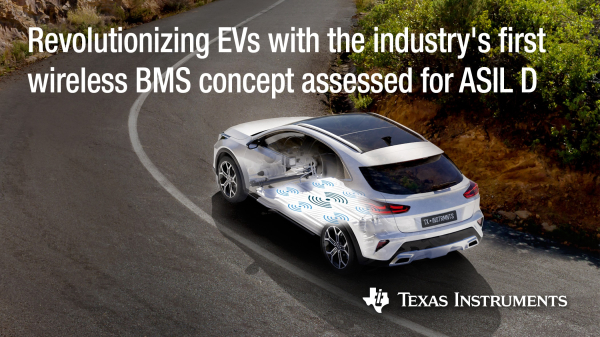
TI's wireless BMS solution combines high network availability with the latest wireless protocols, eliminating copper cables that add to the vehicle's overall weight and maintenance costs, thereby improving the reliability and efficiency of EVs.
The solution includes the 'CC2662R-Q1' SimpleLink™ 2.4GHz wireless MCU evaluation module, software, a safety manual, failure mode and effects analysis (FMEA), failure mode, effects and diagnostic analysis (FMEDA), and functional safety-related materials such as a TÜV SÜD concept report.
◇ TI's wireless BMS solution achieves ISO 26262 ASIL D certification.
The automotive operating environment is harsh. Therefore, the battlefield must be supported by stability and reliability, regardless of whether it's wired or wireless. TI commissioned functional safety assessment agency TÜV SÜD to quantitatively and qualitatively evaluate the error detection performance of TI's wireless BMS functional safety concept, as well as to assess whether it meets ASIL D, the highest level of certification under the ISO 26262 automotive functional safety international standard.
For this concept, TI addressed communication error detection and security issues by using a novel wireless protocol dedicated to wireless BMS. TI's proprietary protocol, used in the CC2662R-Q1 wireless MCU, enables robust and scalable data exchange between the host system processor and the newly released BQ79616-Q1 battery monitoring and balancing IC.
“Compared to wired connections, the TI BMS wireless protocol adopted for the CC2662R-Q1 wireless MCU achieves network availability of over 99.999% and enables network restart at speeds of up to 300ms,” said Park Seo-min, TI Automotive Business Division Domestic Sales Director, who presented the announcement.
The wireless MCU protects data from loss or corruption with dedicated time slots for high data throughput and low latency. Additionally, it enables multiple battery cells to transmit voltage/temperature data to the main MCU with ±2mV accuracy and a network packet error rate of less than 10-7.
Additionally, automotive manufacturers can leverage TI security elements, including key exchange and update, unique device authentication, debug security, software IP protection through Joint Test Action Group (JTAG) locking, 128-bit Advanced Encryption Standard (AES) encryption acceleration, and message integrity checking.
◇ Meeting the diverse design needs of automobile manufacturers
“TI’s real-time protocol delivers the highest data throughput in the industry,” said Park. “Automakers can develop battery modules with various configurations, such as 32-, 48-, and 60-cell systems, by connecting a single wireless system-on-chip (SoC) with multiple BQ79616-Q1 battery monitoring ICs.”
“The system is designed to support up to 100 nodes,” he said, adding that it “provides low latency of less than 2ms per node and time-synchronized measurements across all nodes.”
The CC2662R-Q1 wireless MCU separates individual cell monitoring units, eliminating the need and cost of daisy-chain isolation components. The BQ79616-Q1 battery monitoring and balancing device offers multiple channel options in the same package type, is pin-to-pin compatible, and supports 100% reuse of existing software and hardware across all platforms.
Automotive manufacturers can jump-start their designs with the free, downloadable SimpleLink Wireless BMS Software Development Kit and the SimpleLink Wireless BMS Evaluation Module (CC2662RQ1-EVM-WBMS), available for $999 on TI.com.
The CC2662R-Q1 wireless MCU is priced at $2.79 in 1,000-unit quantities. The BQ79616-Q1 battery monitoring and balancing IC, available in a 16-channel, 10 mm × 10 mm, 64-pin HTQFP package, is priced at $6.90 in 1,000-unit quantities. All products used in the wireless BMS solution are available immediately on TI.com.
Comments
Related news
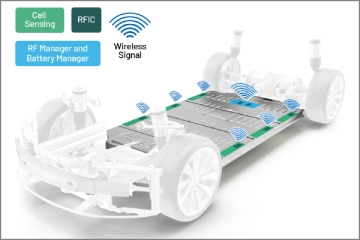
ADI's wireless battery management system will be used in GM electric vehicles.
ADI has launched the industry's first wireless battery management system (wBMS). The wBMS eliminates harnesses, reducing wiring by up to 90% and battery pack volume by up to 15%, while improving design flexibility and manufacturing ease without compromising range and accuracy throughout the battery lifecycle.
2020.09.14by 명세환 기자

Extending Electric Vehicle Range Requires Safe BMS ICs
The battery is a core component of electric vehicles, functioning as a power source with varying roles—either auxiliary or central—depending on the type of electric vehicle. The driving range of an electric vehicle can be extended or shortened depending on how efficiently the battery is utilized. We met with Kim Jin-woo, Assistant Manager at ST Korea, to discuss the competencies required to implement an efficient battery management system for electric vehicles.
2020.10.12by 이수민 기자
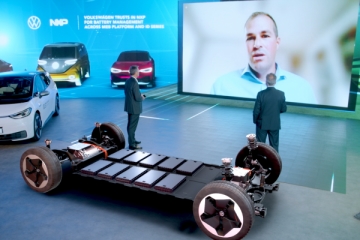
NXP to Supply BMS Solutions for Volkswagen's MEB EV Platform
Kurt Sievers, NXP CEO, announced during the keynote address at NXP Connect, the annual developer conference, that the company is collaborating with Volkswagen in the EV electrical systems field. Volkswagen has currently adopted NXP's BMS in its MEB platform, extending driving range, prolonging battery life, and enhancing safety.
2020.10.21by 명세환 기자

[e4ds Tech Day 2026 ⑨] Sim Sang-gyu, Autocrypt CTO: "In the Physical AI Era, Automotive Security Must Extend Beyond the Vehicle"
At e4ds Tech Day 2026, Sim Sang-gyu, CTO of Autocrypt, explained automotive cybersecurity strategies in the era of Physical AI and SDV (Software-Defined Vehicle). Automobiles are evolving as part of an ecosystem connected to AI, cloud, chargers, IoT, and robots, and he emphasized that the scope of security must expand beyond the vehicle interior to the entire connected environment. In particular, AI model tampering, adversarial attacks, OTA updates, and EV charger hacking were identified as major threats. He explained that response measures require zero trust, AI model integrity protection, intrusion detection, Security by Design and Default, and full lifecycle security management, and that proactive security system establishment beyond regulatory compliance is critical for securing future mobility competitiveness.
2026.10.12by 배종인 기자

Practical HIL Construction Strategy for Automotive and Off-Highway Controller Validation
As vehicle E/E architecture transitions to zonal structures and shifts to software-defined vehicles (SDV), the number of controllers (ECUs) requiring validation and software complexity are surging dramatically. Meanwhile, real vehicle testing cannot provide repeated verification under identical conditions and entails lead time and safety concerns. This white paper explains the principles of HIL (Hardware-in-the-Loop) validation and the structure of the NI platform composed of PXI, SLSC, and VeriStand, and through two actual implementation cases—Camera Record & Replay HIL for In-Cabin Monitoring Controller (ICMU) and Forklift Controller (VCU) HILS—describes how controller-level regression testing becomes possible. Additionally, it explicitly states application boundaries and limitations, such as lack of A2B support.
2026.10.12by 편집부











