



The Korea Automotive Research Institute (KARI) says, "Exploring the automotive semiconductor AP market is essential."
 Published2021.04.13 08:37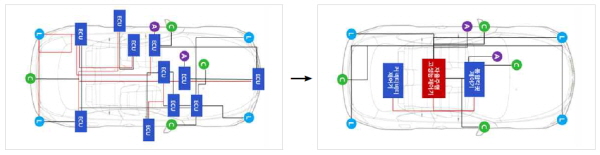
▲The transition from current automotive electrical and electronic (E/E) architecture (left) to future vehicle architecture (right) (Source: Korea Automotive Research Institute)
Accelerate the transition to electric and autonomous vehicles by switching to AP-based systems.
In the electric vehicle semiconductor market, which has recently been suffering from a supply shortage, it has been argued that rather than entering the MCU-centered automotive semiconductor market where solid global powerhouses have established themselves, it is necessary to seek opportunities in the AP (data processing function semiconductor) market that will be newly created amid technological changes.
On the 12th, Lee Ji-hyung, a researcher at the Korea Automobile Research Institute, released an analysis of industry trends titled, "The automotive semiconductor shortage must be addressed from a long-term perspective."
According to this report, the current MCU-centric automotive semiconductor industry is characterized by limited market size, low profits, and supply chain bias.
TSMC, the largest contract manufacturer of automotive semiconductors, saw its automotive semiconductor sales account for approximately 3% of its total sales in the fourth quarter of 2020. Most wafers used for MCU production are 8-inch (200mm) in size, resulting in low productivity and profitability.
In particular, automotive semiconductors require about 10 years for 'development-test-mass production' due to demanding usage conditions, and their supply is concentrated in a few companies due to higher functional safety, reliability, and customer demands compared to other semiconductors.
The domestic automobile and semiconductor industries are each world-class.The automotive semiconductor market is 98% dependent on overseas markets, and there is no domestic supply chain for key items such as MCUs.
Accordingly, it is analyzed that rather than entering the MCU-centered automotive semiconductor market where solid global powerhouses have established themselves, it is necessary to seek opportunities in the AP (data operation/processing function semiconductor) market that will be newly created amid technological changes.
While MCU-based distributed processing electronic control units (ECUs) are currently installed (approximately 40 per vehicle), it is expected that AP-based centralized processing high-performance controllers (approximately 3 per vehicle) will be adopted as the transition to electric and autonomous vehicles accelerates over the next 5-6 years.
If automotive semiconductors are gradually integrated and replaced by general-purpose integrated chips such as APs and expanded to various types of new mobility (e.g., urban air mobility, personal air vehicles), it is analyzed that sufficient demand will be secured and economies of scale can be achieved.
The high-performance semiconductor market, including AI accelerators (NPUs: Neural Processing Units), security chips, network processors, and high-bandwidth sensor ICs, is in the formation stage of future vehicle technology, and global companies are conducting research and development. It is also expected that it will be possible to challenge markets such as AI, security, and data through collaboration between domestic Tier 1 SW companies and semiconductor companies (Fabless).
Researcher Lee Ji-hyung said, “Vehicle APs are related to life, so they require strict stability verification and a long development and testing period, and management and upgrades for a usage cycle of over 10 years are required, which places a large burden on companies, so government support is necessary.” He added, “In order for suppliers to develop products that meet the needs of demand companies and succeed in commercialization, we need to support mass production performance evaluation and performance improvement to overcome the business discontinuity (Death Valley) in semiconductor development and mass production.” He said, "It is necessary."
Meanwhile, the recent shortage of automotive semiconductors began with automakers' failure to predict demand due to COVID-19, and the difficulties were further aggravated by the priority production of semiconductors for mobile phones and home appliances, the shutdown of semiconductor factories due to the cold snap in Texas, the fire at the Renesas plant in Japan, the world's third-largest automotive semiconductor manufacturer, and the disruption of operations at the TSMC plant in Taiwan due to water shortages.
The item with the greatest supply and demand disruption is currently the MCU (Micro Control Unit), which controls the battlefield system, and a bottleneck is occurring in the 'production' part of the value chain of 'semiconductor design → production → module/system manufacturing → mass production of finished vehicles.'
The lead time for automotive MCU production (the period from production planning to receipt) has typically been 12 to 16 weeks, but with the surge in TSMC semiconductor orders, the lead time is now taking 26 to 38 weeks or more.
Due to the shortage of automotive semiconductors that began in the second half of 2020, global automakers are reducing production, and in Korea, production disruptions at Hyundai and Kia Motors have been in full swing since April.

Comments
Related news
The US, China, and Japan are accelerating their efforts to become self-sufficient in semiconductor manufacturing, catching up with South Korea and Taiwan.
In the post-COVID era, semiconductor demand has surged dramatically, increasing the importance of foundries. Amid supply instability in semiconductors caused by the COVID-19 pandemic, US-China trade disputes, natural disasters, and accidents, the United States, China, and Japan are making massive investments to secure semiconductor manufacturing capacity that has been concentrated in South Korea and Taiwan.
2021.04.05by 이수민 기자
Emergency commercialization of 10 automotive semiconductors
The government and private sector are embarking on emergency commercialization of automotive semiconductor components and modules, identifying approximately 10 items seeking performance evaluation and providing initial budget support of 40 billion won.
2021.04.08by 배종인 기자
Key Foundry Begins Full-Scale Mass Production of Automotive Semiconductors
As the semiconductor shortage for automotive applications has been intensifying recently, K-Foundry (CEO Lee Tae-jong), the nation's only pure-play foundry semiconductor company, is ramping up mass production of automotive semiconductors.
2021.04.08by 배종인 기자

[e4ds Tech Day 2026 ⑨] Sim Sang-gyu, Autocrypt CTO: "In the Physical AI Era, Automotive Security Must Extend Beyond the Vehicle"
At e4ds Tech Day 2026, Sim Sang-gyu, CTO of Autocrypt, explained automotive cybersecurity strategies in the era of Physical AI and SDV (Software-Defined Vehicle). Automobiles are evolving as part of an ecosystem connected to AI, cloud, chargers, IoT, and robots, and he emphasized that the scope of security must expand beyond the vehicle interior to the entire connected environment. In particular, AI model tampering, adversarial attacks, OTA updates, and EV charger hacking were identified as major threats. He explained that response measures require zero trust, AI model integrity protection, intrusion detection, Security by Design and Default, and full lifecycle security management, and that proactive security system establishment beyond regulatory compliance is critical for securing future mobility competitiveness.
2026.10.12by 배종인 기자

Practical HIL Construction Strategy for Automotive and Off-Highway Controller Validation
As vehicle E/E architecture transitions to zonal structures and shifts to software-defined vehicles (SDV), the number of controllers (ECUs) requiring validation and software complexity are surging dramatically. Meanwhile, real vehicle testing cannot provide repeated verification under identical conditions and entails lead time and safety concerns. This white paper explains the principles of HIL (Hardware-in-the-Loop) validation and the structure of the NI platform composed of PXI, SLSC, and VeriStand, and through two actual implementation cases—Camera Record & Replay HIL for In-Cabin Monitoring Controller (ICMU) and Forklift Controller (VCU) HILS—describes how controller-level regression testing becomes possible. Additionally, it explicitly states application boundaries and limitations, such as lack of A2B support.
2026.10.12by 편집부











