



Minister Sung Yun-mo: "We will produce 4,800 semiconductor workers over the next two years."
 Published2021.04.16 08:46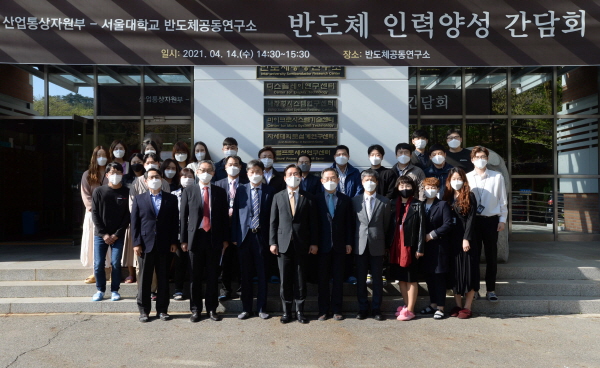
Establishment of a new system semiconductor specialization major for third-year undergraduate students
Minister of Trade, Industry and Energy Sung Yun-mo pledged to supply 4,800 semiconductor workers over the next two years, and has rolled up his sleeves to train semiconductor workers.
Minister of Trade, Industry and Energy Sung Yun-mo visited the Seoul National University Semiconductor Joint Research Center on the 14th to inspect the current status of semiconductor human resource development and discuss solutions to resolve the chronic human resource shortage in the semiconductor industry.
At the meeting, the participants shared information on the current state of the semiconductor industry's manpower shortage, difficulties faced in fostering semiconductor talent, and focused on discussing solutions to foster excellent semiconductor talent and resolve the manpower shortage.
Recognizing the importance of human resource development, the Ministry of Trade, Industry and Energy announced the "System Semiconductor Vision and Strategy" in 2019 and has since pursued a large-scale human resource development project in collaboration with the public and private sectors, resulting in the training of over 1,000 individuals.
We have focused on providing education to cultivate next-generation semiconductor professionals by establishing human resource development infrastructure such as the Semiconductor Design Education Center (IDEC) and the Design Support Center, and starting in 2021, we will begin operating in earnest by selecting new students for contract departments linked to employment, such as Yonsei University's 'System Semiconductor Engineering' (Yonsei University-Samsung Electronics, 50 students per year) and Korea University's 'Semiconductor Engineering' (Korea University-SK Hynix, 30 students per year).
The semiconductor industry technology workforce, which is at the level of 36,000 (as of 2019), needs to secure 1,500 people annually for the next 10 years, and the smooth supply of semiconductor personnel is essential. To supply this, we plan to pursue a customized human resource development policy, including bachelor's, master's and doctoral, and practical training, and produce a total of more than 4,800 diverse talents between 2021 and 2022.
Additionally, we plan to establish a new system semiconductor design major track to support specialized courses in system semiconductor design for third-year undergraduate students.
Graduates of the design major track will be trained to be able to enter the fabless industry without additional training upon graduation, and the Semiconductor Industry Association will also provide support for fabless employment.
In addition, the government and private sectors will jointly invest in a public-private joint project that links core technology R&D, high-level human resources development, and recruitment promotion, with the goal of producing a total of 3,000 master's and doctoral-level personnel over the next 10 years.
We plan to cultivate specialized design professionals for next-generation industries such as future vehicles, energy, and bio, and expand the training of professionals for key promising products such as power semiconductors and AI semiconductors.
Minister of Trade, Industry and Energy Sung Yun-mo emphasized, "With the advent of the Fourth Industrial Revolution, the Digital New Deal, and the data economy, the importance of semiconductors is growing." He added, "Securing core semiconductor talent is paramount to maintaining our country's leading edge, addressing the increasing difficulty of design and processes, and establishing a stable global semiconductor supply chain. The government will spare no policy support to ensure a sufficient supply of talented individuals, both qualitatively and quantitatively, for the domestic semiconductor industry."
He also stated, “While actively pursuing the semiconductor industry’s requests raised last week, including the human resource development raised today, we will also consider enacting a special semiconductor law, taking into account the domestic and international semiconductor industry conditions and legislative trends in other countries.”

Comments
Related news
.jpg)
IBM Announces Free Open Education Platform to Foster New Collar Skills
IBM is launching the Korean service of 'Open P-TECH,' a digital education platform available to anyone for free to nurture new-collar talent customized for the digital new deal. The currently available Open P-TECH is an expanded model that extends the existing public education model P-TECH from students and teachers to the general public for free use. Anyone aspiring to become a future talent equipped with specialized competencies such as professional presentation skills, as well as foundational knowledge of innovative technologies in the Industry 4.0 era including cyber security, AI, and cloud computing, can sign up and receive education for free.
2020.10.28by 강정규 기자

Semiconductor companies' transactions reached a record high last year. "In the next-generation semiconductor competition, only mergers can win."
In 2020, the transaction volume in the semiconductor industry reached a record high. With the rapid advancement of non-face-to-face and digital transformation in response to COVID-19, investment expansion in the semiconductor industry to prepare for the future has been interpreted as the driving force. As market changes accelerate, demand for next-generation semiconductors is also increasing correspondingly. Since securing a leading position in the next-generation semiconductor market is directly linked to a company's future competitiveness, industry investment remains active. In particular, M&A investment is one of the effective means to respond to market changes in a short timeframe while securing talent. At this point, even global companies can no longer keep pace with the speed of technological innovation through independent efforts alone.
2021.01.25by 이수민 기자
The Korea Semiconductor Association (KSA) requests the enactment of a special law to foster the semiconductor industry.
The Korea Semiconductor Industry Association has requested the enactment of a "Special Act for Semiconductor Industry Development" to provide effective support to the semiconductor industry, and stated that support is needed including tax credits of up to 50% of semiconductor manufacturing facility investment costs, as well as support for facility construction, research and development, financial assistance, and talent development.
2021.04.13by 배종인 기자
Intel Unveils Next-Generation 'Core Ultra Series 3' and vPro Platform for Enterprise PCs
Intel has officially unveiled the "Intel Core Ultra Series 3" for next-generation enterprise PCs and the latest vPro platform, addressing a wide range of demands from enterprise notebooks to high-performance workstations.
2026.03.26by 배종인 기자
ROHM Launches ESD Protection Diode Compatible with High-Speed Interfaces of 10Gbps or Higher
Semiconductor specialist ROHM has developed the 'RESDxVx series' of ESD (electrostatic discharge) protection diodes capable of responding to next-generation high-speed data communication environments exceeding 10Gbps, simultaneously enhancing both signal quality maintenance required in high-speed interfaces and IC protection performance.
2026.03.26by 배종인 기자











