


Apple Proves M1 Chip's Usability and Mini LED's Potential
 Published2021.04.22 15:43
Mini LEDs with significantly improved contrast ratios are now fully operational.
Expect OS updates at WWDC21 in June.
On the 20th, Apple held a special event and unveiled the 24-inch iMac, 11-inch and 12.9-inch iPad Pro, purple iPhone 12 and 12 mini, and AirTags. The key features of this event were the M1 chip and mini LED.
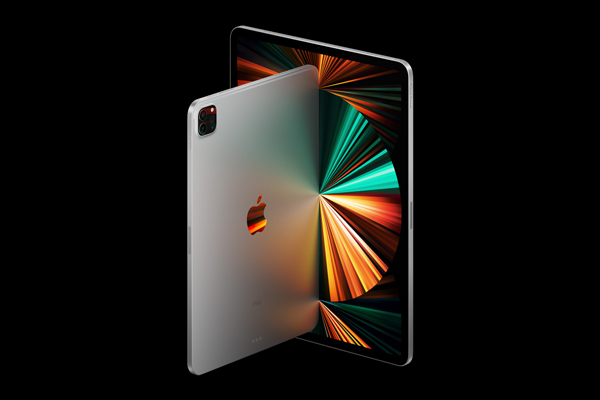
This is the product that was adopted at the same time and is the star of this announcement. [Photo = Apple]
The M1 chip is an Arm core-based system-on-chip (SoC) announced by Apple in November 2020, manufactured using TSMC's 5nm (nanometer) process technology. It integrates an eight-core CPU with four high-performance cores and four low-power cores, as well as up to an eight-core GPU, a 16-core NPU, and two DRAMs, delivering performance optimized for Apple computers.
Over the next two years, Apple plans to transition its computer architecture from Intel's x86 to Arm architecture. Following the MacBook Air, 13-inch MacBook Pro, and Mac mini, which were the first products to feature the M1 chip, Apple is accelerating its plans by adding the M1 chip to the new iMac and iPad Pro. The release is scheduled for mid-May.
In particular, the new iPad Pro, equipped with the M1 chip, boasts performance on par with Apple's desktop and laptop computers, further widening the gap with Android tablets.
Qualcomm's Snapdragon 865+ AP, which is installed in premium Android tablets such as Samsung Electronics' Galaxy Tab S7, is said to be about two generations behind Apple's A14 Bionic in performance, but the M1 is about two to three times better than the A14. The Snapdragon 865+ also has an advantage in power efficiency as it is manufactured using TSMC's 7nm FinFET process, while the M1 is manufactured using TSMC's 5nm FinFET process.
The M1 chip offers significant price competitiveness, as it allows for economies of scale and streamlined inventory management, allowing for the production of a wide range of products based on the same chip. In fact, the lowest-priced M1-equipped 11-inch iPad Pro model (KRW 999,000) is priced KRW 30,000 cheaper than the previous-generation A12Z Bionic-equipped 11-inch iPad Pro (KRW 1,029,000).
The M1 hardware is ready. Now, we need to build the M1 software environment. First, there is a loud voice in the market that macOS, which is based on Intel x86 architecture, should be quickly converted to Arm architecture-based (including third-party apps) for compatibility reasons.
iPadOS, which has been relatively under-represented in the Arm architecture and high-performance workloads, also needs improvement. Some even predict integration of macOS and iPadOS. Details on these plans are expected to be revealed at Apple's 2021 Worldwide Developers Conference (WWDC21), which will be held over five days from June 7th to 11th.
◇ Achieving OLED-level picture quality without burn-in by adopting mini LEDs
Among the products announced that day, only the 12.9-inch iPad Pro is equipped with a mini LED display, 'Liquid Retina XDR'. While Apple has previously equipped some iPhones with OLED displays, it has insisted on using only LCD displays for the iPad due to concerns about burn-in, a chronic problem with OLED displays where the light-emitting elements deteriorate.
Mini LEDs are called LEDs, but they're actually LCDs with numerous LEDs replacing the backlight. Because they're based on inorganic compounds, they're less susceptible to burn-in than OLEDs, which are based on organic compounds.
Additionally, it supports the 'Local Dimming' function that can turn off the LED in a specific area, and the contrast ratio is 1,000,000:1, which is much higher than the 1,000:1 of LCD. Among the 2,500 local dimming zones of LG Electronics' '80-inch QNED TV' to be released this year, the 12.9-inch iPad Pro has 2,596, making it optimal for consuming HDR (High Dynamic Range) content.
Instead, the 12.9-inch model is 0.5mm thicker than the previous generation, and unlike the 11-inch model, which saw a price drop, its price has increased by 80,000 won, from 1,299,000 won to 1,379,000 won.
Apple implemented Center Stage on the iPad Pro, leveraging the 12-megapixel front-facing wide-angle camera and the M1 machine learning capabilities. This feature recognizes the user's movements and follows their focus. When another person is captured, it zooms out to keep everyone in the frame. It's ideal for remote work, video calls, and meetings.
The iPad Pro has increased bandwidth with Thunderbolt and USB 4 support. Additionally, Apple emphasized its environmental, social, and governance (ESG) management, including carbon neutrality and the use of recycled aluminum.
Comments
Related news
Apple Ignites Arm Revolution in Computer Industry
Apple unveiled the M1 chip, its first Arm core-based Mac-exclusive SoC, in December of last year. Apple has shattered the premise that Arm offers low power while x86 delivers high performance, and plans to transition all of its computers to Arm architecture-based systems over the next two years. In response, the pace is quickening for Intel and AMD, the two major pillars of the CPU market, Qualcomm, a competitor in smartphone AP technology, and Microsoft, which possesses SW and HW capabilities that do not lag behind Apple's.
2021.02.08by 이수민 기자

Arm Unveils 'Armv9', Next-Generation Architecture, 10 Years Later
Arm has announced a new architecture, 'Armv9', that responds to market requirements for security, AI, and ubiquitous specialized processing. Simon Segars, Arm CEO, stated, "The Armv9 architecture, suited for safe, powerful, and specialized processing, will play a crucial role in the 300 billion Arm-based chips to be launched in the future."
2021.03.31by 이수민 기자
Nvidia to Build Arm Core-Based CPUs for Data Centers
NVIDIA is entering the CPU market following GPU and DPU. CEO Jensen Huang unveiled a data center processor with the codename 'Grace' CPU during his keynote speech at GTC 2021. News of this server CPU business initiative boosted NVIDIA's stock price, while Intel and AMD stock prices declined.
2021.04.14by 이수민 기자

Intel Unveils Next-Generation 'Core Ultra Series 3' and vPro Platform for Enterprise PCs
Intel has officially unveiled the "Intel Core Ultra Series 3" for next-generation enterprise PCs and the latest vPro platform, addressing a wide range of demands from enterprise notebooks to high-performance workstations.
2026.03.26by 배종인 기자

ROHM Launches ESD Protection Diode Compatible with High-Speed Interfaces of 10Gbps or Higher
Semiconductor specialist ROHM has developed the 'RESDxVx series' of ESD (electrostatic discharge) protection diodes capable of responding to next-generation high-speed data communication environments exceeding 10Gbps, simultaneously enhancing both signal quality maintenance required in high-speed interfaces and IC protection performance.
2026.03.26by 배종인 기자











