


KT and Samsung Launch World's First Nationwide National Disaster and Safety Communication Network
 Published2021.04.26 10:20
By dividing the control center into three and redundant communication equipment
Non-stop operation even in traffic surge situations
On the 26th, KT and Samsung Electronics launched the world's first nationwide National Disaster and Safety Communication Network. The National Disaster and Safety Communication Network is a next-generation wireless communications network, built by the government to efficiently prevent and respond to various major disasters, including natural disasters. It will secure an integrated on-site command system in the event of a disaster and facilitate close cooperation between disaster response agencies.
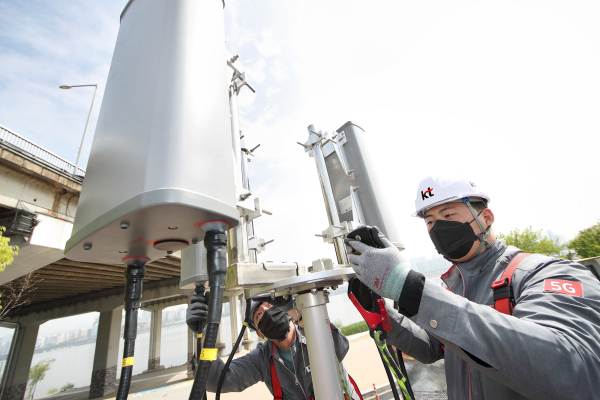
Checking [Photo = KT]
The disaster safety communications network built by the two companies complies with the 3GPP disaster safety communications standard (PS-LTE). Covering the entire country and sea, the network began pilot and reinforcement projects in 2015. In just six years, it has integrated the wireless communications networks of 333 government agencies across eight sectors, including police, fire departments, national defense, railways, and local governments.
A multi-communications network structure and technology were implemented to support rescue operations even in the worst-case disaster scenarios. Control centers were also established in three locations: Seoul, Daegu, and Jeju. Each station's equipment was also redundant, ensuring uninterrupted operation even in the event of a failure in one unit.
To ensure smooth communication even during peak traffic conditions, eMBMS technology enables real-time communication between up to 2,500 devices. This is more than double the existing TETRA method, which limited the number of devices to 1,200. It also supports direct communication between terminals, enabling communication between field personnel even in areas where wireless base station connections are difficult, such as in mountains or underground.
Comments
Related news
SKT-Samsung Electronics Develop Cloud Core Network Using SCP
SK Telecom and Samsung Electronics announced that they jointly developed a next-generation cloud core network. The next-generation cloud core network is a cellular infrastructure that provides device authentication, customer service, and QoS management for internet connectivity of mobile device data traffic, and is the first core network to meet the international standard Rel.16.
2020.11.23by 이수민 기자

Microchip Unveils Family of TSN IEEE Standard Ethernet Switches
Microchip has launched the SparX-5i Ethernet switch product family, which supports major TSN IEEE standards. By providing various standards on a single chip, it ensures end-to-end transmission of high-priority traffic with low latency. Additionally, it supports standard L2/L3 Ethernet with maximum bandwidth of 200G.
2021.02.05by 이수민 기자
Keysight Unveils LTE/5G Network Traffic Monitoring Capabilities
Keysight announced MobileStack, a new capability exclusively for its Keysight Vision X network packet broker platform. The MobileStack feature provides scalable subscriber-aware visibility into LTE and 5G core networks, enabling cost reduction while improving service monitoring quality.
2021.03.31by 이수민 기자
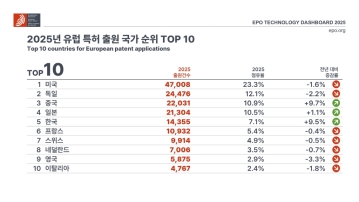
European Patent Applications Surpass 200,000 for the First Time… South Korea Maintains 5th Place, Led by Batteries and Telecommunications
According to the European Patent Office (EPO)'s 'Technology Dashboard 2025', European patent applications last year reached 201,974, surpassing 200,000 for the first time. Korean companies and inventors filed 14,355 applications, representing a 9.5% increase from the previous year and maintaining 5th place by country. Battery, digital communication, and semiconductor technologies led the growth, with Samsung ranking as the top EPO applicant for the second consecutive year and LG reaching 3rd place. The presence of major domestic cities such as Seoul, Suwon, and Yongin was also confirmed. It was also revealed that Korea's European patent strategy is expanding beyond individual technologies to span the entire industry.
2026.03.24by 명세환 기자

SK Telecom First Applies AI-Based Network Operations at Gwanghwamun K-Pop Concert
SK Telecom announced that it applied an AI-based network operation system for the first time at a large-scale K-pop concert held in the Gwanghwamun area of Seoul on March 21st, managing communication quality throughout the event. Mobile data usage during the three hours before and after the concert reached 12.15TB, approximately doubling compared to the same time slot the previous weekend. SK Telecom monitored traffic using the AI system 'A-One' in five-minute and 50-meter units to respond to potential overload situations, while also operating temporary communication facilities and on-site personnel in parallel. This case is interpreted as confirmation of the practical applicability of AI-based autonomous network operation in an environment where demand from dense events and foreign users increases simultaneously.
2026.03.23by 명세환 기자











