


"Level 4+ autonomous driving projects, worth 1 trillion won, require essential collaboration with semiconductor businesses."
 Published2021.07.12 17:23
Lotte Data Communication, Hyundai Motors, Kakao Mobility, etc.
We need to grow AI, V2X, BMS, SiC, and GaN semiconductors rather than MCUs.
Launched in March, the Autonomous Driving Technology Development Innovation Project (hereinafter referred to as the Project) is carrying out the "Autonomous Driving Technology Development Innovation Project (hereinafter referred to as the Project)" with an investment of 1.1 trillion won by 2027 to accelerate the commercialization of autonomous driving "Level 4+." With the goal of completing the foundation for commercialization of convergent Level 4+ autonomous driving, the Project will support detailed tasks centered on five strategic areas: ▲New vehicle convergence technology ▲New ICT convergence technology ▲New road and traffic convergence technology ▲Service creation ▲Ecosystem construction.
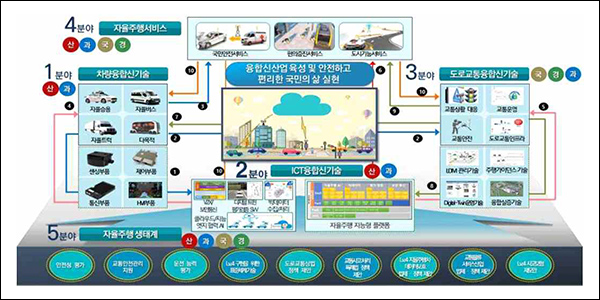
Level 4 autonomous driving is a highly automated level where the vehicle perceives and makes decisions on its own, eliminating the need for driver intervention even in emergencies. Furthermore, the converged Level 4+ autonomous driving aims to innovate not only autonomous driving technology but also social infrastructure and services to Level 4 or higher. On June 28, the task force selected 53 detailed projects related to the commercialization of Level 4+ autonomous driving and decided to invest 85.04 billion won in government funding.
The project involves the Ministry of Trade, Industry and Energy, the Ministry of Science and ICT, the Ministry of Land, Infrastructure and Transport, and the National Police Agency. The Ministry of Trade, Industry and Energy will lead the development of components for autonomous vehicle perception, judgment, and control. The Ministry of Science and ICT is promoting the development of technologies for automating data collection and processing, vehicle communication and security, cloud-edge connectivity, and autonomous driving AI software and simulators.
The Ministry of Land, Infrastructure and Transport will focus on road traffic technology, dynamic maps, legal and institutional improvements, and mobility service demonstrations. The National Police Agency will review revisions to laws and regulations, including the Road Traffic Act and the Traffic Safety Act. It will also pursue the development of pre-verification of autonomous vehicle driving capabilities, operational support systems, and traffic accident analysis technology.
A total of 3,474 researchers from 373 autonomous driving-related organizations will participate in 53 sub-projects. Specifically, Level 4+ commercialization research and development will involve 903 researchers from 92 organizations, including KT, Moray, Stris, the Electronics and Telecommunications Research Institute (ETRI), the Korea Institute of Industrial Technology (KITECH), and Seoul National University. Additionally, the project team will visit seven autonomous driving pilot operation zones—Sangam in Seoul, Pangyo in Gyeonggi Province, North Chungcheong Province, Sejong, Gwangju, Daegu, and Jeju—as well as automakers to discuss cooperation plans.
The Ministry of Land, Infrastructure and Transport aims for 2025 as the first year of commercialization of autonomous driving.
The Ministry of Land, Infrastructure and Transport is currently pursuing detailed projects aimed at commercializing Level 4 autonomous vehicles by 2027. On June 29, it finalized the "First Basic Plan for Autonomous Driving Transportation and Logistics (2021-2025)," which aims to commercialize autonomous driving services on highways, national roads, and local roads nationwide by 2025. This plan is the first statutory plan specifically designed for the autonomous driving field, and includes the development of a transportation and logistics system based on autonomous driving and the expansion of autonomous vehicles over a five-year period.
The goal is to provide autonomous driving commercial services on national highways and major hubs in each city and province by 2025, while developing more than 10 autonomous driving service technologies and establishing systems and infrastructure for the commercialization of autonomous vehicles and the advancement of services.
The five major strategies include ▲ advancing autonomous driving transportation logistics service technology, ▲ creating a demonstration environment for autonomous driving transportation logistics services, ▲ creating a business environment for autonomous driving transportation logistics services, ▲ strengthening autonomous driving safety and improving technology acceptance, and ▲ establishing an autonomous driving transportation logistics ecosystem.
The Ministry of Land, Infrastructure and Transport will develop Level 4 autonomous public transportation and shared services in accordance with its strategy and advance operational technologies, including route and dispatch optimization. In the freight delivery sector, the ministry plans to establish truck platooning vehicles and operating systems, as well as develop small delivery vehicles for last-mile delivery within urban areas, mobile unmanned parcel boxes, and robot-drone integration technologies.
Domestic ICT companies are working on autonomous driving technology demonstrations.
Commercialization of autonomous driving is expected to reduce public transportation access times by 20%, transfer rates by 50%, and bus accidents related to driver inattention by 50%. Accordingly, domestic ICT companies are actively working to commercialize autonomous driving.
On June 16, Lotte Data Communications became the first company in Korea to receive a temporary permit to operate a driverless autonomous shuttle in Sejong City. This marks the first permit granted since the revision of the "Regulations on Safety Operation Requirements and Test Operations of Autonomous Vehicles" in March of this year. This autonomous shuttle can accommodate up to 15 people and is capable of Level 4 autonomous driving.
Furthermore, for actual driving on public roads in urban areas, next-generation Cooperative Intelligent Transport Systems (C-ITS) technology is applied to recognize and assess real-time traffic information, including signal information, to control the vehicle. Furthermore, testing has been completed for various road conditions, such as lane keeping, lane changing, and cutting in, as well as driving scenarios for unexpected situations involving pedestrians and cyclists.

It's getting serious [Photo = Pixabay]
Last March, Hyundai Motor Company established Motional, a joint venture with US autonomous driving company Aptiv, and is preparing to commercialize Level 4 and 5 fully autonomous driving technology. The company plans to introduce Level 3 autonomous driving capabilities in mass-produced vehicles as early as the second half of this year, and Level 4 technology is also under development. The dedicated electric vehicle brand, the Ioniq 5, will utilize a next-generation autonomous driving platform exceeding Level 4 and will be deployed in commercial robotaxi services.
Kakao Mobility plans to launch a pilot service in the autonomous driving pilot zone in Pangyo, Gyeonggi Province, within this year. The key difference between this pilot service and the existing service is that it will integrate autonomous driving-based mobility services directly through the Kakao T Platform, which has 24 million subscribers. It is expected that Kakao T will be able to quickly commercialize and integrate autonomous driving-based mobility services that cover everything from 'call-board-move-get-off-payment' into real life.
Through the pilot service, Kakao Mobility will verify the following technologies that are key to commercializing autonomous driving-based services: △cognitive technology for the road, vehicle, pedestrian, and traffic light driving environment; △judgment technology for determining driving methods such as lane keeping, lane changing, and stopping on the shoulder; and △sophisticated vehicle control technology for steering, acceleration, and deceleration. Furthermore, the company plans to enhance its platform with △AI-based dispatching algorithms to efficiently connect vehicles and passengers; △navigation technology to provide optimal routes; and △positioning technology to increase vehicle location accuracy.
◇ Autonomous driving and next-generation vehicle semiconductor R&D support are becoming increasingly necessary.
It's clear that autonomous driving technology will propel the automotive industry to a new level. Consequently, the importance of automotive semiconductors, currently in short supply, is expected to increase even further.
The automotive semiconductor shortage arose early in the COVID-19 pandemic when many automakers reduced production due to concerns about declining demand. Following these production cuts, the automotive semiconductor industry also reduced orders, and foundries shifted production to more profitable consumer electronics semiconductors. However, automotive demand recovered faster than expected, rapidly depleting automotive semiconductor inventories. Despite the surge in demand, supply growth was slower than anticipated.
The automotive semiconductor sector, with its limited technological differentiation, is a market where new companies have difficulty entering the market and existing companies have difficulty expanding their volumes. Furthermore, changing foundry lines typically takes about six months. To make matters worse, a series of events, including a drought in Taiwan, an earthquake in Japan, and a cold snap in the US, frequently forced foundry operations to halt. This global automotive semiconductor shortage is expected to persist at least until the third quarter of this year.
This shortage demonstrates the robust demand for automotive semiconductors. Automotive semiconductors are used to connect and control various mechanical and electronic components within a car. Microcontrollers (MCUs), power semiconductors, and sensors account for a significant portion of these semiconductors.
As mentioned earlier, the automotive semiconductor market is difficult for new companies to enter. The automotive industry prioritizes safety, requiring semiconductors to be certified by standards such as AEC-Q100, IATF 16949, and ISO 26262. Mass production takes at least five years, and commercialization requires a mandatory 30-year production period. Furthermore, unlike system and memory semiconductors, which have a minimum line width of 10 nm or less, automotive semiconductors are produced on 16-100 nm processes, making design and manufacturing difficult and yielding lower returns relative to development and production costs.
With the advancement of autonomous driving technology, the demand for automotive semiconductors is clearly increasing. Our industry, which lacks competitiveness in existing markets, must focus on developing automotive semiconductors related to autonomous driving, including AI, V2X, BMS semiconductors, and high-efficiency SiC and GaN power semiconductors. Constrained by the massive investments made by the US, China, and Japan, we must reduce our dependence on foreign companies for autonomous driving technology and simultaneously enhance our system semiconductor capabilities.
At the government level, 1.1 trillion won and policy support have been invested in the development of autonomous driving technology, and the private sector is accelerating efforts to commercialize autonomous driving technology, including through demonstrations. However, these projects are also being pursued by other major countries. In order for our autonomous driving technology to differentiate itself from those of leading countries, continuous investment support and attention are needed to ensure that the K-semiconductor business (supply) and autonomous driving business (demand) are connected.
Comments
Related news
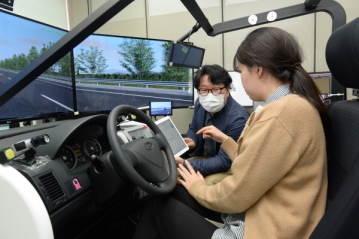
ETRI Develops Driver-Informed Guide for Autonomous Vehicle Control Transition
Domestic researchers have developed guidelines to help drivers safely regain control from autonomous vehicles. This is expected to provide significant assistance to government agencies and automotive manufacturers in establishing standards related to autonomous vehicle control and implementing safety functions.
2021.05.12by 배종인 기자
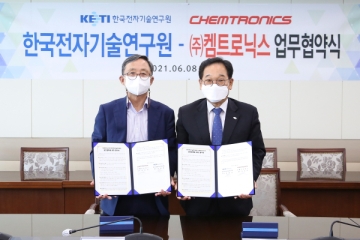
KETI-Chemtronics to Develop V2X and Wireless Charging Technologies
KETI and Kemtronics have concluded a memorandum of understanding for the development of core material technologies in V2X technology and wireless charging fields. Based on their respective proprietary technologies and infrastructure, both parties plan to establish a demonstration environment for autonomous driving and develop autonomous cooperative driving technology. Additionally, they intend to explore new business models in the mobile wireless charging material technology sector.
2021.06.09by 이수민 기자
SE Supports Energy Efficiency Improvement in Semiconductor Manufacturing
The semiconductor market is expected to grow steadily over the next decade in line with global industry trends such as IoT and autonomous vehicles. In parallel, reducing carbon emissions and improving operational efficiency in manufacturing processes have emerged as new challenges in response to climate change. Schneider Electric announced that it will expand its solutions for improving energy efficiency in semiconductor manufacturing facilities.
2021.06.23by 이수민 기자

[e4ds Tech Day 2026 ⑨] Sim Sang-gyu, Autocrypt CTO: "In the Physical AI Era, Automotive Security Must Extend Beyond the Vehicle"
At e4ds Tech Day 2026, Sim Sang-gyu, CTO of Autocrypt, explained automotive cybersecurity strategies in the era of Physical AI and SDV (Software-Defined Vehicle). Automobiles are evolving as part of an ecosystem connected to AI, cloud, chargers, IoT, and robots, and he emphasized that the scope of security must expand beyond the vehicle interior to the entire connected environment. In particular, AI model tampering, adversarial attacks, OTA updates, and EV charger hacking were identified as major threats. He explained that response measures require zero trust, AI model integrity protection, intrusion detection, Security by Design and Default, and full lifecycle security management, and that proactive security system establishment beyond regulatory compliance is critical for securing future mobility competitiveness.
2026.10.12by 배종인 기자

Practical HIL Construction Strategy for Automotive and Off-Highway Controller Validation
As vehicle E/E architecture transitions to zonal structures and shifts to software-defined vehicles (SDV), the number of controllers (ECUs) requiring validation and software complexity are surging dramatically. Meanwhile, real vehicle testing cannot provide repeated verification under identical conditions and entails lead time and safety concerns. This white paper explains the principles of HIL (Hardware-in-the-Loop) validation and the structure of the NI platform composed of PXI, SLSC, and VeriStand, and through two actual implementation cases—Camera Record & Replay HIL for In-Cabin Monitoring Controller (ICMU) and Forklift Controller (VCU) HILS—describes how controller-level regression testing becomes possible. Additionally, it explicitly states application boundaries and limitations, such as lack of A2B support.
2026.10.12by 편집부











