



Automotive semiconductor orders for 2022 will exceed production.
 Published2021.12.28 10:44
Strengthening supply chain management for automakers and responding to semiconductor integration and concentration.
With orders for automotive semiconductors for next year already exceeding production capacity and orders for 2023 production already underway, automakers are responding to supply risks by pursuing internalization or collaboration of technologies and by integrating and centralizing semiconductor designs.
The Korea Automotive Research Institute recently published an article in Industry Trends Vol. 1 titled, “Changes in the Automotive Semiconductor Ecosystem Triggered by Supply and Demand Shortages.” 85 reports were published.
In the report, senior researcher Jang Hong-chang stated that the cumulative order volume to recover production and secure supplies in advance following the shortage of automotive semiconductors is exceeding production capacity.
Additionally, automakers reported that the cumulative annual semiconductor orders have already exceeded their 2022 production capacity due to the surge in demand.
Currently, approximately 20-30% of the 2022 automotive semiconductor production capacity is overbooked, and orders for 2023 are being accepted. The semiconductor industry's average lead time after ordering is also showing an increase from 22.9 weeks (as of October 2021) to 23.3 weeks (as of November 2021).
Semiconductor distributors that deal with domestic first-tier and lower-tier partners are receiving orders for delivery volumes that will be delivered after one year and six months.
Meanwhile, automotive semiconductor companies are focusing their investments on next-generation semiconductors, such as power semiconductors, and are using a fab-lite strategy for MCUs and other products.
It was analyzed that efforts are being made to expand the business not only to new material power semiconductors such as SiC and GaN, but also to semiconductors other than automotive semiconductors.
In relation to power semiconductors, Infineon plans to increase production by expanding its Villach, Austria, and Dresden, Germany plants, while STMicroelectronics and ON Semiconductor are expected to expand mass production by acquiring SiC manufacturers last year and this year, respectively.
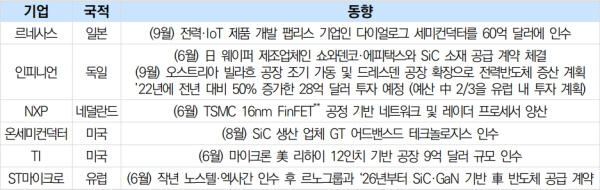
▲2021 Trends in Major Automotive Semiconductor Companies
In relation to semiconductors other than automotive, Renesas is said to be attempting to expand into fields such as power and IoT by acquiring Dialog Semiconductor.
Currently, automotive semiconductor companies are continuing their fab-lite strategy for MCUs and fine processes that are experiencing serious supply and demand imbalances. Renesas has announced plans to strengthen its fab-lite strategy for fine process products below 40 nm to maximize profitability, and it has been analyzed that other automotive semiconductor companies are also continuing their existing fab-lite strategy.
Meanwhile, automakers are responding by changing their semiconductor supply chain management practices and consolidating and integrating semiconductors.
Ford is planning a strategic partnership with GlobalFoundries to vertically integrate its technology, while GM plans to collaborate with automotive semiconductor companies such as NXP, Qualcomm, and TSMC to meet growing demand for semiconductors.
Additionally, it was analyzed that many automakers, including Hyundai Motor Company, Toyota, Tesla, and Volkswagen, are pursuing internalization of semiconductors, and are pursuing a change from the Just-in-Time (JIT) method, which reduces costs by minimizing inventory within the automaker, to a supply chain management method that reduces dependence on Tier 1 and directly manages key components.
As efforts continue to redesign electrical and electronic functional structures (architectures) to reduce the number of semiconductors and use general-purpose semiconductors, the trend is toward integration and concentration centered on a small number of high-performance semiconductors.
Tesla, Volkswagen, and Nissan are securing supply flexibility by replacing custom chips with general-purpose chips through SW redesign, GM plans to reduce diversity by 95% by consolidating its current semiconductors into three product groups, and Stellantis is forming a new semiconductor product group with Foxconn. We plan to develop four types and replace 80% of chip demand.
Senior Researcher Jang Hong-chang stated, “Unlike other automotive components, semiconductors are subject to a pre-order priority system, so a shift in ordering methods is necessary. Furthermore, it is necessary to secure SW capabilities to respond to the accelerated transition to power semiconductor materials and to prepare for architectural changes.”

Comments
Related news

TI to Start Construction of 300mm Wafer Factory Next Year
Texas Instruments (TI) is breaking ground on a 300mm semiconductor wafer manufacturing facility next year, which is expected to strengthen long-term manufacturing capacity and improve supply chain management capabilities.
2021.11.18by 배종인 기자
ST Optimizes Electric Vehicle Power Devices
ST Microelectronics (Korea Branch Representative Park Jun-sik) has launched power semiconductors optimized for advanced automotive applications including traction inverters, onboard chargers, and DC/DC converters for electric vehicles, as well as electrically-driven eco-friendly compressors.
2021.12.15by 배종인 기자
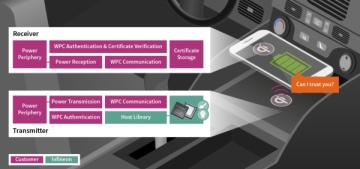
Infineon's automotive wireless charging security chip meets Qi 1.3 standards.
Infineon has introduced a vehicle-grade wireless charging security chip that meets Qi 1.3 certification, reducing customers' security infrastructure investment costs.
2021.12.21by 명세환 기자
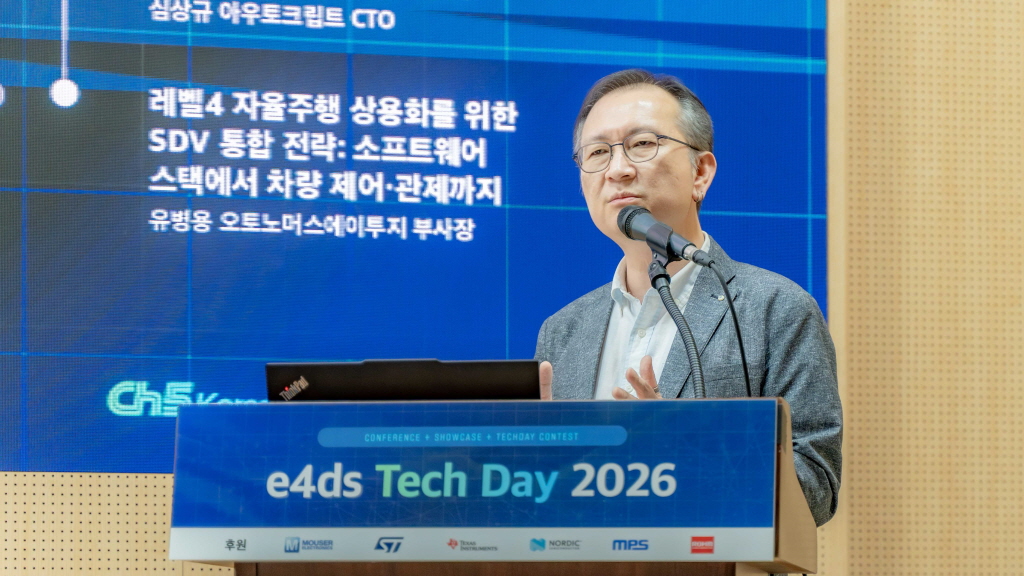
[e4ds Tech Day 2026 ⑨] Sim Sang-gyu, Autocrypt CTO: "In the Physical AI Era, Automotive Security Must Extend Beyond the Vehicle"
At e4ds Tech Day 2026, Sim Sang-gyu, CTO of Autocrypt, explained automotive cybersecurity strategies in the era of Physical AI and SDV (Software-Defined Vehicle). Automobiles are evolving as part of an ecosystem connected to AI, cloud, chargers, IoT, and robots, and he emphasized that the scope of security must expand beyond the vehicle interior to the entire connected environment. In particular, AI model tampering, adversarial attacks, OTA updates, and EV charger hacking were identified as major threats. He explained that response measures require zero trust, AI model integrity protection, intrusion detection, Security by Design and Default, and full lifecycle security management, and that proactive security system establishment beyond regulatory compliance is critical for securing future mobility competitiveness.
2026.10.12by 배종인 기자

Practical HIL Construction Strategy for Automotive and Off-Highway Controller Validation
As vehicle E/E architecture transitions to zonal structures and shifts to software-defined vehicles (SDV), the number of controllers (ECUs) requiring validation and software complexity are surging dramatically. Meanwhile, real vehicle testing cannot provide repeated verification under identical conditions and entails lead time and safety concerns. This white paper explains the principles of HIL (Hardware-in-the-Loop) validation and the structure of the NI platform composed of PXI, SLSC, and VeriStand, and through two actual implementation cases—Camera Record & Replay HIL for In-Cabin Monitoring Controller (ICMU) and Forklift Controller (VCU) HILS—describes how controller-level regression testing becomes possible. Additionally, it explicitly states application boundaries and limitations, such as lack of A2B support.
2026.10.12by 편집부











