



Semiconductors, Core of the Automotive Industry… Value Soars
 Published2022.02.04 15:33
Autonomous driving requires processing thousands or tens of thousands of instructions per second, necessitating immense computing power
Movements to localize import-dependent automotive semiconductors are intensifying global competition.
[Editor's Note] Due to a semiconductor shortage last year, the automotive finished vehicle and parts industries struggled with production throughout the year. These difficulties have persisted into this year, with the shortage continuing to the point where some vehicle models are being shipped with certain semiconductor components omitted; the shortage is projected to continue until the second half of 2022. Amidst this, semiconductors are emerging as a core element of the automotive industry as recent vehicles feature electrification, an increase in electronic components such as displays, and the addition of autonomous driving functions. Consequently, movements to localize the production of automotive semiconductors, which were previously dependent on imports, are gaining momentum, and global competition in the automotive semiconductor industry is expected to intensify. Accordingly, this publication has prepared an article examining automotive semiconductors, which are gaining increasing prominence in the automotive industry.
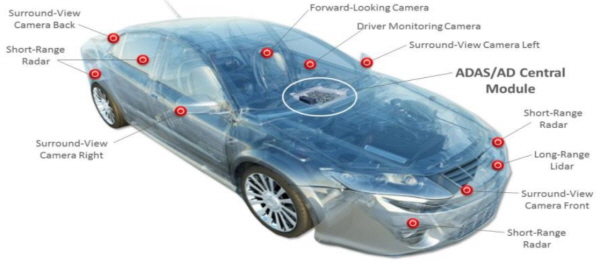
▲ Increased adoption of in-car cameras (Source: Shinhan Investment)
The global automobile market, which had a demand of 105 million units in 2018, decreased to 90 million units in 2019, and further decreased to 77 million units in 2020 due to the impact of COVID-19.
Due to this decline in automobile demand, orders for automotive semiconductors have decreased, leading foundries to shift their processes toward the IT sector.
Amidst this, automobile demand surged to 87 million units in 2021, leading to increased demand for automotive semiconductors. Although orders were placed to meet the growing demand, the automotive industry faced a semiconductor supply shortage in 2021 as the production of automotive semiconductors was not smooth due to process transitions at foundries.
Consequently, domestic automakers, including Hyundai Motor, faced several crises of production suspension due to semiconductor supply shortages.
The automotive industry, having failed to prepare for this, faced a shortage of automotive semiconductors.
Although the impact of the semiconductor supply shortage has been improving since last December, shortages of some items are expected to persist until the first quarter of this year, with a more gradual normalization beginning in the second quarter. It is expected that this will continue until the second half of this year.
■ Cars Emerge as Center of Life, Semiconductors Key
This shortage of automotive semiconductors served as a catalyst for recognizing how critical a component semiconductors are in automobiles.
In the past, the importance of semiconductors could not be felt, but now automobiles and semiconductors have become inseparable.
In particular, with the recent trend of smart cars emerging as the center of our lives, semiconductors have established themselves as a key keyword in the automotive industry to the extent that they are unthinkable without them.
Today, a single car requires hundreds or more semiconductors.
Hundreds of semiconductors control the vehicle, ranging from semiconductor chips with special functions such as power controllers, MCUs, acoustic sensors, and high-resolution image sensors to engine management systems, backup cameras, battery charging systems, and tire pressure monitors.
Furthermore, features reflecting smart car trends, such as autonomous driving, active safety, immersive infotainment, and wireless connectivity, require processors with top performance and energy efficiency; additionally, due to the nature of automobiles, semiconductor products with verified safety reliability are necessary.
Furthermore, autonomous driving requires the installation of numerous sensors and a massive amount of computing power to collect high-resolution, low-latency data and perform thousands to tens of thousands of operations per second using onboard AI models.
Therefore, power semiconductors for energy efficiency are also essential.
■ Domestic localization of automotive semiconductors begins in earnest
As a result of the increasing demand for automotive semiconductors and the resulting shortage, efforts to develop and increase production of automotive semiconductors are gaining momentum.
Traditional automotive semiconductor companies such as Infineon, STMicroelectronics, NXP, Renesas, and TI have recently begun full-scale expansion.
Infineon has started production of 12-inch wafer-based SiC semiconductors at its new fab in Palach, Austria, and NXP has also started mass production of TSMC 16nm FinFET-based LiDAR and networking processors.
ST expanded the capacity of its 12-inch fabs at Crolles and Agrate, and increased the capacity of its SiC fab at Catania. It also started operations at a new 8-inch fab in Singapore.
TI also expanded its third 12-inch fab, and Renesas fully normalized operations in June following the fire damage at its Naka plant last year and increased capacity by investing more than before the fire.
TSMC, which primarily handles orders from automotive semiconductor companies, has invested in a new factory in Kumamoto, Japan, and in Arizona, USA, while Greater China foundries such as UMC and Nexchip have also invested in expanding capacity to 80,000 wafers per month.
Meanwhile, the localization of automotive semiconductors is also progressing rapidly.
DB HiTek is providing automotive foundry services and is expanding its automotive solutions.
Samsung Electronics is preparing for the era of autonomous driving in earnest by supplying advanced automotive memory solutions that meet the AEC-Q100 quality standard for automotive semiconductors. In addition, it is expanding its portfolio of automotive semiconductors, including communication chips, processors, and power management chips.
Hyundai Mobis secured automotive semiconductor development capabilities by acquiring Hyundai Autoron's semiconductor business unit in 2020, and recently has been actively working on developing next-generation radar sensors capable of implementing Level 4 or higher autonomous driving.
Samsung Electro-Mechanics is also stepping up its efforts to expand the automotive semiconductor market through additional facility investments in semiconductor substrates and camera modules.
As a result, the movement to localize automotive semiconductors, which were previously dependent on domestic imports, is accelerating, and fierce competition among global automotive semiconductor manufacturers is expected.
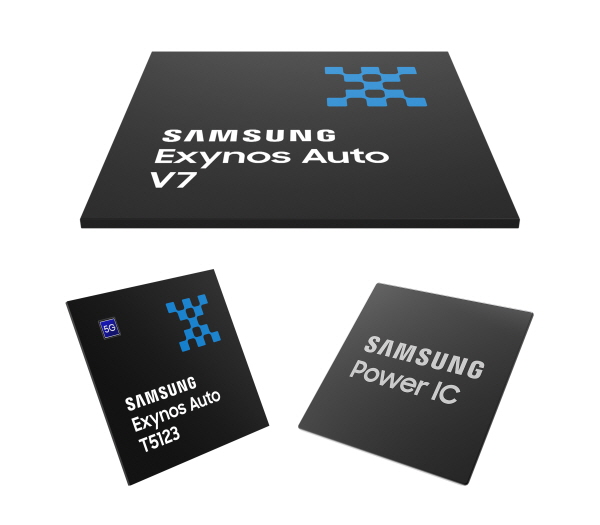
▲ Samsung Electronics' 3 Next-Generation Automotive System Semiconductors

Comments
Related news
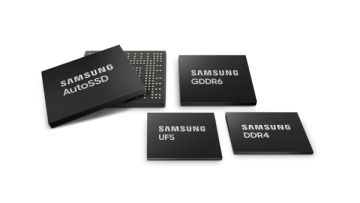
Samsung Electronics to Supply Automotive Memory, Accelerating its Targeting of the Automotive Market
Samsung Electronics has begun supplying next-generation automotive memory solutions to global automakers, marking its full-scale entry into the automotive semiconductor market.
2021.12.16by 배종인 기자
Automotive semiconductor orders for 2022 will exceed production.
Automotive semiconductor orders for next year are already exceeding production capacity, with orders being placed for 2023 production, while automakers are pursuing technology internalization or collaboration, responding to supply risks through semiconductor integration and concentrated design.
2021.12.28by 배종인 기자
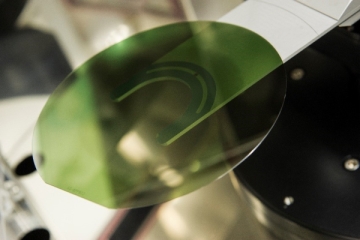
Automotive Power Optimization, SiC Market Explosion
The electrification of automobiles and mobility, adoption of autonomous driving systems, and increasing incorporation of in-vehicle electrical equipment such as entertainment systems are making power management within vehicles increasingly important, and the automotive SiC compound semiconductor market is projected to experience explosive growth.
2022.01.11by 배종인 기자

[e4ds Tech Day 2026 ⑨] Sim Sang-gyu, Autocrypt CTO: "In the Physical AI Era, Automotive Security Must Extend Beyond the Vehicle"
At e4ds Tech Day 2026, Sim Sang-gyu, CTO of Autocrypt, explained automotive cybersecurity strategies in the era of Physical AI and SDV (Software-Defined Vehicle). Automobiles are evolving as part of an ecosystem connected to AI, cloud, chargers, IoT, and robots, and he emphasized that the scope of security must expand beyond the vehicle interior to the entire connected environment. In particular, AI model tampering, adversarial attacks, OTA updates, and EV charger hacking were identified as major threats. He explained that response measures require zero trust, AI model integrity protection, intrusion detection, Security by Design and Default, and full lifecycle security management, and that proactive security system establishment beyond regulatory compliance is critical for securing future mobility competitiveness.
2026.10.12by 배종인 기자

Practical HIL Construction Strategy for Automotive and Off-Highway Controller Validation
As vehicle E/E architecture transitions to zonal structures and shifts to software-defined vehicles (SDV), the number of controllers (ECUs) requiring validation and software complexity are surging dramatically. Meanwhile, real vehicle testing cannot provide repeated verification under identical conditions and entails lead time and safety concerns. This white paper explains the principles of HIL (Hardware-in-the-Loop) validation and the structure of the NI platform composed of PXI, SLSC, and VeriStand, and through two actual implementation cases—Camera Record & Replay HIL for In-Cabin Monitoring Controller (ICMU) and Forklift Controller (VCU) HILS—describes how controller-level regression testing becomes possible. Additionally, it explicitly states application boundaries and limitations, such as lack of A2B support.
2026.10.12by 편집부











