



[Interview] Jin Yong-ha, ST Vice President, "Stella MCU Integrates with Vehicle ECU Integration Trend"
 Published2022.08.01 16:30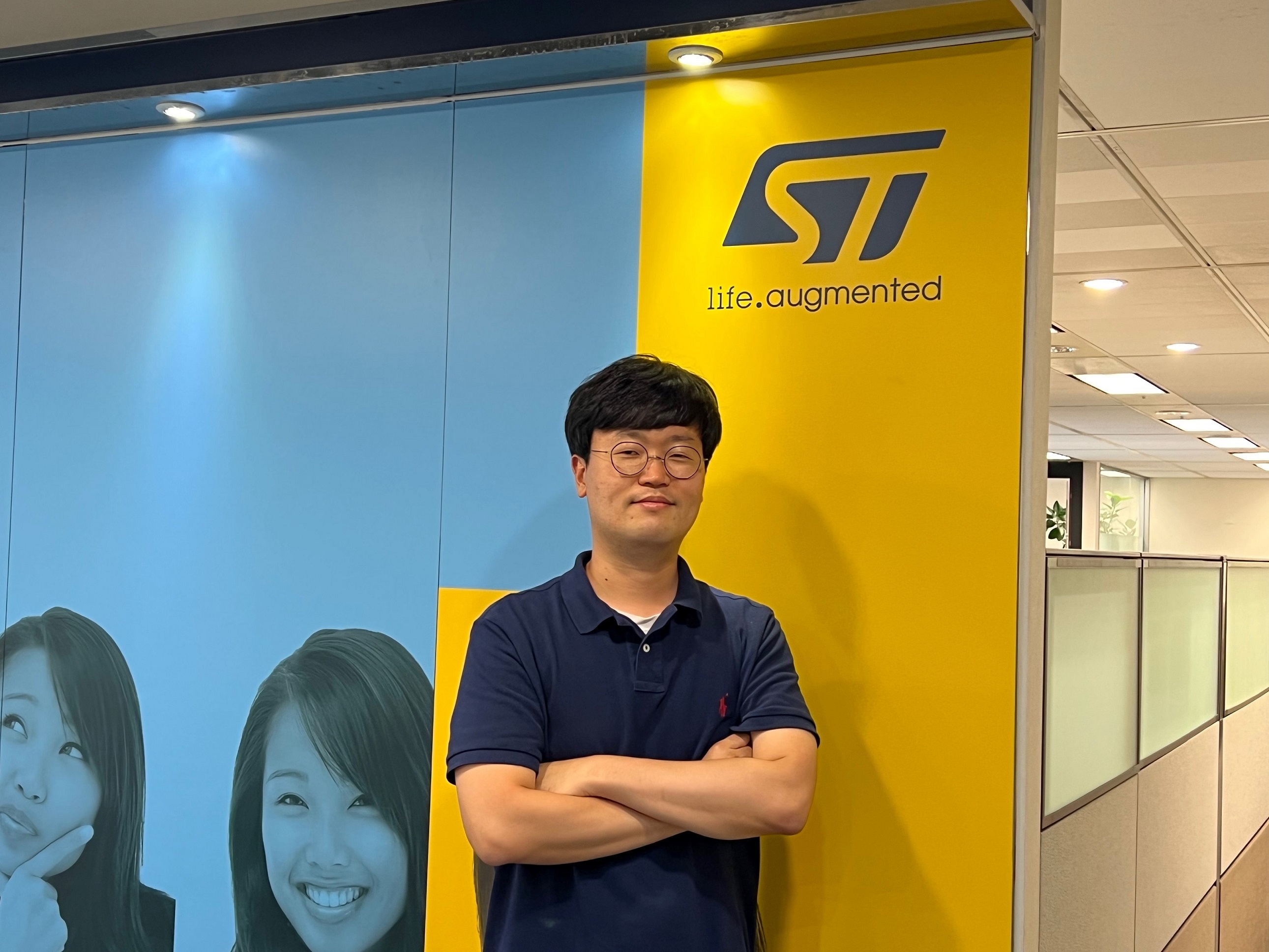
▲ST Microelectronics Automotive 32bit MCU FAE Deputy Manager Jin Yong-ha
ST Stella MCU Supports Real-Time Virtualization Platform
Memory duplication with single flash in OTA X2 mode
[Editor's Note] Recently, the automotive industry is rapidly changing its automotive E/E architecture amidst the trends of new technologies such as eco-friendliness, lightweighting, connected cars, and autonomous driving. In order to reduce the length of wiring devices and lighten the weight of vehicles in line with the eco-friendliness trend, many existing ECUs must be integrated. ECUs that were previously installed in a distributed manner are being integrated into a small number of ECUs and are changing to a centralized type, and the design direction is changing to a functionally concentrated architecture and a domain-concentrated architecture. In addition, the importance of automotive MCU solutions is gradually increasing due to the demands for more real-time data processing and high-level security. We met with Jin Yong-ha, Deputy Manager of Automotive 32bit MCU FAE at STMicroelectronics, to hear about related trends and the Stellar Next Gen ST Automotive 32-bit MCU solution.
■ Please introduce the Stellar Next Gen ST Automotive 32-bit MCU (hereinafter referred to as Stellar MCU)
Automotive architecture is undergoing many changes with new trends such as connected cars and autonomous driving. As many automakers move from distributed architecture to domain architecture and even zonal architecture, electronic control units (ECUs) in vehicles are becoming increasingly integrated.
In addition, MCUs for battlefields require more computing power. Stella MCU is the first Automotive MCU to support a real-time virtualization platform for ECU integration and domain controllers. The difficulty of integrated development of multiple ECUs is supported by virtualization through a hardware hypervisor inside the MCU. By allocating peripherals and memory space exclusively to ECU applications of different ASIL levels, each application can be implemented to operate independently by strongly isolating them internally.
Providing virtual machines using the hardware hypervisor of the Stella MCU can provide much lower overhead and real-time performance than the hypervisor implemented in software (SW). In addition, firmware updates through OTA, etc. can update only the desired applications without affecting other applications through the virtual machine.
■ What are the OTA trends in vehicles and the advantages of the OTA solution provided by Stella MCU?
In recent vehicles, OTA is a matter of memory redundancy. While the vehicle is running, a separate memory space is needed to download new firmware from the memory space that executes the firmware on the device. This increases the memory cost burden because it requires twice the space of firmware memory.
The ST Stella family of products eases the burden on customers by supporting memory duplication OTA by using a new embedded flash, PCM (Phase Change Memory). Stella’s OTA X2 mode implements memory duplication with a single flash instead of using a flash twice the size of the existing one.
PCM memory consists of two cells, which are the storage spaces of the flash, to ensure retention. In the case of standard mode, not OTA X2 mode, one logical bit value of 0 or 1 is stored in two cells, and if the two cell values are different, the logical bit is judged as 1, or 0.
When changing to OTA X2 mode, instead of using one logical bit with two cells, each of the two cells is used as a 1-bit storage space. Therefore, in OTA X2 mode, the flash usage space can be doubled. This has the advantage of not requiring a large flash capacity MCU in customer applications simply for the sake of doubling the space.
Additionally, firmware updates via OTA, etc. can update only the desired applications without affecting other applications through a virtual machine.
■ With the recent trend of strengthening laws on cyber security, what security features does Stellar MCU support?
Stella's Security offers enhanced security performance over the security features found in its predecessor, SPC5. △It supports protection against external tool access, △dedicated channel function for communication between Host and HSM, and △staged application of security according to life cycle.
In particular, HSM is a second-generation Cortex-M4 core with a clock speed of 200MHz, independent memory and various peripherals, and satisfies EVITA FULL.
In addition, the Crypto Engine added to Stella satisfies ASIL-D and is excellent at encrypting and decrypting data by performing encryption key management with HSM and data processing with HOST at a speed of 400MHz.
■ Stella MCU is divided into P/G/E product lines. What applications would you recommend for utilizing each product line?
The Stella MCU P/G family is particularly suited for domain and zone controllers.
In detail, the Stella P family is used for next-generation drivetrain applications such as transmissions and electrification integration and domain systems.
The Stella G family of products can be utilized in CCUs, etc. by implementing gateway functions efficiently and safely through data routing accelerators.
The Stella E series also excels in analog performance. △Suitable for traction inverter △OBC △BMS △DC/DC controller.
In addition, it provides compatibility for each application with various product configurations by memory and package, so it can be used in next-generation applications of various automobiles.
■ Trend changes in the automotive market are also influencing the development of MCUs. In this trend, what are the directions that ST MCUs will take and what are the challenges they will face in the future?
The automotive E/E architecture is changing rapidly due to many new trends such as lightweight and eco-friendly cars, connected cars, and autonomous driving. Currently, automakers need to integrate many existing ECUs to reduce the length of wiring devices and lighten the weight of vehicles in line with the eco-friendly trend.
In addition, trends such as connected cars and autonomous driving are demanding more and more data processing and high-level security functions in real time. In the future, MCUs will need to support the integration of numerous automotive ECUs through multi-cores and virtualization, and will likely require data routing accelerators, faster core clocks, and Evita full-level security modules. ■ Please say a word to e4ds news readers.
We ask for your interest in ST Automotive's next-generation MCU, Stella.
thank you

Comments
Related news
STMicroelectronics Launches Energy-Saving, Low-EMI 40V STripFET F8 MOSFETs
A new MOSFET utilizing oxide-filled trench technology has been launched. It is expected to be utilized in fields such as power conversion and motor control through characteristics including power efficiency and low EMI emissions.
2022.06.28by 명세환 기자
ST to Build New 12-inch Factory
As the importance of semiconductor supply chains has been emphasized, competition among countries to attract semiconductor companies has intensified. In this context, new factory construction investments by global semiconductor companies are expected to proceed in France, which is anticipated to provide momentum to Europe's semiconductor industry development.
2022.07.15by 명세환 기자
ST Launches Motor Drive Reference Design
Motors are widely used in industrial and residential applications, and various solutions for controlling them are increasingly emerging in the market. Recently, as solutions that simplify complex designs are gaining preference, motor control reference designs have been released that emphasize fine-tuning settings to achieve optimal performance and easy connectivity with host systems.
2022.07.21by 명세환 기자
Intel Unveils Next-Generation 'Core Ultra Series 3' and vPro Platform for Enterprise PCs
Intel has officially unveiled the "Intel Core Ultra Series 3" for next-generation enterprise PCs and the latest vPro platform, addressing a wide range of demands from enterprise notebooks to high-performance workstations.
2026.03.26by 배종인 기자
ROHM Launches ESD Protection Diode Compatible with High-Speed Interfaces of 10Gbps or Higher
Semiconductor specialist ROHM has developed the 'RESDxVx series' of ESD (electrostatic discharge) protection diodes capable of responding to next-generation high-speed data communication environments exceeding 10Gbps, simultaneously enhancing both signal quality maintenance required in high-speed interfaces and IC protection performance.
2026.03.26by 배종인 기자











