


60% of semiconductor experts predict the current semiconductor industry crisis will persist beyond 2024.
 Published2022.09.05 11:03
반도체 전문가 76.7%, "現반도체 상황 위기"로 규정
대한상공회의소가 최근 국내 반도체 전문가 30명을 대상으로 국내 반도체산업 경기에 대한 인식을 조사해 5일 발표한 결과에 따르면, 전문가 10명 중 7명(76.7%)은 현재 반도체산업이 처한 상황을 ‘위기(위기상황 초입 56.7%, 위기 한복판 20%)'로 진단했다. '위기상황 직전'이라는 응답은 20%, '위기상황이 아니다'라는 답변은 3.3%에 그쳤다.
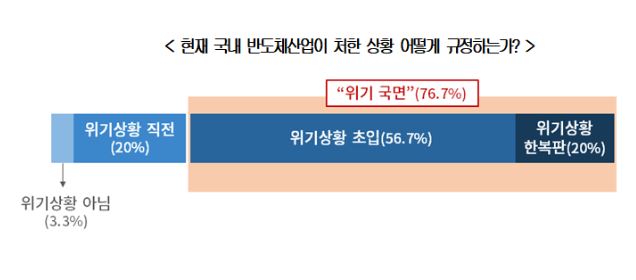
▲국내 반도체산업 경기 인식 조사 (자료-대한상공회의소)
■"단기간에 여건 개선 쉽지 않아"...전문가 60% 위기상황 내후년 지속 응답
전문가들은 현재의 어려운 상황이 금세 나아지지 않을 것으로 예상했다. 현재 상황을 '위기' 혹은 '위기 직전'으로 진단한 전문가들에게 이 상황이 언제까지 이어질 것으로 예상하는지를 물은 결과, 가장 많은 전문가들이 '내후년 이후에도 지속될 것'(58.6%)으로 전망했다. 이어 '내년까지'(24.1%), '내년 상반기까지'(13.9%), '올해 말까지'(3.4%) 순으로 내다본 전문가가 많았다.
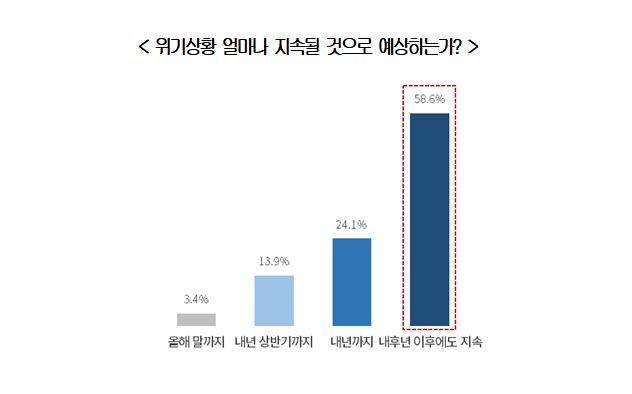
▲위기상황 지속 예상 시기 (자료-대한상공회의소)
전문가들은 겹겹이 쌓인 장단기 대외리스크를 주요 원인으로 꼽았다.
김양팽 산업연구원 전문연구원은 "△반도체 공급 과잉 △글로벌 수요 감소 및 재고 증가에 따른 가격하락 △중국의 빠른 기술추격 △미·중 기술패권 경쟁 심화 등의 리스크들이 동시다발적으로 일어나 반도체산업의 불확실성이 가중되고 있다"며 "장단기 이슈들이 복합적으로 얽혀 있기 때문에 그 영향이 상당기간 지속될 가능성이 크다"고 말했다.
실제, 메모리 반도체 가격의 하락세도 심상치 않은 분위기다. D램과 낸드플래시의 가격은 최근 수개월째 하락세를 보이고 있고, 전문가들과 시장조사기관들은 3분기에도 2분기 대비 메모리 반도체 가격이 10%이상 하락할 것으로 내다보고 있는 상황이다.
현재 반도체산업이 처한 상황이 최근 10년 내 가장 심각한 수준 이라는 의견도 많았다. 최근 10년 내 있었던 국내 반도체산업의 부진 시기, 즉 2016년 중국의 메모리시장 진입과 2019년 미중 무역분쟁 당시와 현재의 상황 비교해보면 전문가들의 43.4%는 '그때보다 심각한 수준(매우 심각 16.7%, 심각 26.7%)'이라고 응답했다. '유사하다'는 답변은 36.6%, '양호하다'는 답변은 20%로 집계됐다.
2016년은 중국의 메모리 반도체 시장 진출과 사드 사태 여파로 4년 간의 수출 증가세가 꺾인 해이다. 2019년에는 미중 무역분쟁과 글로벌 반도체 다운사이클 여파로 반도체 수출이 전년대비 1,281억달러에서 952억달러로 약 26%가량 감소했다.
범진욱 서강대 전자공학과 교수는 "과거 반도체산업의 출렁임이 주로 일시적 대외환경 악화와 반도체 사이클에 기인했다면, 이번 국면은 언제 끝날지 모를 강대국 간 공급망 경쟁과 하루가 다르게 발전하는 중국의 기술추격 우려까지 더해진 양상"이라며 "업계의 위기감과 불안감이 어느 때보다 큰 상황"이라고 진단했다.
일례로 지난주 애플이 메모리 반도체의 신규 공급처로 중국 YMTC를 낙점하면서 국내 반도체산업에 위기감을 안겨줬다. YMTC가 애플에 공급하게 될 낸드플래시 부문은 한·중간 기술 격차가 1~2년에 불과한 것으로 알려졌다.
■칩4 논의·美 반도체법, 우려와 기대 혼재...상의 "외교 노력·획기적 대책 必"
국내 반도체산업을 둘러싼 대외현안으로 급부상한 칩4 논의와 미국 반도체와 과학법의 영향에 대해선 전문가들의 긍·부정 평가가 혼재했다.
먼저 칩4 논의가 국내 반도체산업에 미칠 영향에 대해서는 '긍정적'이라는 응답이 36.6%(매우 긍정적 3.3%, 다소 긍정적 33.3%)를 차지한 가운데, '부정적'이라고 답한 전문가 비중도 46.7%(매우 부정적 16.7%, 다소 부정적 30%)에 달해 논의에 보다 신중하게 임할 필요가 있음을 암시했다. '큰 영향 없을 것'이라는 답변은 16.7%로 집계됐다.
박진섭 한양대 융합전자공학부 교수는 "반도체산업은 엄청난 국제 분업 구조를 갖고 있기 때문에 칩4 대화에 참여할 수밖에 없다"면서 "글로벌 반도체 기업들과의 R&D·공급망 협력 등의 기회를 얻을 수 있는 한편, 미·중 경쟁 심화 및 중국의 반발에 따른 부작용을 염려하지 않을 수 없다"고 말했다. 다만 박 교수는 "아직까지 반도체 분야에서 중국과의 기술격차가 확연하고 중국의 필요가 크기 때문에 당장 반도체 수출이 타격 받을 가능성은 낮다"고 내다봤다.
'미국의 반도체와 과학법'의 영향에 대해서는 '긍정적' 전망이 50%(매우 긍정적 3.3%, 다소 긍정적 46.7%), '부정적' 전망은 40%(매우 부정적 20%, 다소 부정적 20%)로 집계됐다. '큰 영향 없을 것'이라는 답변은 10%에 그쳤다.
정의영 연세대 전기전자공학부 교수는 "반도체와 과학법으로 인해 글로벌 반도체 공급망이 미국 중심으로 급속히 재편될 가능성이 커졌다"며 "가드레일 조항 때문에 중국 투자가 제한받는 등의 부정적 요인도 있지만, 반도체 개발·설계 분야에서 기술적 우위에 있는 미국과의 협력을 통해 얻을 수 있는 효과도 또한 클 것으로 기대한다”고 말했다.
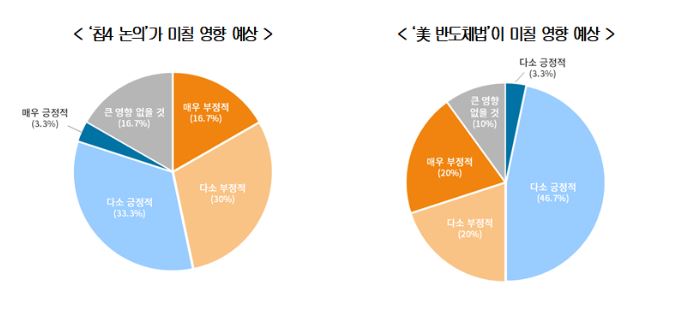
▲칩4 논의와 미국 반도체법 영향 예상 (자료-대한상공회의소)
국내 반도체산업의 단기적 위협요인으로는 △'글로벌 반도체 수요 감소(부정적 영향 80%, 영향 없음 16.7%, 긍정적 영향 3.3%)' △'중국의 코로나19 봉쇄(부정적 영향 66.7%, 영향 없음 13.3%, 긍정적 영향 20%)' △'글로벌 금리인상 기조(부정적 영향 63.3%, 영향 없음 26.7%, 긍정적 영향 10%)' △'우크라이나 전쟁(부정적 영향 56.7%, 영향 없음 36.7%, 긍정적 영향 6.6%)' 순으로 우려하는 전문가들이 많았다.
반도체산업 발전을 위해 가장 시급한 정책과제로는 △칩4 대응 등 정부의 원활한 외교적 노력(43.3%) △인력 양성(30%) △R&D 지원 확대(13.3%) △투자에 대한 세제·금융 지원 확대(10%) △반도체 소재에 대한 공급망 안정화 지원(3.4%)을 차례로 꼽았다.
우태희 대한상의 상근부회장은 "전체 수출의 5분의 1을 담당하는 반도체 수출이 감소한 상황에서 지난주 정부가 '수출경쟁력 강화 전략' 발표를 통해 반도체에 대한 기업투자와 인력양성을 약속한 것은 다행"이라면서도 "해외기술기업 투자‧인수를 위한 특단의 제도 개선과 반도체 경쟁국 사이에서의 적극적이고 세련된 외교 등 반도체분야 초격차 유지를 위한 보다 근원적 노력이 필요한 시기"라고 말했다.

Comments
Related news
Semiconductor Industry Urges Swift Passage of Semiconductor Competitiveness Enhancement Act
The semiconductor industry has urged the swift passage of the Semiconductor Industry Competitiveness Enhancement Act to overcome the semiconductor crisis and secure semiconductor leadership.
2022.08.29by 배종인 기자
Fabless Industry Association: "National support for semiconductors is essential."
Domestic semiconductor fabless companies have strongly urged nationwide support.
2022.08.29by 배종인 기자
The Ministry of Trade, Industry and Energy announced efforts to minimize the burden on the industry from the US semiconductor support law.
The Ministry of Trade, Industry and Energy announced that it will make efforts to minimize the burden on Korea's semiconductor industry resulting from the 'guardrail' provisions stemming from the U.S. Semiconductor Support Act.
2022.08.29by 배종인 기자

Intel Unveils Next-Generation 'Core Ultra Series 3' and vPro Platform for Enterprise PCs
Intel has officially unveiled the "Intel Core Ultra Series 3" for next-generation enterprise PCs and the latest vPro platform, addressing a wide range of demands from enterprise notebooks to high-performance workstations.
2026.03.26by 배종인 기자

ROHM Launches ESD Protection Diode Compatible with High-Speed Interfaces of 10Gbps or Higher
Semiconductor specialist ROHM has developed the 'RESDxVx series' of ESD (electrostatic discharge) protection diodes capable of responding to next-generation high-speed data communication environments exceeding 10Gbps, simultaneously enhancing both signal quality maintenance required in high-speed interfaces and IC protection performance.
2026.03.26by 배종인 기자











