


Fast pace toward ultra-pure water localization
 Published2022.09.21 15:35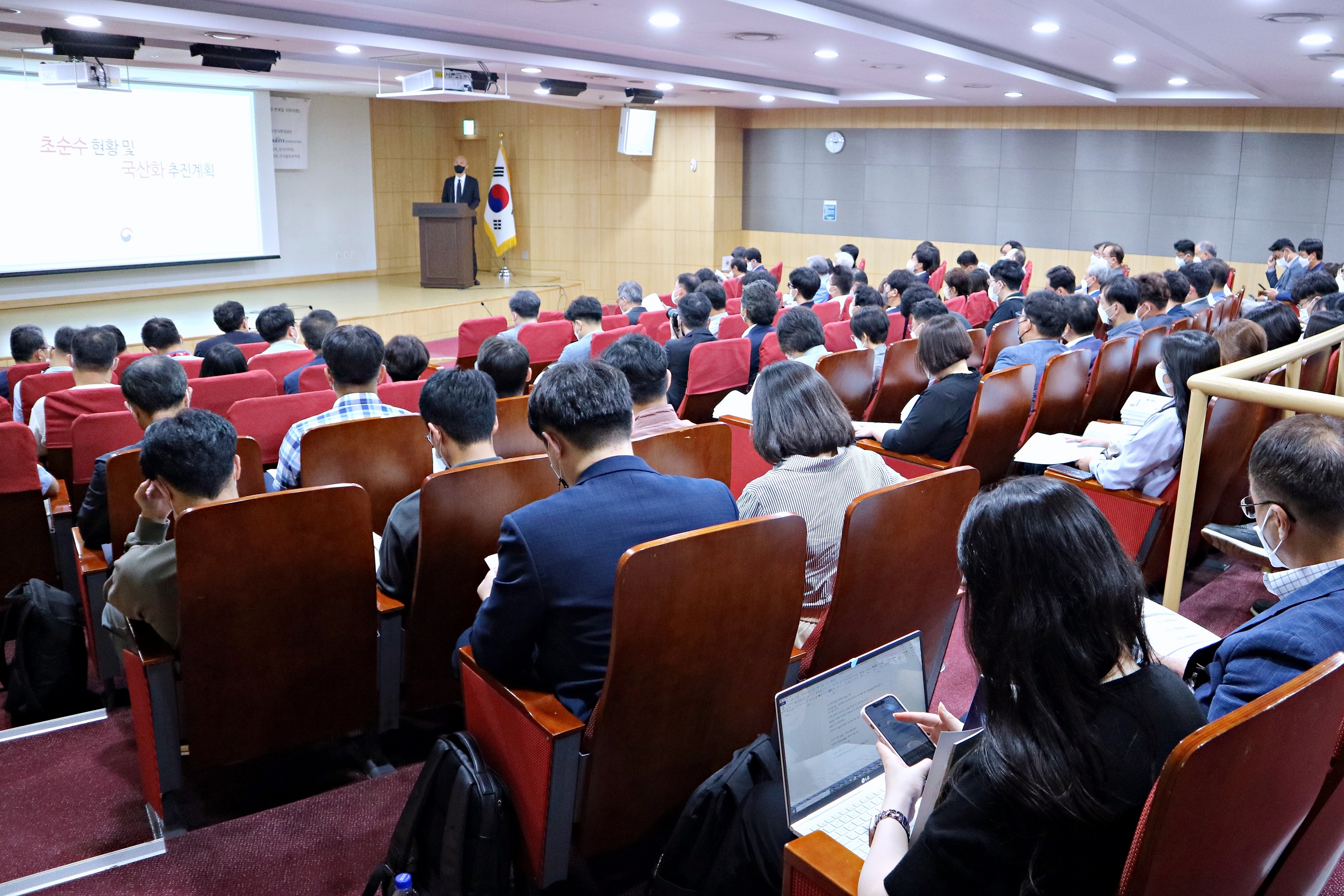
▲Ultra-pure Water Industry Fostering Policy Discussion Forum Held
Policy Direction for Semiconductor Material 'Ultra-pure Water' Discussed
Water is essential in semiconductor manufacturing processes and is used in excess of 20 million tons annually by major domestic semiconductor factories alone. Against this backdrop, the high overseas dependency in ultra-pure water, a high-purity industrial water, has prompted continuous calls for localization.
On the 20th, an 'Ultra-pure Water Industry Fostering Policy Discussion Forum' was held in Conference Room 2 of the National Assembly. The 18th discussion forum, hosted by the National Assembly Water Forum and organized by the Korean Ultra-pure Water Society, discussed ultra-pure water trends and localization implementation plans.
Ultra-pure water (Ultrapure Water) refers to water that approaches theoretical pure water with extremely suppressed impurities such as ions, organic matter, and particulates contained in water through advanced purification processes, with electrical conductivity approaching zero.
It is used in wafer fabrication, pre-process, and packaging stages during semiconductor manufacturing processes, and large quantities of water are required for wafer cleaning operations. Ultra-pure water, a high-purity industrial water, becomes increasingly sensitive to fine dust as processes advance to nanometer-level microfabrication, and water containing ions and gases in the etching process changes material characteristics and causes lamination problems. Therefore, securing ultra-pure water quality is essential for yield assurance.
The ultra-pure water industry is advanced in Japan and the United States, while the domestic infrastructure remains weak. Current domestic ultra-pure water manufacturing is receiving technical support such as plant design from Japanese companies Kurita and Nomura, with domestic companies only conducting simple construction work. Industry and academia expressed unanimous concern that policy support for breaking free from high overseas dependency and securing domestic supply chains, along with domestic research and development and demonstration applications, must be backed up.
Lee Chang-han, Executive Vice President of the Semiconductor Industry Association, presented on the topic of 'Semiconductor Industry and Ultra-pure Water' and stated, "Major semiconductor factories require 700,000 tons of water daily from Samsung Electronics and SK Hynix requires the same amount," and advised, "To internalize ultra-pure water equipment within semiconductor processes, performance and quality verification evaluations and securing related technology development must be achieved."
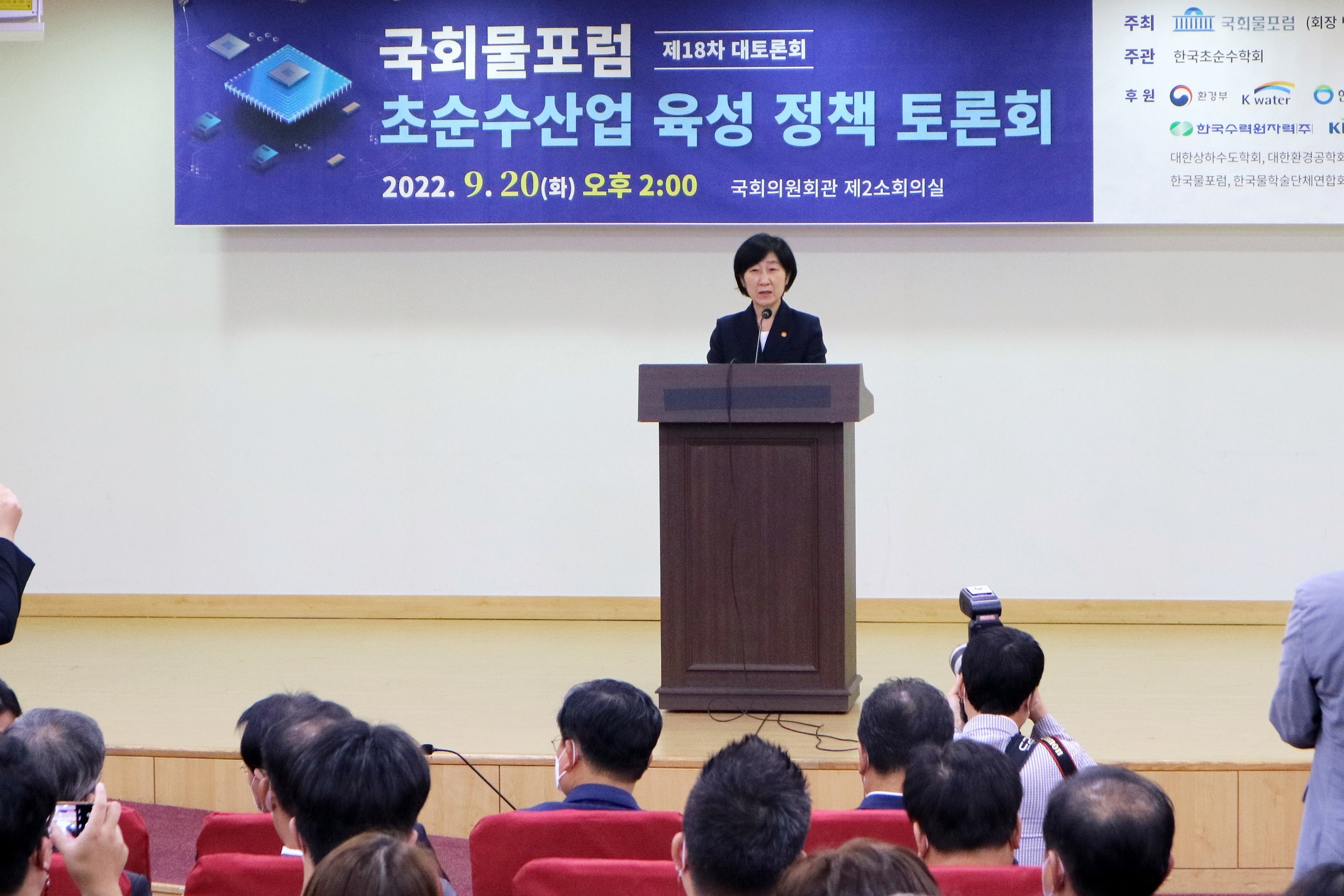
▲Han Hwa-jin, Minister of Environment
In response, the government expressed its will to raise the self-sufficiency rate of domestic materials and components industry to 50% or more and included the ultra-pure water sector in related support measures from the Ministry of Environment.
Han Hwa-jin, Minister of Environment, stated in her congratulatory remarks at the forum that "ultra-pure water, an essential material for the semiconductor industry, has high overseas dependency and is actively promoting localization," and announced, "By 2024, we plan to proceed with relevant support targeting 70% localization rate of core equipment through development of △ultraviolet oxidation △degassing membrane △ion-exchange resin equipment, and by 2025, we plan to construct and operate an ultra-pure water demonstration plant with a daily capacity of 2,400 tons."
Additionally, KAIST will open a specialized education program in ultra-pure water to nurture 10 expert personnel annually, and mentioned plans to establish an education center within the platform center and provide educational support with a goal of building education infrastructure by 2029.
The Ministry of Environment conveyed that it will continue support with goals of △ultra-pure water core technology localization by 2025 △platform center construction enabling development, verification, and education by 2030 △fostering star companies through industry promotion and full-lifecycle support after 2030.
Professor Kang Seok-tae of KAIST forecasted, "The ultra-pure water industry will require future technology development and advancement to respond to improved water quality of ultra-pure water in line with the trend of semiconductor linewidth refinement."

Comments
Related news
Recycling Technology Essential for Stable Supply of Semiconductor Material 'Tantalum'
Recently, as the United States has imposed import restrictions on tantalum (Ta, tantalum), which is predominantly used in domestic semiconductor processes, there are increasing calls to secure stable supply of tantalum to ensure the stability of domestic semiconductor materials. In this context, recycling technology for tantalum scrap has emerged as a key factor in ensuring supply stability.
2022.08.30by 배종인 기자
EUV introduction hinders, semiconductor special gas regulation innovation
Regulatory improvements related to specialty gases for semiconductors, including the use of new materials for gas piping within exposure equipment—which has served as an obstacle to the adoption of EUV, an advanced semiconductor equipment—are expected to alleviate the burden on companies.
2022.09.13by 배종인 기자
.jpg)
“It depends on semiconductor ultra-fine material analysis technology”
As semiconductors become increasingly ultra-miniaturized beyond the capabilities of impurity analysis, opinions have been raised that overcoming this limitation requires analysis management starting from semiconductor materials.
2022.09.16by 배종인 기자

Intel Unveils Next-Generation 'Core Ultra Series 3' and vPro Platform for Enterprise PCs
Intel has officially unveiled the "Intel Core Ultra Series 3" for next-generation enterprise PCs and the latest vPro platform, addressing a wide range of demands from enterprise notebooks to high-performance workstations.
2026.03.26by 배종인 기자

ROHM Launches ESD Protection Diode Compatible with High-Speed Interfaces of 10Gbps or Higher
Semiconductor specialist ROHM has developed the 'RESDxVx series' of ESD (electrostatic discharge) protection diodes capable of responding to next-generation high-speed data communication environments exceeding 10Gbps, simultaneously enhancing both signal quality maintenance required in high-speed interfaces and IC protection performance.
2026.03.26by 배종인 기자











