



[Planning] Quantum Computer Era, Fierce Security Market
 Published2023.01.09 15:44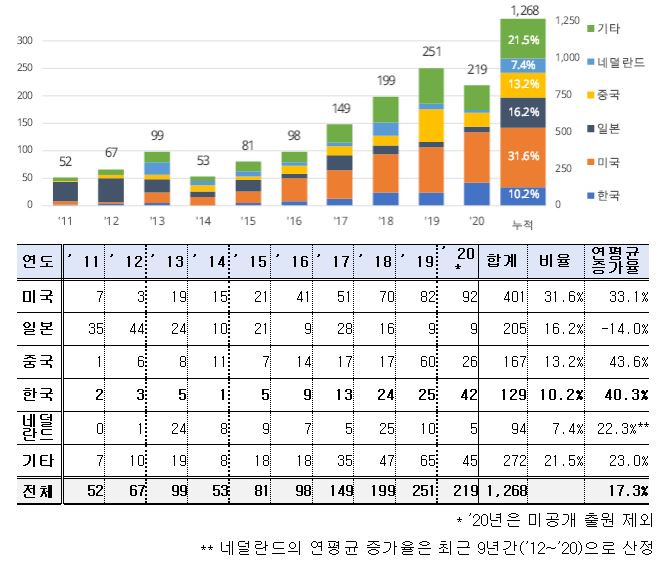
▲출원인 국적별 특허출원 동향(자료:특허청)
상위 10위권 국내기업 단 1곳, 크립토랩

양자컴퓨터가 현대 정보통신 분야 암호체계를 무력화시킬 수 있다는 우려가 커지면서 사이버 보안에서의 새로운 시장이 열리고 있다. 양자컴퓨터 공격에도 안전한 암호체계 개발을 위해 각국의 선점 경쟁이 치열해지고 있다.
특허청에 따르면 포스트 양자 암호 기술의 경제적 가치는 2026년 27조원에 이르며 전체 보안 시장 규모 247조원 가운데 11%를 차지할 것으로 예측했다.
이에 특허출원 수도 가파르게 증가하고 있다. 2011년 이후 연평균 17.3%씩 증가해 10년 만에 219건에 이르렀다.
국가별로 보면 미국이 31.6%로 가장 많았으며, 그 뒤로 △일본(16.2%) △중국(13.2%)에 이어 한국이 10.2%로 4위를 차지했다. 특허청은 일본의 출원량은 감소하는 경향을 보이는 반면, 중국과 한국의 출원 증가폭은 연평균 40%대에 이르며 관련 개발에 열을 올리고 있는 것으로 나타났다.
암호 방식 순에선 격자 기반 암호가 32%로 가장 많았으며 해시 기반 방식이 28.3%로 그 뒤를 이었다. 포스트 양자 암호는 양자컴퓨터로도 풀 수 없도록 수학 문제의 복잡도를 대폭 높인 형태의 암호 알고리즘으로, 어떤 수학 문제에 기반하고 있는지에 따라 △격자 △해시 △다변수 △코드 △타원곡선으로 구분된다.
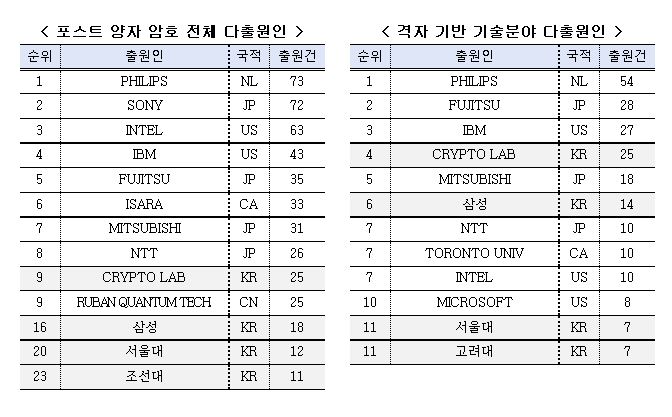
▲전세계 특허 출원인 순위(자료:특허청)
포스트 양자 암호 개발은 기업들이 80%가량 특허 출원 비중을 보이며 주도하고 있다. 네덜란드 필립스가 73건으로 가장 많은 특허를 보유했으며, 그 뒤를 △소니 72건 △인텔 63건 △IBM 43건 △후지쯔 35건 등으로 5위권 안에 네덜란드, 미국, 일본 기업들이 포진하고 있었다.
국내 기업은 10위권 안에 단 1곳뿐인데 크립토랩이 25건으로 9위를 기록했으며 16위에 삼성 18건, 20위권 밖으로 서울대(12건)와 조선대(11건)가 이름을 올렸다.
특히 크립토랩은 격자 기반 기술분야에서 특허를 25건 출원하며 포스트 양자 암호 개발에 집중하고 있다. 크립토랩에 따르면 실수연산을 지원하는 4세대 동형암호 CKKS의 원천특허를 포함해 동형암호/포스트 양자 암호 분야의 다양한 특허를 국내 66건, 해외 80건을 보유하고 있다.
▲크립토랩 홈페이지 캡처
크립토랩은 동형암호 기술을 적용해 △코로나 동선 안심이 앱 △Privacy Preserving Training △HEaaN as a Service (HEaaN Homomorphic Analytics)을 개발해 서비스했다.
특허청 박재일 인공지능빅데이터심사과장은 “암호 기술은 뛰어난 아이디어로 세계적 대기업과 경쟁할 수 있는 분야로 우리 기업과 연구자들이 선전하고 있어 고무적이다”라며, “양자 컴퓨팅이라는 파괴적 기술의 등장으로 차세대 암호 기술 시장이 열리고 있는 지금, 핵심 기술을 확보해 사이버 안보 위협에 대비하고 시장을 선점하기 위한 범국가적 노력이 필요한 시점이다”라고 말했다.

Comments
Related news
'Quantum Cryptography World on the Brink': Quantum Technology Achievements Announced
The Ministry of Science and Technology held a "Quantum Technology Industrialization Achievement Presentation and Future Quantum Convergence Forum 1st Anniversary Commemorative Ceremony" at the Korea Institute of Science and Technology (KIST) headquarters on the 1st to review quantum technology development and commercialization achievements in connection with the '2022 Quantum Information Week' and to commemorate the first anniversary of the establishment of the 'Future Quantum Convergence Forum (Quantum Forum)'.
2022.07.01by 김예지 기자
.jpg)
SKT-SKB, First Commercialization of International Network Quantum-Resistant Cryptography
SK Telecom is commercializing PQC (Post-Quantum Cryptography) in a global VPN (Virtual Private Network) network utilizing international lines with SK Broadband.
2022.09.13by 김예지 기자
Intel Makes Major Progress in Quantum Chip Production Research
Quantum computer development research is accelerating. Progress has been made in advancing silicon spin qubit yield and uniformity, which is expected to bring forward the feasibility of realizing quantum computers in the future.
2022.10.07by 명세환 기자
.png)
Databricks Unveils Open AI Security Monitoring 'Lakewatch'
Databricks entered the security market on March 24 by unveiling LakeWatch, an open-source agentic SIEM. The core functionality of this product is to integrate and analyze security, IT, and business data in a single environment to support AI-based threat detection and investigation. The company explained that it reduces the limitations of existing security operations centers, which have had to forgo some data due to high cost structures, and enables large-scale data analysis and automation based on open formats and ecosystems. LakeWatch is currently offered as a private preview, with Adobe and Dropbox mentioned as early customers. Databricks also announced an expanded partnership with Anthropic as well as the acquisition of Antimatter and SiftD.ai.
2026.03.26by 배종인 기자

Kaspersky Unveils Revamped 'NEXT' Combining SOC Integrated Management and AI Analytics
As enterprises increase demand for integrated management and automation in the construction and operation of Security Operations Centers (SOC), Kaspersky has disclosed updates to its B2B security product suite 'Kaspersky Next'. This update expands EPP, EDR, XDR, and SIEM integration through a single console based on OSMP, incorporates AI capabilities such as DLL hijacking detection and suspicious account takeover behavior identification, and includes integration with generative AI assistant tool KIRA. The company stated that in large-scale deployment environments, EDR Expert can reduce resource requirements by up to 30%, and XDR Expert by up to 60%.
2026.03.25by 배종인 기자











