


[Planning-ChatGPT①]ChatGPT Syndrome, AI Permeating Everyday Life
 Published2023.02.27 11:13
Released in December last year… Surpassed 100 million users in just 2 months
Government, ChatGPT Education and K-Cloud 'Active'
AI giants such as MS, Google, SKT, and KT compete
ChatGPT has surpassed 100 million monthly users in just two months, and interest in generative AI that resembles human intelligence is growing by the day.
The emergence of ChatGPT, which was released by OpenAI in December last year, showed the possibility that super-large AI can replace humans. Interest in ChatGPT is spreading not only to the industry but also to general consumers, whether curious or fearful.
'Super-large AI' is AI that can learn and reason on its own like humans, with data hundreds of times larger than existing artificial intelligence (AI). ChatGPT is a model that converses and interacts based on human-level language ability, and can answer human questions, raise objections, or reject inappropriate requests.
ChatGPT is a large-scale language generation model developed by OpenAI based on GPT 3.5. ChatGPT is a GPT-3.5 model with 175 billion parameters. GPT-4 is expected to reach 100 trillion. Google's Lambda has 137 billion parameters.
ChatGPT's use cases are increasing not only among businesses but also among the general public, and our daily lives are changing at a rapid pace. Actual users are surprised by ChatGPT's ability to converse at a high level and are attempting to apply it to various fields.
Of course, ChatGPT has its limitations at this point in time, and there are also negative views. As a result of various tests conducted in the American academic world, ChatGPT was evaluated to be at a level that could pass medical licensing exams and law school graduation exams, but plagiarism and other problems are inevitable. The University of Washington and the University of Vermont have included 'AI-based plagiarism' in their school regulations, and a detection service called 'ZeroGPT' has also appeared that identifies whether a text was written by ChatGPT.
However, ChatGPT's usability is acknowledged enough by one actual user to say, "It's worth paying the $20 monthly fee." Its current popularity is raising expectations that ChatGPT can produce better-than-human results in a wide range of areas, including design, creation, and translation.
■ A ‘game changer’ that even the government is paying attention to

▲Minister Lee Jong-ho is discussing ChatGPT trends and policy directions with experts.
President Yoon Seok-yeol mentioned his experience writing a New Year's address using ChatGPT in a previous Ministry of the Interior and Safety work report, hinting at the government's intention to take the lead in the ultra-large AI market.
Minister of Science and ICT Lee Jong-ho discussed ChatGPT trends and policy directions with AI experts from academia, LG, SK, Naver Cloud, etc. at the Seoul Central Post Office on the 22nd.
Minister of Science and ICT Lee Jong-ho said, “Chat GPT will be a signal that AI is permeating our daily lives,” and added, “We will spare no support to maximize the digital capabilities of our companies so that they can lead the global giant AI market.”
The Ministry of Culture, Sports and Tourism has been promoting employee capacity building training and idea contests to find ways to utilize ChatGPT in the cultural sector. The training, which was conducted over several sessions, received a great response, with over 400 people applying within just three days of the announcement.
In particular, it is expected that Korea's establishment of a foundation as a leading country in AI semiconductors will accelerate due to the emergence of ChatGPT.
Last December, the government announced the 'K-Cloud Promotion Plan' and the 'AI Daily Life and Industrialization Plan' utilizing domestic AI semiconductors, concretizing the plan to support AI semiconductors and ultra-large AI. To this end, a total of KRW 826.2 billion will be invested in the development of domestic AI semiconductors by 2030, and KRW 265.5 billion will be invested in the development of AI that goes beyond ChatGPT.
■ MS, Google, SKT, KT… Domestic and international AI war
MS, which made an aggressive investment of 12 trillion won in Open AI last January, has accelerated its market conquest by applying ChatGPT AI technology to its search portal site 'Bing'.
GPT-3.5 will also be introduced to the meeting solution 'Teams Premium' and will be introduced to cloud Azure, PowerPoint, Word, Outlook, etc. The MS vice president also expressed his will to actively expand the partnership with Open AI on the company's homepage.
In response, Google, which is a key player in the AI market with AlphaGo and others, has responded with a plan to release Bard. Google announced that it plans to apply and release it to about 20 AI services within the year, and has also invested $400 million in startup Anthropic, a competitor to OpenAI. Meanwhile, China's Baidu is also strengthening its position by announcing plans to launch an AI chatbot around March.
In Korea, there is strong interest from major companies such as the three mobile carriers, Kakao, and Naver, as well as startups.
SKT announced at MWC23 held in Spain that its first Korean model AI service, 'A.', secured 1 million subscribers in just 9 months since its launch. In particular, SKT's strategy is to apply multimodal AI within the first quarter of this year to enhance conversations, services, and characters, and establish itself as Korea's representative AI service.
ChatGPT continues to be a hot topic at the Mobile World Congress (MWC), a mobile communications exhibition held in Barcelona, Spain. A total of 130 companies, including MS, SKT, KT, Samsung Electronics, and startups from Korea, participated in MWC.
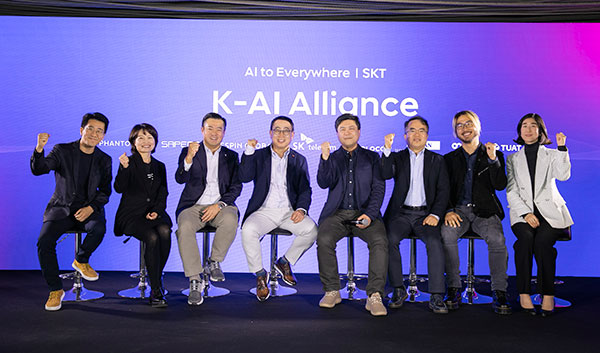
▲SKT establishes K-AI alliance at MWC
Also on this day, SKT unveiled AI semiconductor Sapion, vision AI applied to robots, security, and media, and various other services, and announced the establishment of the K-AI Alliance by forming an alliance with AI tech companies. △Phantom AI △SAPEON △BESPIN GLOBAL △MOLOCO △Conan Technology' △Swit △TUAT, etc. Representatives of K-AI Alliance partners attended in person.
KT is in the midst of developing a super-large AI called 'Faith'. KT, which aims to create AI that understands and empathizes with human emotions as part of Digico KT's vision, is partnering with AI semiconductor startup Rebellion.
Rebellion, which has grown rapidly since its establishment in September 2020, reaching a cumulative sales of KRW 100 billion as of last year, introduced 'ATOM' for data centers on the 13th. KT will install ATOM in its lightweight 'Trust' model scheduled for release in the first half of the year.
At MWC, KT introduced ‘Trust’ and AI R&D portal ‘Genie Labs’, and startup ‘More’, which is collaborating with Rebellion to develop cloud services for building AI infrastructure for data centers, also participated.
Domestic search engine Naver is also making a bet in the huge AI market. Naver has been steadily evolving since releasing 'HyperClova', an AI model based on GPT-3 specialized for Korean, in May 2021. Based on Naver's voice recognition, it has also been applied to the 'Clova Care Call' service, Clova Speaker, Clova Note, etc., and the Aurora Project is in full swing.
Naver Cloud CEO Kim Yu-won announced at the developer conference 'DEVIEW' on the 27th that 'Hyperclova X', an upgraded version of 'Hyperclova', will be released in July. On this day, Naver revealed its ambition to become a powerhouse in building large-scale AI products, saying, “HyperClova X has improved by learning 6,500 times more Korean than ChatGPT.”
Naver is expected to demonstrate differentiated competitiveness, as it possesses the largest Korean language database in Korea and is also evaluated as having advanced AI technology.
As ChatGPT, which accelerates innovation in various industries, becomes a daily topic of conversation, the government's institutional arrangements to secure competitiveness by utilizing ChatGPT services will be a key. As ultra-large AI requires dedicated semiconductors, systematic support seems necessary so as not to miss opportunities as a leading semiconductor country and not to be reduced to a temporary marketing tool.
Comments
Related news

The ever-growing "hyper-large AI" market
Since Google's AlphaGo competed against Go champion Lee Sedol 9-dan in 2016, AI that has permeated our daily lives has continued to evolve and become increasingly closer to humans. <br><br>'Super-large AI' refers to AI that can learn and reason on its own like humans by processing massive data sets hundreds of times larger than conventional AI. <br><br>#AI #SuperLargeAI #AISemiconductor #OpenAI #MultimodalAI #LargeLanguageModel #Naver #SamsungElectronics #SKT #LGUplus #KT
2023.01.25by 김예지 기자
ST Unveils MCU Edge AI Developer Cloud
ST has unveiled the world's first MCU AI developer cloud that works seamlessly with the STM32Cube.AI ecosystem.
2023.02.01by 명세환 기자
.jpg)
SKT, Doubles GPU of Ultra-Large AI 'Adot' Supercomputer
SKT has been building and operating its own supercomputer since 2021. This time, it expanded the system with 1040 NVIDIA A100 GPUs.
2023.02.13by 김예지 기자
.jpg)
Vice Chairman Park Jung-ho: “AI Chatbots Are New Killer Applications for Semiconductor Demand”
Park Jung-ho, Vice Chairman and CEO of SK Hynix, delivered a keynote speech at an academic symposium held at the Press Center in Gwanghwamun, Seoul on the 15th to commemorate the opening of Hallym University's Doheon Institute for Academic Studies, with the theme "The Path Forward for Korean Semiconductors in the AI Era," arguing that AI chatbots will become a new killer application driving semiconductor demand.
2023.02.15by 배종인 기자

SKT Introduces AI Location Analysis Platform in Seocho-gu
SKT is applying and commercializing its AI-based location analytics platform 'LITMUS' for the 'Digital Twin National Territory-Based Transportation Impact Assessment Support Model Project' commissioned by the Seocho-gu Office.
2023.02.16by 김예지 기자











