



“New semiconductor models, new materials, new structures: 3 new, basic science-based essential”
 Published2023.06.13 16:57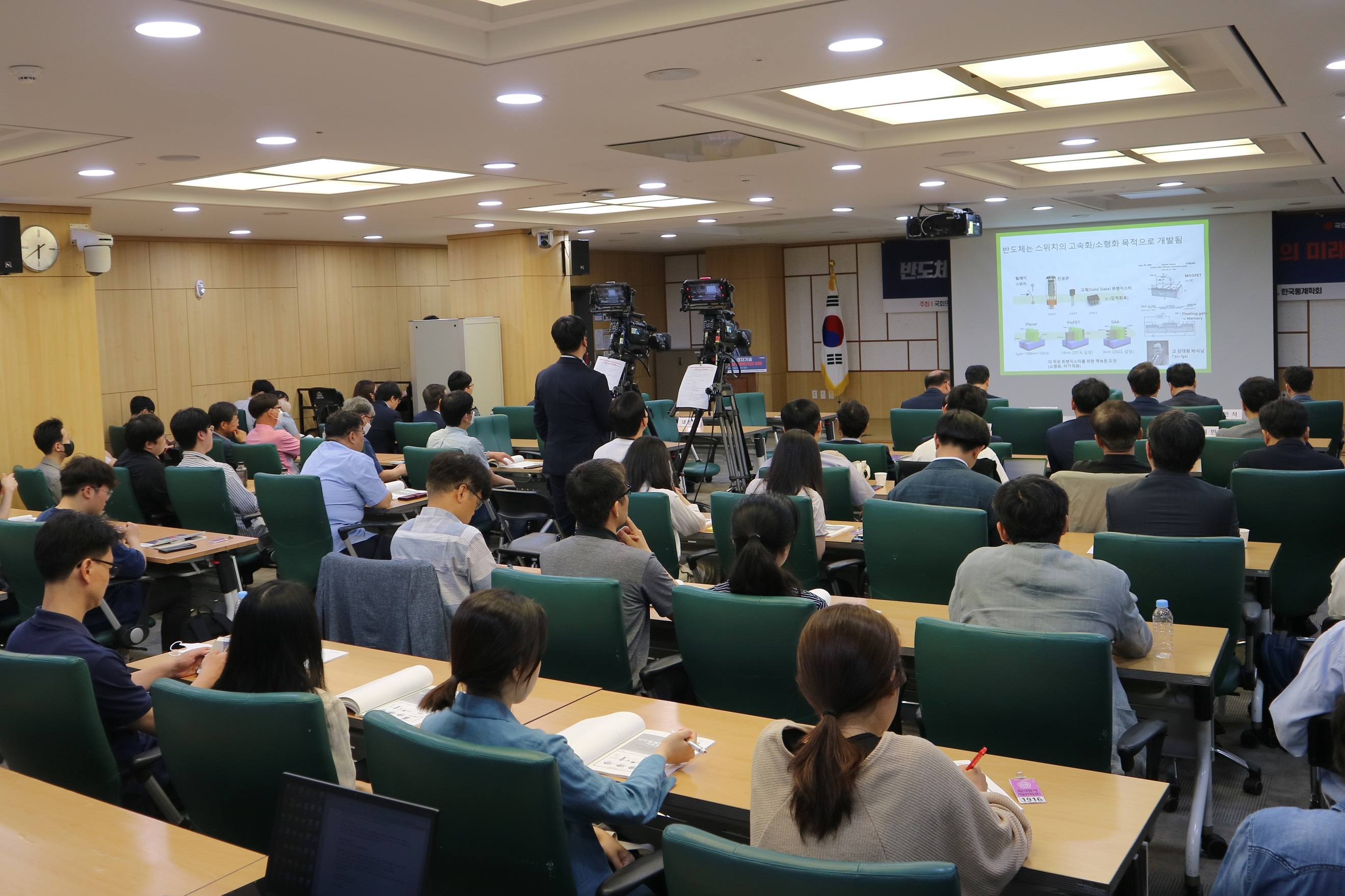
▲Discussion on 'The Era of Semiconductor and Quantum Technology Hegemony Competition and the Future of Korea'
“Semiconductors, a collection of materials and chemical engineering”… Increased need for new materials due to miniaturization limits
Global companies are competitive in securing technology in the quantum industry, “Noise issues must be resolved”
In an era of global competition for hegemony in cutting-edge industries, voices have been raised that Korea's basic science foundation must be strong in order to secure future industrial competitiveness.
On the 13th, a discussion was held at the National Assembly Members' Hall in Yeouido, Seoul, with the theme of 'The Era of Competition for Hegemony in Semiconductor and Quantum Technology and the Future of the Republic of Korea.'
This discussion, hosted by the Basic Science Academic Societies Council, which consists of six academic societies including the Korean Mathematical Society and the Korean Physical Society, was organized for experts from various fields to discuss the role of basic science and the direction of education for the development of semiconductors and quantum technology.
Hong Seok-ryun, chairman of the Basic Science Academic Society Council and president of the Korean Physical Society, said, “At this point in time when the world is fiercely competing as we enter the cutting-edge industry due to the Fourth Industrial Revolution, the future of the Republic of Korea lies in the development of basic science.” He added, “In order to maintain the semiconductor status and maximize the potential of the quantum industry, continued investment in basic and cutting-edge science is essential.”le="text-align: center;">
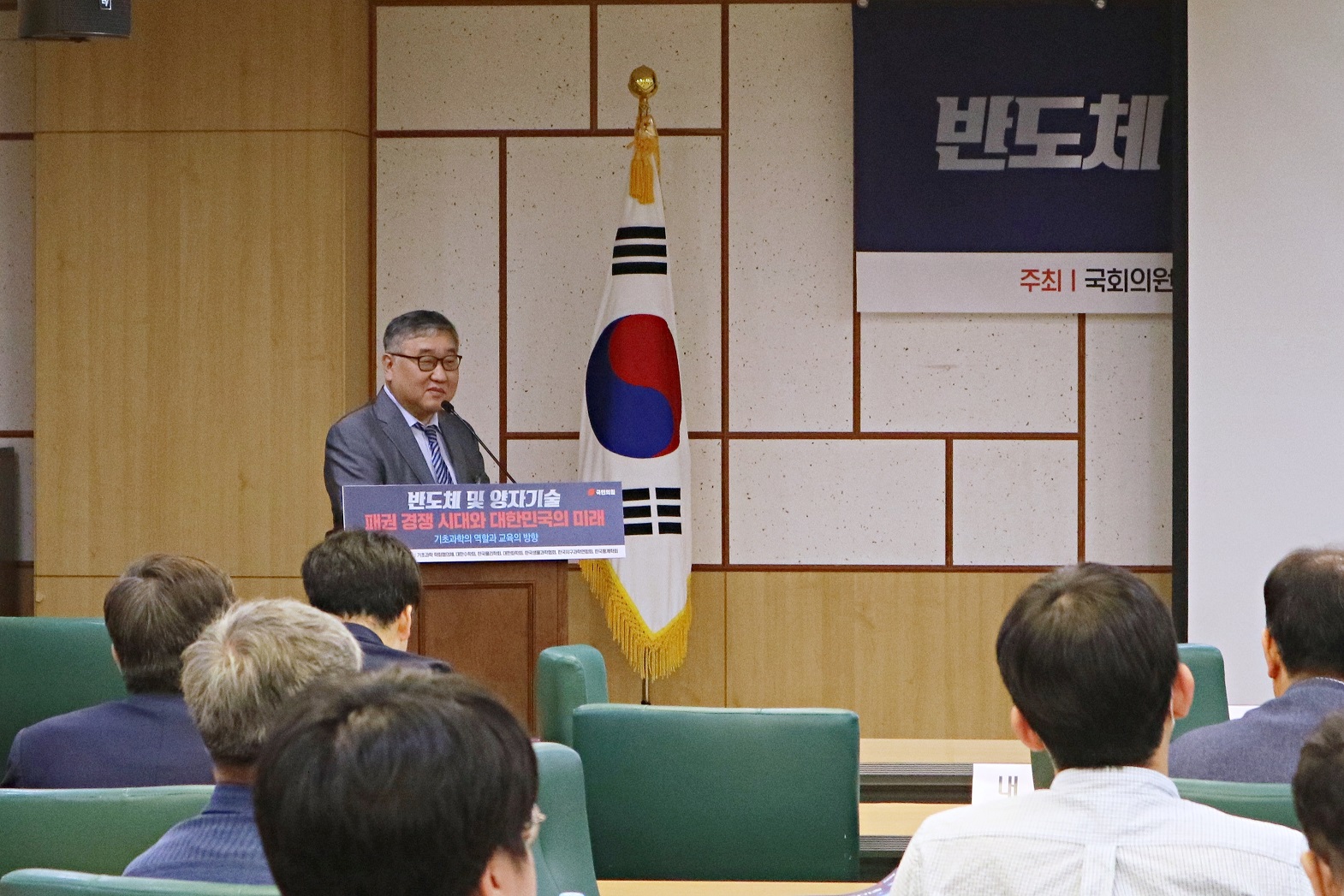
▲Song Jin-dong, Director of the Photovoltaic Materials Research Group, Next-Generation Semiconductor Research Institute, Korea Institute of Science and Technology
At the discussion that day, Song Jin-dong, head of the Optoelectronic Materials Research Group at the Next-Generation Semiconductor Research Institute of the Korea Institute of Science and Technology (KIST) , presented a session on the role of basic science in the era of competition for semiconductor hegemony. He mentioned diamond and neuromorphic materials, which are emerging as next-generation semiconductor materials along with the emergence of compound semiconductors such as silicon carbide and gallium oxide, and described semiconductors as “a lump of materials engineering and chemical engineering.”
He said, “Silicon substrates are a product of materials engineering, and as the applications required for semiconductors diversify, the market need for new materials increases,” and mentioned that silicon materials will reach their limits in extreme semiconductors.
The main issues surrounding semiconductors are the limits of miniaturization, and it is predicted that three types of innovations will need to be established from basic science: new models such as quantum computing and neuromorphic computing; new materials such as nanomaterials and spintronics; and new structures such as optical connections and three-dimensional connections.
CEO Song mentioned the development process of transistors and EUV, and said that when a technology first comes out, it tends to be unstable and underestimated, but he quoted Michael Faraday's answer to "What good is a newborn baby?" and pointed out that "discovering its usefulness takes time."
Professor Lim Hyeon-sik of Dongguk University's Department of Physics and Semiconductor Sciences delivered a presentation on quantum technology and industry trends and their importance through a quantum industry and basic science presentation. Recently, quantum technology has shown remarkable performance advancements, and investments in the field of quantum computers are increasing.
As qubit technology using superconducting elements is considered a leading technology in the quantum industry, leading companies such as IBM, D-Wave, Microsoft, and Intel are known to be preparing to dominate the market by competitively securing original technologies.
Professor Lim explained, “Advanced countries’ quantum technology development strategies are government-led R&D policies,” and “Korea also included the quantum industry in the 12 national strategic technologies announced last year and has embarked on a construction project aimed at developing a Korean-style quantum computer with hundreds of qubits by 2030.”
In the development of such quantum technologies, the key task is to “improve qubit performance so that we can reduce computational and communication errors caused by ‘noise,’” he added, adding that “the solution to the noise problem lies in the development of error correction algorithms that can correct qubit errors.” He also mentioned that quantum sensing also requires sophisticated calibration, and that low cost, small size, and power efficiency must all be addressed together.
The council stated that a balanced human resource development strategy in basic science and engineering is essential for the development of the quantum industry, including semiconductors, and requested that this be accompanied by support for related R&D, as well as industrial promotion policies and the operation of talent development programs.
Meanwhile, the Basic Science Academic Societies Council consists of a total of six participating societies: four single societies: the Korean Mathematical Society (President Park Jong-il), the Korean Physical Society (President Hong Seok-ryun), the Korean Chemical Society (President Shin Seok-min), and the Korean Statistical Society (President Kim Dong-wook), and two combined societies: the Korean Earth Science Association (President Shin Dong-hee) and the Korean Biological Sciences Association (President Jeong Gyu-yeong).
We are contributing to the strengthening of national competitiveness and joint development of academic societies through cooperation in policies to strengthen mathematics and science education and cooperation and mutual exchange in policies to promote basic science research.
Comments
Related news
"Materials and equipment capabilities are essential to overcome the limitations of semiconductors."
A severe shortage of semiconductor talent is intensifying not only domestically but also globally. As both government and private sectors are rolling up their sleeves to cultivate advanced semiconductor talent to secure competitiveness in cutting-edge industries, Samsung Electronics and SK Hynix are sharing technology agendas to break through the limitations of next-generation semiconductor development, while the importance of the role of materials and infrastructure supply chains has been emphasized.
2023.02.23by 명세환 기자
Materials Research Institute: "Securing Extreme Materials Technology Competitiveness"
The Korea Institute of Materials Science (KIMS, Director Lee Jung-hwan) held an industry-academia-research expert roundtable discussion and launched the promotion committee for the 'Extreme Materials Demonstration Research Infrastructure Development Project,' followed by a plaque unveiling ceremony.
2023.03.29by 배종인 기자
.jpg)
Korea Electronics Manufacturing Industry Exhibition, Advanced Manufacturing Small and Medium Business Managers All Out
Leading domestic materials, parts, and equipment (MPE) companies spanning the electronic manufacturing industry have gathered together. At the Korea Electronics Manufacturing Expo, various materials, components, and equipment manufacturers serving semiconductor, automotive, and PCB&SMT manufacturing processes showcased their advanced machinery and equipment in one venue.
2023.04.12by 명세환 기자
Korea Institute of Materials Science, Leading the Way to Becoming a Materials Powerhouse in Its 16th Anniversary
The Korea Institute of Materials Science (KIMS, Director Lee Jung-hwan), a government-funded research institute under the Ministry of Science and ICT, marked its 16th anniversary by emphasizing the importance of the extreme materials demonstration research infrastructure project and unveiling KIMS's aspirations toward realizing Korea as a materials powerhouse.
2023.04.25by 배종인 기자

Intel Unveils Next-Generation 'Core Ultra Series 3' and vPro Platform for Enterprise PCs
Intel has officially unveiled the "Intel Core Ultra Series 3" for next-generation enterprise PCs and the latest vPro platform, addressing a wide range of demands from enterprise notebooks to high-performance workstations.
2026.03.26by 배종인 기자











