


AI Talk ④ - Delta X CEO Kim Soo-hoon: "All services begin with 'perception'" - Part 2
 Published2023.11.14 10:46
In-cabin monitoring systems and sensor integration potential increase
Computer Vision: Better Services and Blind Spots in Sensing
"Edge-case failures are unacceptable in in-car computing."
[Editor's Note] There are two axes driving the development of artificial intelligence. Generative AI is undoubtedly the one currently receiving the most attention in the market. The small ball launched by Chat GPT has snowballed into a massive leap forward, leading to a fierce competition among big tech companies to develop and lead the development of ultra-large language models. The remaining axis is edge AI, or on-device AI. While edge AI hasn't received as much public attention as its predecessor, generative AI, its practical applications in industry and technology are rapidly expanding.
Accordingly, we explored computer vision, a cognitive solution that is the hottest area in edge AI and the starting point for all AI-based services. We met with DeltaX CEO Kim Su-hoon, who has expertise in computer vision and edge AI.
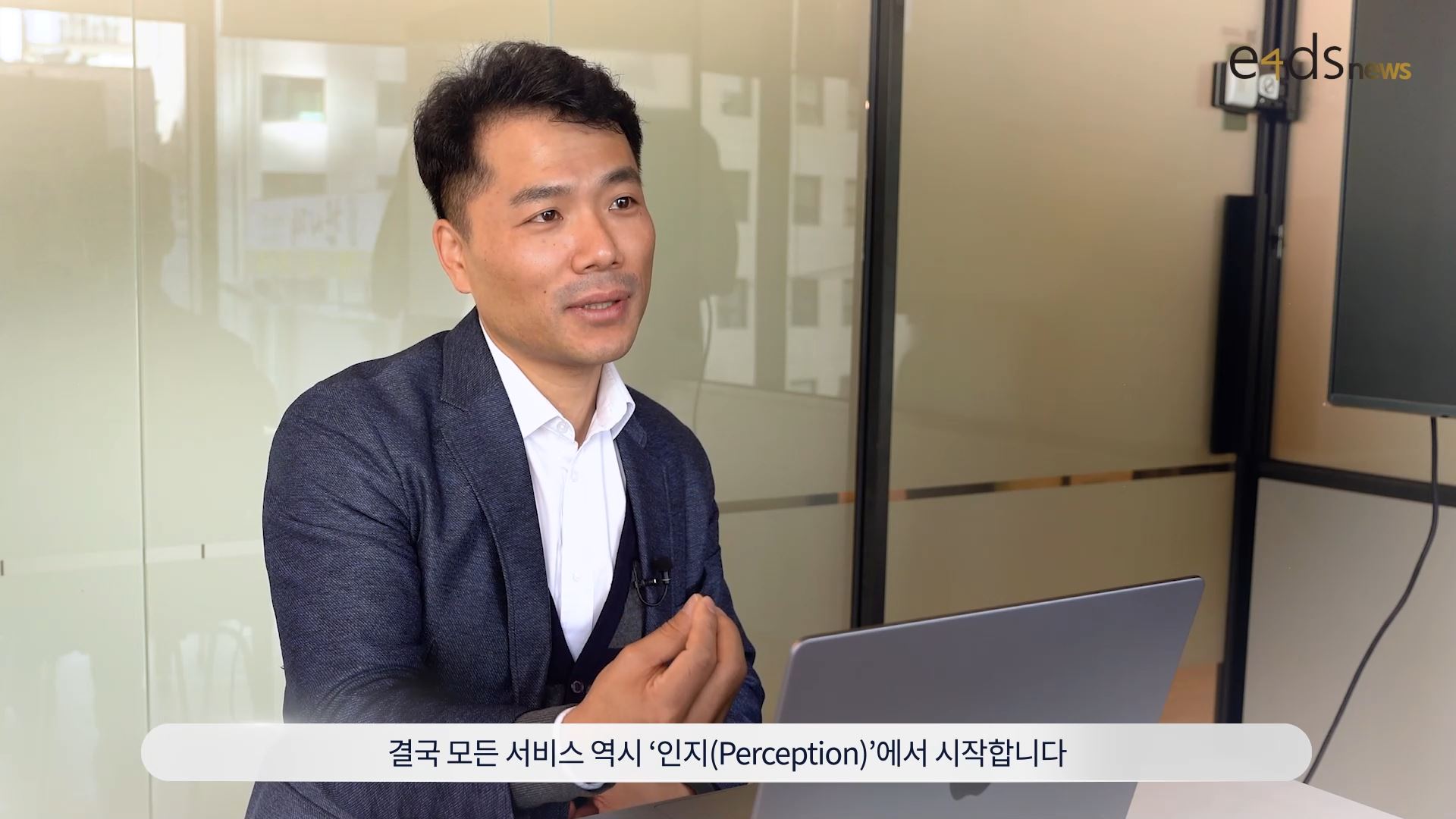
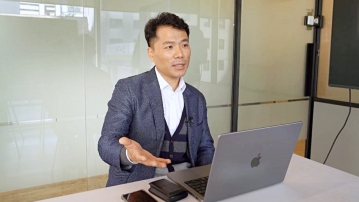
▲Delta X CEO Kim Soo-hoon during an interview.
■ Where is computer vision technology being applied in automobiles?
One of them is called the in-cabin monitoring system, which installs a camera inside the car to monitor the inside of the car and can even create a service model based on the monitored results.
Some features are also being implemented as necessary for safety. Originally, a camera was installed on the front of the car to analyze whether the driver was drowsy or inattentive. This solution was commonly called a DMS (Driver Monitoring System), and some high-end vehicles are equipped with it.
Beyond the driver's inattention, whether their eyes are open or closed, or where they are looking, it is possible to control the entire vehicle through gestures, by knowing where all the passengers are, whether they are wearing their seat belts or not, and what they need.
■ The future of services within smart cars when vision technology is utilized
Solutions that enable conversations, such as generative models and GPT, are emerging. But, the reporter or producer got into the car and suddenly started talking about something I had no interest in, or this is a woman thing.
If you say it's a conversation that people would be interested in or a conversation that children would be interested in, they might lose interest.
Ultimately, in order for me to meet like this and have a proper conversation, I have to start with knowing and understanding who I am and what I am interested in, so all services also start with 'perception'.
It is possible to create better services, and from another perspective, it is possible to create things that were impossible with past sensors.
For example, if there is a camera attached, it seems like there will be advertisements like this on the car.
My child was in the backseat, and he fell asleep. But Dad was playing loud music. The camera in the backseat recognized the child and recognized the person. Seeing his eyes closed and not opening them, it figured out, "Oh, he's sleeping." It then made a decision: "We should turn down the music."
I think this is probably how advertisements for smart cars will look like.
■ Can computer vision solutions replace broad sensor solutions?
The cameras installed in our in-cabin monitors understand the driver and all passengers as if they were human beings, based on the images coming through the cameras.
So, if there is a solution like this, it seems like it could replace the seat belt sensor, and if you look at level 2 or 3 these days, there are smart cruise functions like holding the steering wheel like this. If you take your hands off the handle, an alarm will sound shortly afterward, but the fact that it knows you have taken your hands off means that there is some kind of sensor installed.
If you open the window and get out, it tells you that the door is open, and if the door doesn't close, the sensor tells you that the door is open. In other words, there are a huge number of analog-digital sensors installed all over the interior, and through them, you can know the condition of the car and things like that.
Replacing so many sensors with a single camera opens up the potential for significant cost savings for automotive systems. Reliability aside, functionally, the ability to integrate so many sensors into a single image sensor offers tremendous potential. It's a highly attractive approach.
■ What are the considerations when developing vision technologies in the automotive field that DeltaX is focusing on?
Computer vision required for automobiles is actually developed using a code language system called Python, and these code systems are usually designed to run on operating systems such as Linux or Windows on computers.
However, the automotive environment is quite different. First, it's not feasible to install and configure high-performance computing devices like PCs or servers.
Because the automobile industry is extremely cost-sensitive, the first challenge is that artificial intelligence must run on a single, small chip.
Second, since the automotive application itself is a means of transportation for people to ride, if something like a sensor error occurs, the results can be very fatal. Usually, things work fine, but problems arise in very special cases. These are called edge cases or corner cases. The automobile market does not tolerate failures in these small edge cases.
So, in the typical industry, when things that are said to be “good enough” are transferred to automobiles, there are many cases where they fail to go beyond that and are either not applied or not released as products.
The automotive business faces a tremendous challenge: to make things more perfect and to create solutions that ensure no failures in any case.
The harsh operating environment means we have to streamline our modules and model algorithms into a very small, lightweight form factor. This requires careful optimization for lightweighting, as models that are extremely heavy, both in terms of size and processing, cannot run. This is an area that is even more challenging than development itself, requiring significant experience and expertise. This presents significant technical challenges.
How to overcome this is a much bigger concern for us than developing our own algorithms, and it's an area where we're investing a lot of manpower to build up experience and skills.
There are countless computer vision companies. However, if we look at the automotive industry, only a handful are capable of developing and optimizing algorithms for fast performance within the automotive environment, even down to lightweight design.
DeltaX currently boasts of being among those few.
■ Is the core competitiveness of cognitive technology in embedded environments the optimization and lightweighting of algorithms?
We get asked this question a lot these days. Since there are so many different companies working on artificial intelligence, people actually ask, “What makes DeltaX’s solution different?”
Perhaps the question is, have you seen similar solutions that are doing cognitive modeling, and what is the performance difference compared to them? If we want to objectively compare performance, we need to compare the difference between A and B while keeping the rest of the environment the same.
Within the automotive space, there is a clear difference in performance when running under the very harsh operating environments that manufacturers demand.
First of all, although they say they “develop artificial intelligence algorithms,” only a few companies have a good understanding of the environment in which cars should operate, and the reason they operate in such environments is because the code system is different.
For example, we develop new algorithms using a new code system called C++ instead of Python, and since this system is completely different, the capacity is also large, whereas in the past, models had large capacities, and the embedded environment has a very small memory size, so the capacity itself must be small and the operation version must be very small.
Developing a solution that satisfies all of these is a completely different story from developing the typical computer vision solutions we know or the typical solutions you've seen demoed.
■ Finally, a word to e4ds news readers
I'm still a developer and engineer, and I've been in the development field since graduating from school. I'm still a developer and engineer, constantly working on development, and I'm the CEO of this company.
DeltaX is also considering internal listing in 2025. That's also part of our timeline, and I think that for me, next year, completing research and development, the PoC we're currently working on, and the various investments related to it is one of the important agendas right now.
thank you

Comments
Related news
AI Talk ① - Kim Hyun-seok, CEO of AMC PLANET, “Fire Detection Solution, YOLO·GhostNet Based, Achieves 99% Recognition Rate”
[Editor's Note] As artificial intelligence (AI) technology continues to advance, commercialization trends are accelerating. While autonomous driving has received considerable attention and remains at the center of current trends, various services such as △facial recognition △object detection-based services and △AI chatbots are becoming increasingly sophisticated and gaining prominence in the market. In response, we met with Kim Hyun-seok, CEO of AI specialist AMC PLANET, to discuss fire detection solutions utilizing computer vision, as well as hear perspectives on related market prospects and AI development.
2023.01.27by 명세환 기자
AI Talk②-Kim Hyun-seok, CEO of AMC PLANET, “Object Tracking, ID Continuity Confirmation Required”
[Editor's Note] As artificial intelligence (AI) technology becomes increasingly sophisticated, commercialization trends are accelerating. While autonomous driving has garnered considerable attention and remains at the center of current trends, various services including △face recognition △object detection-based services and △AI chatbots are advancing and gaining market presence. Accordingly, we met with Kim Hyun-seok, CEO of AI specialist AMC PLANET, to discuss fire detection solutions utilizing computer vision, as well as to hear insights on the related market outlook and AI development perspectives.
2023.02.01by 명세환 기자
AI's Eye 'Computer Vision', Actively Introduced into the Market... Many Challenges to Solve
As artificial intelligence moves beyond the technology stage to be fully integrated into services and products, there is intense momentum around artificial intelligence in the global market. 'Computer Vision,' which can be called the eyes of artificial intelligence, is rapidly growing in markets worldwide.
2023.05.04by 명세환 기자
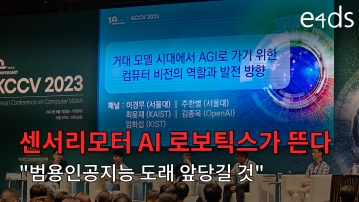
Computer Vision General AI, 'Sensor-Motor AI' is a Must
General artificial intelligence (AGI) has recently garnered attention not only in academic circles but also across the industrial sector, with discussions being conducted from various angles. Artificial intelligence that reasons, learns, and solves problems independently without human intervention can be considered the ultimate form of artificial intelligence.
2023.08.11by 명세환 기자
AI Talk ③ - Kim Soo-hoon, CEO of Delta X, “Computer vision and cognitive technology essential for transition to software cars”_Part 1
[Editor's Note] There are two axes driving the advancement of artificial intelligence. Currently, the spotlight in the market is undoubtedly on generative AI. The small ball launched by ChatGPT has become a snowball, and the development and leadership competition of large language models centered around big tech companies is fierce. The remaining axis is edge AI, or on-device AI. While edge AI receives relatively less public attention compared to the aforementioned generative AI, its practical applications in industry and technology are rapidly expanding.
2023.11.09by 명세환 기자











