This page was machine-translated and may differ from the original. View original
SDV to Drive Change in Automotive Tier Companies… Partnerships and Collaboration Essential

.jpg)
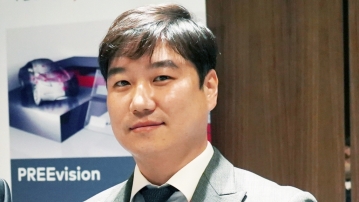
▲ Kim Eui-yeol, Head of Process Solutions Division at Vector Korea
Tier 1 is expected to supply platforms, while Tier 0.5 will likely play the role of Tier 1.5 by supplying software or partial hardware.
Possibility of 1.5 Tier raised by forming partnerships with OEMs without going through Tier 2 and Tier 1.
Tech companies like Amazon, Google, and Naver could operate like Tier 1 or Tier 2 companies
Experts suggest that the key success factors in the paradigm and architectural shift toward a software-centric vehicle driven by Software Defined Vehicles (SDVs) are partnerships and close collaboration that establish new roles.
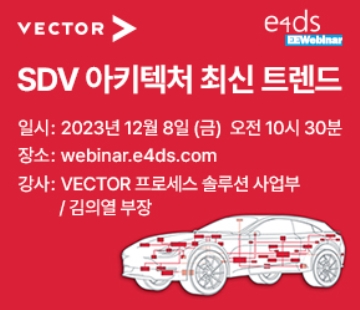
Kim Eui-yeol, Head of the Process Solutions Business Division at Vector Korea, gave a presentation on the topic of 'Latest Trends in SDV Architecture' at the e4ds webinar, explaining SDV-related concepts, features, and development trends.
This webinar is structured to explore the changing trends resulting from the automotive industry's shift toward a software-centric model, which has a significant impact on manufacturing, as well as the definition and characteristics of SDV.
"While the price of the existing smartphone business was subject to significant fluctuations based on factors such as camera resolution, the value of software and applications connected to various industries has become crucial," said Business Division Head Kim. "Following the SDV trend, business models in the automotive industry are also shifting towards software..." "It is changing to the center," he said.
He continued by emphasizing, “These changes in the automotive industry are expected to create business models that are larger and broader than those in the mobile phone market,” adding, “Companies that respond proactively will develop successfully, while those that fail to recognize this will struggle.”
The core of a Software Defined Vehicle (SDV) is providing value to customers through services; via OTA, it enables cloud-based updates even after vehicle delivery, allowing users to maintain the latest performance and download and use new features.
Current technologies, such as Android Auto or proprietary systems, limit Vehicle OS capabilities to the level of installing and updating applications, specifically infotainment apps (radio, navigation, etc.).
Ultimately, the industry will move beyond infotainment to improve vehicle performance and create new value by aligning with other industries; in the near future, it is projected that automobiles will not only connect with industries such as logistics, shopping, and leisure but will also be able to improve performance aspects like battery life and torque.
To implement this, it is necessary to increase the number of cores and provide multi-threading for parallel processing and virtual machines for software, as complex and precise functions must be processed quickly and accurately.
Ultimately, high-performance computing (HPC) that makes these things possible is essential.
It is necessary to solve technically complex challenges, such as a centralized architecture based on high-performance computers, the configuration of an Ethernet communication backbone for fast data transmission, and enhanced external information reception and interfaces through strengthened connectivity with the cloud.
The long lead times of the safety-conscious automotive industry It is necessary to transition to a development environment that allows for shortened processing and continuous updates.
A change in architecture is essential for this technological paradigm shift, which means that changes to the development organization, processes, and development toolchain are required.
While existing vehicle controllers have configured their architectures based on functions, in the future, many functions will be integrated, and networks will be configured based on HPCs.
Functions that perform complex and fast calculations are handled by computers, while simple sensing and actuation are handled by conventional controllers.
These changes mean that existing controllers become slightly simpler, while the size and complexity of the functions implemented in HPC increase.
The roles of OEMs and suppliers are completely changing in the trend of architectural change.
Kim Eui-yeol, Head of the Process Solutions Business Division at Vector Korea, gave a presentation on the topic of 'Latest Trends in SDV Architecture' at the e4ds webinar, explaining SDV-related concepts, features, and development trends.
This webinar is structured to explore the changing trends resulting from the automotive industry's shift toward a software-centric model, which has a significant impact on manufacturing, as well as the definition and characteristics of SDV.
"While the price of the existing smartphone business was subject to significant fluctuations based on factors such as camera resolution, the value of software and applications connected to various industries has become crucial," said Business Division Head Kim. "Following the SDV trend, business models in the automotive industry are also shifting towards software..." "It is changing to the center," he said.
He continued by emphasizing, “These changes in the automotive industry are expected to create business models that are larger and broader than those in the mobile phone market,” adding, “Companies that respond proactively will develop successfully, while those that fail to recognize this will struggle.”
The core of a Software Defined Vehicle (SDV) is providing value to customers through services; via OTA, it enables cloud-based updates even after vehicle delivery, allowing users to maintain the latest performance and download and use new features.
Current technologies, such as Android Auto or proprietary systems, limit Vehicle OS capabilities to the level of installing and updating applications, specifically infotainment apps (radio, navigation, etc.).
Ultimately, the industry will move beyond infotainment to improve vehicle performance and create new value by aligning with other industries; in the near future, it is projected that automobiles will not only connect with industries such as logistics, shopping, and leisure but will also be able to improve performance aspects like battery life and torque.
To implement this, it is necessary to increase the number of cores and provide multi-threading for parallel processing and virtual machines for software, as complex and precise functions must be processed quickly and accurately.
Ultimately, high-performance computing (HPC) that makes these things possible is essential.
It is necessary to solve technically complex challenges, such as a centralized architecture based on high-performance computers, the configuration of an Ethernet communication backbone for fast data transmission, and enhanced external information reception and interfaces through strengthened connectivity with the cloud.
The long lead times of the safety-conscious automotive industry It is necessary to transition to a development environment that allows for shortened processing and continuous updates.
A change in architecture is essential for this technological paradigm shift, which means that changes to the development organization, processes, and development toolchain are required.
While existing vehicle controllers have configured their architectures based on functions, in the future, many functions will be integrated, and networks will be configured based on HPCs.
Functions that perform complex and fast calculations are handled by computers, while simple sensing and actuation are handled by conventional controllers.
These changes mean that existing controllers become slightly simpler, while the size and complexity of the functions implemented in HPC increase.
The roles of OEMs and suppliers are completely changing in the trend of architectural change.

▲ From the e4ds Webinar on Latest Trends in SDV Architecture
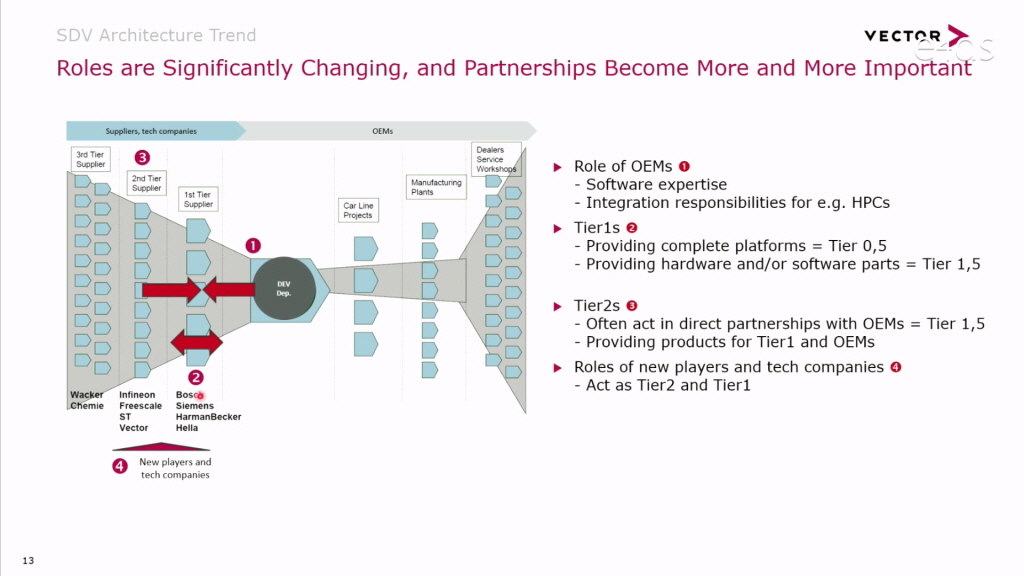
OEMs will act as software experts and play a role in HPC integration, while existing Tier 1s are expected to play the role of Tier 0.5, supplying complete platforms, or Tier 1.5, supplying parts of software or hardware.
Existing Tier 2 suppliers can become Tier 1.5 suppliers by forming partnerships directly with OEMs without going through Tier 1, and new players such as tech companies like Amazon and Google are becoming Tier 1 suppliers.I expect to be active like Na 2.
Business Unit Manager Kim emphasized that partnerships where members learn from each other and establish new roles amidst these shifts are a key success factor for the SDV trend.
Business Unit Manager Kim Eui-yeol explained how OEMs will change, mentioning the "Illusion Phase." He stated, "The Illusion Phase refers to the 'illusion' that OEMs can develop all software and OS in-house and do not need Tier 1 suppliers, and the period when this illusion is shattered is called the Phase of Disillusionment." He added, "Developing everything in-house and understanding all source code is nearly impossible, and the Volkswagen case supports this." He also shared the story of how Volkswagen founded the software group CARIAD and attempted to develop everything in-house, only to face failure and restructuring.
Overseas OEMs and suppliers have been preparing for SDV for a long time and have reached the stage of discussing technical details, but Korea remains at the stage of defining the direction of SDV and developing concepts, and in terms of technology, Korea is at least 2 to 3 years behind.
Business Division Manager Kim Eui-yeol once again emphasized the need for close collaboration among domestic companies to narrow the gap with global firms.
During the Q&A session following the presentation, in response to a question regarding "what impact SDV will have on uncomplicated actuators or sensors and what preparations need to be made," Business Unit Manager Kim Eui-yeol gave a candid answer, stating that suppliers and Tier 2 vendors currently supplying these components would face difficulties in the future.
He said, “I am well aware that many companies are struggling,” adding, “Since the prevailing outlook is that they will face difficulties, they must change their business models. "It appears that..." he replied.
※ Company information
We would like to thank everyone for watching 'Latest Trends in SDV Architecture' with Vector Korea on December 8th.
I would like to answer all the questions from our readers and viewers, but please understand that I was unable to provide all answers due to time constraints.
We have compiled the security-related questions and other inquiries left by many people in the comments and forwarded them to Vector Korea.
Even if it takes a little time, we will do our best to resolve your questions through articles.
Thank you once again to everyone who showed interest in the e4ds webinar.
Existing Tier 2 suppliers can become Tier 1.5 suppliers by forming partnerships directly with OEMs without going through Tier 1, and new players such as tech companies like Amazon and Google are becoming Tier 1 suppliers.I expect to be active like Na 2.
Business Unit Manager Kim emphasized that partnerships where members learn from each other and establish new roles amidst these shifts are a key success factor for the SDV trend.
Business Unit Manager Kim Eui-yeol explained how OEMs will change, mentioning the "Illusion Phase." He stated, "The Illusion Phase refers to the 'illusion' that OEMs can develop all software and OS in-house and do not need Tier 1 suppliers, and the period when this illusion is shattered is called the Phase of Disillusionment." He added, "Developing everything in-house and understanding all source code is nearly impossible, and the Volkswagen case supports this." He also shared the story of how Volkswagen founded the software group CARIAD and attempted to develop everything in-house, only to face failure and restructuring.
Overseas OEMs and suppliers have been preparing for SDV for a long time and have reached the stage of discussing technical details, but Korea remains at the stage of defining the direction of SDV and developing concepts, and in terms of technology, Korea is at least 2 to 3 years behind.
Business Division Manager Kim Eui-yeol once again emphasized the need for close collaboration among domestic companies to narrow the gap with global firms.
During the Q&A session following the presentation, in response to a question regarding "what impact SDV will have on uncomplicated actuators or sensors and what preparations need to be made," Business Unit Manager Kim Eui-yeol gave a candid answer, stating that suppliers and Tier 2 vendors currently supplying these components would face difficulties in the future.
He said, “I am well aware that many companies are struggling,” adding, “Since the prevailing outlook is that they will face difficulties, they must change their business models. "It appears that..." he replied.
※ Company information
We would like to thank everyone for watching 'Latest Trends in SDV Architecture' with Vector Korea on December 8th.
I would like to answer all the questions from our readers and viewers, but please understand that I was unable to provide all answers due to time constraints.
We have compiled the security-related questions and other inquiries left by many people in the comments and forwarded them to Vector Korea.
Even if it takes a little time, we will do our best to resolve your questions through articles.
Thank you once again to everyone who showed interest in the e4ds webinar.
본 기사에 대한 정정·반론·추후보도 청구는 보도 청구 안내를, 그간 게재된 보도문은 정정·반론보도 모아보기를 참고해 주세요.