



SK Hynix swings to operating profit in Q4... Memory Riding the AI Wave
 Published2024.01.25 10:03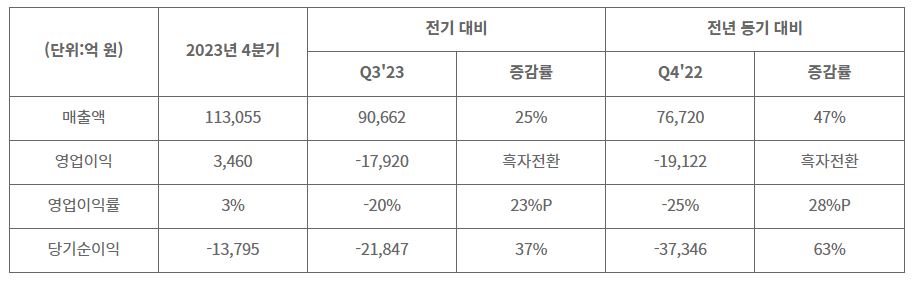
▲SK하이닉스 4Q23 경영실적(자료:SK하이닉스)
4Q23 매출 11조원...영업이익 3,460억원 흑자전환
HBM·DDR5 등 고부가가치 메모리 생산 확대기조
PC·모바일·서버 수요↑ 전망...시장 주도하는 ‘AI’
실적 반등을 노리는 SK하이닉스가 4분기 실적을 발표했다. AI향 메모리를 중심으로 고부가가치 증산, 저수익 레거시 메모리 감산 기조에 힘입어 적자폭이 줄고 이익이 개선되는 실적 흐름을 보였다.
■ 지난해 총매출 32조8,000억원...메모리 실적 회복 中
SK하이닉스가 25일 컨퍼런스콜에서 2023년 4분기 실적을 발표했다.
지난해 4분기 SK하이닉스는 △매출 11조 3,060억원 △영업이익 3,460억원 △당기순이익 –1조3,790억원 등을 기록했다.
SK하이닉스는 메모리 가격 상승에 힙입은 수익성 개선과 재고평가손실충당금 환입이 일부 발생해 영업이익에서 흑자전환을 이뤘다고 밝혔다. 낸드플래시 ASP 상승에 따라 손실충당금 환입이 4,000~5,000억원 가량이 발생한 것으로 전해진다.
HBM3, DDR5 등 고용량·고성능 AI향 메모리 제품 판매를 대폭 확대한 성과가 있었음에도 전체적인 D램과 낸드플래시 재고 적체로 인해 연결기준 2023년 총매출액은 전년대비 11조9,000억원 감소한 32조8,000억원을 기록했다. 영업이익은 전년 대비 7조7,000억원 가량이 감소했다.
■ AI향 메모리 증산·일반 D램 및 낸드 감산 기조
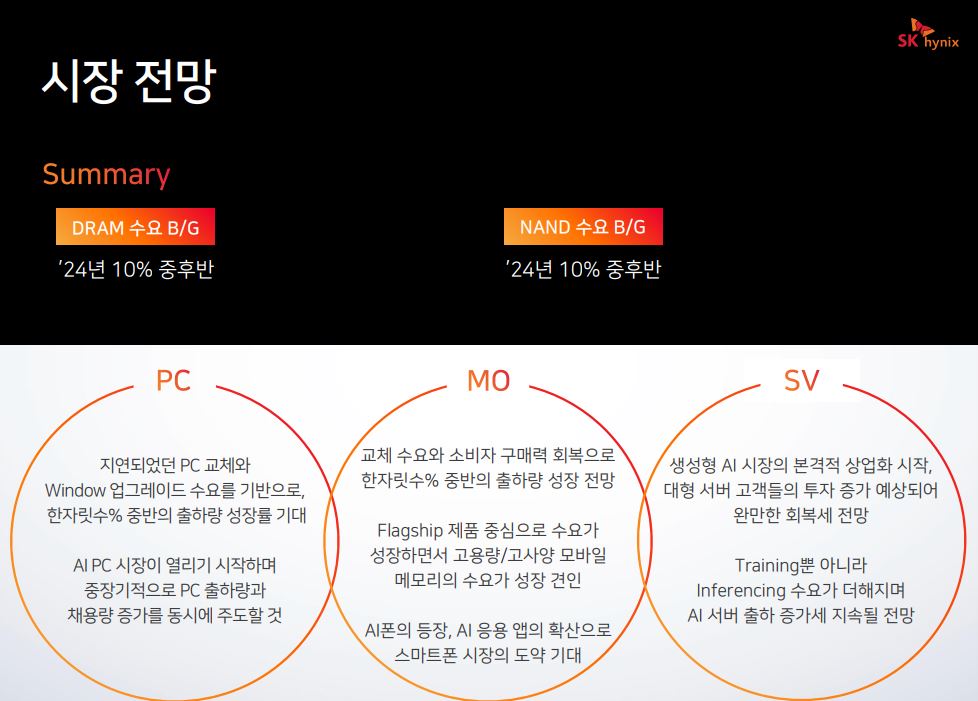
▲SK하이닉스 시장전망
SK하이닉스는 낸드플래시는 다른 사업 부문 대비해 시장 수요에 여건이 어려웠다고 밝히며 보수적인 생산 기조를 유지하며 투자 및 비용 효율화에 집중했다고 밝혔다.
반면 D램에서 고용량 DDR5와 고성능 HBM3 프리미엄 제품 포트폴리오를 강화하며 급격히 성장하는 AI향 고객 수요에 대응하는 방향으로 성장기조를 잡았다. DDR5 매출은 전년 대비 4배 이상 상승했으며 HBM3 매출 또한 전년 대비 5배 이상 증가했다고 전했다.
SK하이닉스는 2024년 전망으로 △지연된 PC 교체 수요 회복 및 AI PC 시장 개화로 한자릿수 퍼센트 중반의 출하량 성장 △모바일에서 교체 수요 및 소비자 구매력 회복, 고가 제품 중심 수요 성장 및 AI폰 등장으로 한자릿수 퍼센트 중반의 출하량 성장 △서버에서 생성형 AI 본격 상업화 및 AI 추론 서버 증가 등 대형 CSP의 투자 증가 전망에 완만한 회복세 등을 예상했다.
출하량 계획에서 D램은 올해 1분기 10% 중반의 지난 분기 대비 감소를, 낸드에서 1분기 한자릿수 퍼센트 중반의 증가를 계획한다고 밝혔다.
설비투자는 지난해와 비교해 증가할 것으로 보이나 수익성 기반 투자 집행 및 투자효율성 강화를 통해 증가분을 최소화해 집행할 것으로 전해졌다.
향후 SK하이닉스는 중장기 연평균 60%의 수요 성장이 이뤄지고 있는 HBM 공급에 집중할 것으로 보인다. HBM3E 및 HBM4의 공급과 개발에 집중하는 한편, 고용량 DDR5에서 최근 수요가 증가하는 256GB 제공과 LPDDR5T 16~24GB 솔루션 확대 등으로 시장 대응에 나설 것으로 보인다.
지난해 말 공개한 고성능 서버 모듈 MCR DIMM 및 온디바이스 AI 시장을 대응하는 모바일 모듈 LPCAMM2를 준비하고 있다고 밝혀 최근 출시를 표명한 마이크론과의 경쟁이 예고되고 있다.
SK하이닉스는 컨퍼런스콜에서 “올해 하반기까지 메모리 업황 회복이 예상되지만 보수적인 투자기조를 계획하고 있다”며 “HBM3 및 DDR5 등 프리미엄 제품군을 중심으로 생산을 확대하고 레거시 제품에서는 감산 기조를 유지해 레거시 제품의 재고가 연말 낮아질 것”이라고 밝혔다.
■ "HBM은 공급 과잉 없다, 온디바이스 AI 킬러앱이 신호탄"
최근 고객 구매 수요는 레거시 제품 중심으로 살아나고 있다고 전해졌지만 SK하이닉스는 “올해는 공급 증가가 선단공정쪽으로 갈 것이기에 고객 입장에선 중저가형 제품 판매 위한 레거시 메모리 재고 축적이 필요할 것으로 판단된다”고 답변했다.
이에 저수익 레거시 제품군에서 ASP가 적정수준에 이를 때까지 감산기조는 지속될 것으로 예상된다고 덧붙였다. 특히 낸드 플래시는 3D 적층단이 높아짐에 따라 자본집약도가 높아져 과거 대비 효율적인 생산량 조정이 관건이 될 것으로 보인다.
SK하이닉스가 HBM 등 고부가가치 제품에 집중할수록 일반 D램 및 레거시 제품 생산은 줄어들 수밖에 없다. 이는 HBM이 동일생산을 가정할 때 케파를 2배 이상 차지하기에 일반 D램 생산이 가능한 케파가 줄어들기 때문이다.
특히 HBM은 사전 수주형으로 최소 1년 전부터 고객사와 협업해 공급단가 및 케파를 지정하기에 과잉 공급 우려가 없으며 적층에서부터 첨단패키징, GPU 결합에 필요한 후공정 등 리드타임 또한 굉장히 길다. 예약된 케파에서 유연성을 발휘할 여지가 적어 올해 일반 D램 및 레거시 제품의 공급 축소는 필연적인 수순이다.
2024년은 AI 주도권 확보 위한 빅테크 업체 경쟁 본격화됨에 따라 클라우드 서비스 제공사에서 자체 AI 서버 채용을 확대하면서 HBM 수요 또한 다변화될 것 전망이다. 더불어 “온디바이스 AI 시장은 2025년부터 본격적인 확대가 점쳐지며 킬러 애플리케이션의 등장 여부가 시장 확대의 신호탄이 될 것”으로 예상했다.
Comments
Related news
HBM4 to be launched in 2026… “HBM on GPU”
HBM (High Bandwidth Memory), which has emerged to revolutionize processing speed, is a high-bandwidth memory that vertically connects multiple DRAM chips using TSV (Through Silicon Via) technology. The HBM market is dominated by Samsung Electronics and SK Hynix, with Micron following behind. According to TrendForce, last year's global HBM market share was SK Hynix at 50%, Samsung Electronics at 40%, and Micron at 10%. HBM4, which will be released in 2026 to meet demand from cloud service providers (CSPs) such as NVIDIA, Amazon, Google, and Microsoft, will introduce methods different from current semiconductors.
2023.11.30by 김예지 기자
SK Hynix Establishes 'AI Infra' Organization, Promotes Kim Joo-sun to President
SK Hynix has undergone organizational restructuring to establish itself as a core AI infrastructure company, including creating a new 'AI Infra' organization and promoting President Kim Joo-seon to the position.
2023.12.07by 배종인 기자
.jpg)
S&P Upgrades SK Hynix Rating Outlook... Strong AI Semiconductor Performance Key to Success
Positive evaluations of SK Hynix are expanding as AI semiconductor demand grows. Optimistic outlook has emerged, with expectations for improved operating performance and expanded investment capacity.
2023.12.15by 명세환 기자
SK Hynix to Unveil AI Memory at CES 2024... "Performance Rebound Begins in Full Swing"
As AI services ramp up in earnest, driving increased demand for high-bandwidth memory, SK Hynix will showcase its latest AI-oriented memory solutions at CES.
2024.01.03by 명세환 기자
Kwak No-jeong, CEO of SK Hynix, “The driving force behind AI development is memory semiconductors”
Artificial intelligence keywords are dominating CES this year. As the AI era enters full bloom, global corporations and big tech companies are promoting their products with AI-focused messaging. SK Hynix is also solidifying its position as a "total AI memory supplier" by showcasing memory semiconductors—the driving force behind AI advancement—at CES 2024, the world's largest consumer electronics and appliances exhibition.
2024.01.09by 권신혁 기자











