



Intel Unveils Edge Platform, Simplifying On-Device AI Development
 Published2024.02.27 16:55
Intel Announces New Edge Platform to Expand AI Applications (Photo: Intel)
New open software platform released
Competition among companies to expand AI to edge devices that interact with consumers and users is intensifying. Amidst this, Intel has unveiled a new open software platform that facilitates the development, deployment, and execution of edge AI solutions for developers, operators, and enterprises.
Intel announced its new 'Edge Platform' at MWC24 on the 27th, a modular, open software platform that helps enterprise customers develop, deploy, run, secure, and manage edge and AI applications at scale with cloud-like ease.
In this announcement, Intel emphasized its commitment to monetizing its investments in 5G, edge, and enterprise infrastructure. Intel emphasized its success at the edge, having spent over a decade transforming current network infrastructure into a software-defined platform and driven by over 90,000 real-world deployments.
Because the edge is where data is generated, the amount of computing at the edge is growing rapidly. Many edge computing deployments are incorporating AI, and enterprises are seeing a need to automate the edge for a variety of reasons, including securing price competitiveness, alleviating labor shortages, expanding innovation, increasing efficiency, improving time-to-market, and delivering new services.
Some of the challenges facing edge operations include: 1) Difficulty in building high-performance edge AI solutions with high return on investment (ROI) across diverse use cases in specific industries; 2) Diversity in hardware, software, and power requirements at the edge; 3) Lack of secure and cost-effective ways to move and utilize the large amounts of data required for AI at the edge while maintaining low latency; and 4) Operational management of increasingly complex, massively distributed edge devices and applications.
△Short latency, on-site availability, and cost-effectiveness are essential to meet the stringent requirements of diverse use cases, including industrial facility defect detection and preventive maintenance, seamless checkout and inventory management in retail stores, and smart city, transportation, and traffic management and emergency safety management.
This requires advanced networking and AI analytics at the edge, typically blending on-premises analytics with some AI processing in the cloud to manage global deployment locations. These hybrid AI scenarios require software platforms built to handle them.
“The edge is the next frontier for digital transformation, which is further accelerated by AI,” said Pallavi Mahajan, Intel vice president and general manager of software for the Network and Edge Group. “Intel has spent years integrating software initiatives and building a customer base in the market to deliver the next phase of a complete edge-native platform required to enable the infrastructure, applications and efficient AI deployments at scale.”
He also said, “Intel’s modular platform helps enterprises implement optimal edge infrastructure performance and simplify application management, thereby improving corporate competitiveness and TCO.”
Intel's Edge Platform customers include AWS, Lenovo, L&T Technology Services, Red Hat, SAP, Vericast, Verizon Business, and Wipro, and will be launched to market with the support of industry leaders and a broad ecosystem.
The platform reportedly offers infrastructure management and AI application development capabilities that can be integrated into existing software stacks through open standards.

Comments
Related news

Intel Announces 'AI Everywhere' Strategy for SDV SoCs
Intel announced on the 10th (local time) at CES that it plans to lead an AI Everywhere strategy for the automotive market, including the acquisition of Silicon Mobility, a fabless silicon and software company specializing in SoCs for intelligent EV power management. Along with this, Intel announced a new product line of AI-based software-defined vehicle SoCs (System-on-Chip), and stated that Zeekr will be the first OEM to adopt the new products to provide next-generation vehicles with generative AI-based in-cabin experiences.
2024.01.10by 권신혁 기자

Intel Opens Semiconductor Manufacturing Facility 'Fab 9' in New Mexico, USA
Intel opened its state-of-the-art semiconductor manufacturing facility "Fab 9," which enables mass production of cutting-edge 3D packaging technology.
2024.01.25by 배종인 기자
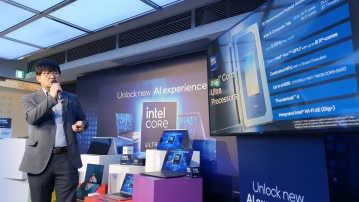
Intel: "AI-accelerated PC supply will be a priority, with 100 million units to be delivered by next year."
Intel stated that AI represents a new opportunity for the PC industry, and that devices must be supplied in large quantities as a priority for AI advancement. The company announced that it will make every effort to ensure sufficient product supply to deliver approximately 100 million devices by next year.
2024.02.19by 배종인 기자
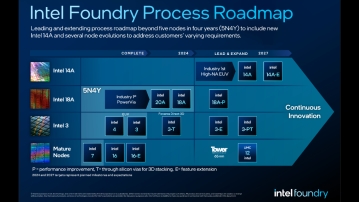
Intel Launches Systems Foundry...1nm Shipments in 2025
The advanced semiconductor foundry market is prepared to expand from a two-way competition into a three-way battle. Intel has launched a full-fledged systems foundry business, revealing ambitions to establish ecosystem leadership by leveraging advanced process nodes and cutting-edge packaging technologies.
2024.02.22by 권신혁 기자
.jpg)
Intel and OSC Double AI Processing with HPC Clusters
AI and machine learning are being actively utilized to solve complex research problems in the fields of science, engineering, and biomedical studies. As the effectiveness of these technologies continues to be demonstrated, their application is expanding into academic disciplines such as agricultural science, architecture, and sociology.
2024.02.23by 명세환 기자











