



Arm: "Shortening Vehicle Development Cycles by Up to Two Years"
 Published2024.03.14 17:35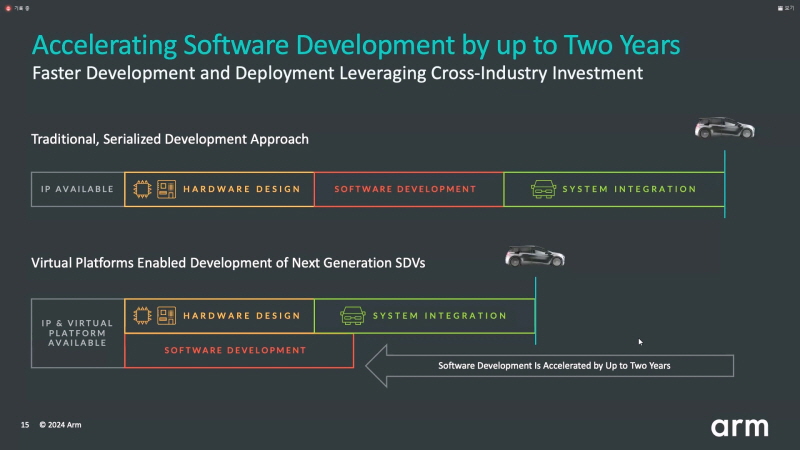
Virtual prototyping on Arm AE IP enables development to begin before physical silicon is available.
Arm's next-generation AE processor brings Armv9 and server-class performance to the automotive sector.
Arm held an online press conference on the 14th and announced new solutions that will help the automotive partner ecosystem accelerate development.
This announcement marks a significant step forward in activating the automotive ecosystem, opening new opportunities for developers, and accelerating time to market for leading OEMs, tier 1s, silicon partners, and software providers building the future of software-defined vehicles on Arm, Arm said.
Arm enables the ecosystem to leverage Arm AE IP for software development ahead of silicon through virtual prototyping.
Kim Tae-yong, Principal FAE of Arm Korea, who took the helm as a presenter, said, “A sequential development methodology, such as building hardware and then developing software on silicon after the solution is released, cannot meet the needs of today’s automotive industry.” He added, “Platforms for hardware and software implementation must be released simultaneously, and only then can we achieve t for vehicle manufacturers.”He emphasized that “it can contribute to achieving time-to-market goals.”
Today, Arm is changing this with a new approach that enables software developers to begin development before physical silicon is available by performing virtual prototyping on the latest, industry-leading Arm AE IP.
Director Kim announced that Arm will introduce its proposal for automotive virtual prototyping based on the next-generation AI product line that it is launching this time, together with industry-leading cloud and virtual platform companies, by applying digital twin technology (virtual prototyping) that was previously applied to factory automation to the automotive sector.
This will likely allow developers to begin developing software even before silicon samples are released.
Arm is partnering with industry leaders including Amazon Web Services (AWS), Cadence, Corellium, and Siemens to deliver these virtual platforms and cloud solutions, enabling faster and more seamless development across full-stack software.
We have also collaborated with Autoware Foundation, Blackberry QNX, Elektrobit, Kernkonzept, LeddarTech, Mapbox, Sensory, Tata Technologies, TIER IV, and Vector to realize Foundational Automotive Software for Automotive.
Director Kim Tae-yong said, “This pre-prepared foundational software is also necessary for the development of automotive applications to be performed on top of it.“The benefits of virtual prototyping can be fully utilized,” he said. “These solutions will have a significant impact on the developer experience and will allow time-to-market to be reduced by up to two years.”
Arm is bringing Armv9-based technologies to the automotive space for the first time, enabling the industry to leverage the AI, security, and virtualization capabilities of the latest Arm architecture.
To meet the increasing performance requirements of today's vehicles, Arm is bringing its server-grade Neoverse technology to vehicles, along with new Armv9-based Cortex-A products for scalability.
Products Arm announced today include: the Arm Cortex-A720AE, delivering industry-leading sustained performance with SoC design flexibility for a wide range of SDV applications; the Arm Cortex-A520AE, delivering leading power efficiency with scalable functional safety features across automotive use cases; the Arm Cortex-R82AE, the highest-performance real-time processor ever for functional safety, bringing 64-bit compute to real-time processing for the first time; and the Arm Mali-C720AE, a configurable ISP optimized for the most demanding computer and human vision use cases.
Arm said that the Automotive Arm CSS will provide pre-integrated and validated configurations of Arm AE IP optimized for performance, power, and area using state-of-the-art foundry processes, and that Arm's first Automotive CSS is expected to be released in 2025.
Meanwhile, Hwang Sun-wook, President of Arm Korea, said in his welcoming speech, “The automotive market is experiencing unprecedented changes such as electrification and autonomous driving, and these changes are becoming a catalyst for the development of SDV and AI.” He added, “AI functions for vehicles are functional safety and real-time operation.” “It is further increasing the complexity of implementation as it must be taken into consideration,” he said.
He continued, “Automotive systems will become more complex and the need for safety will expand, and there will be a need for standardization to integrate all of these compute components into one for our partners, maintaining consistency at the core.” “Arm CSS for Automotive will use the most advanced foundry processes to deliver pre-integrated and validated configurations of Arm AE IP, optimized for performance, power, and area.”
Comments
Related news
Nordic to Unlimited Arm Licenses
Nordic Semiconductor has entered into a multi-year Arm Total Access (ATA) license agreement with Arm, enabling unrestricted access to Arm's cutting-edge processor and security technologies. This is expected to further strengthen Nordic's next-generation wireless product roadmap, including multi-protocol SoCs, Wi-Fi, cellular IoT, and DECT NR+ solutions.
2024.02.15by 배종인 기자
.jpg)
Samsung Electronics Optimizes Arm Design Assets for GAA Process
Samsung Electronics' Foundry Division is optimizing Arm's next-generation SoC design assets for its cutting-edge GAA (Gate-All-Around) process to strengthen cooperation between the two companies.
2024.02.21by 배종인 기자
.jpg)
IAR Releases Latest Functional Safety Version of IAR Embedded Workbench for Arm
IAR, a globally recognized software and services supplier for embedded development, has announced version 9.50.3 Functional Safety Edition of IAR Embedded Workbench for Arm.
2024.02.21by 배종인 기자

Arm Expands Neoverse Roadmap... Supporting Technology and Ecosystems in AI Transition
From small sensors to the largest data centers, organizations worldwide are adopting artificial intelligence (AI), with AI being realized across diverse sectors including △education △employment △manufacturing △healthcare △transportation based on Arm architecture.
2024.02.22by 권신혁 기자

Arm Design Ecosystem Expands...Samsung and Aegic Land Join
Generative AI has emerged like a comet. Subsequently, to process the vast volume of data generated from billions of devices and to drive more optimized solutions, demands for higher computing performance and flexibility have emerged. In response, Arm has launched Arm Total Design, a leading group comprising industry leaders collaborating in accelerating and simplifying system development based on Neoverse CSS, and is expanding its ecosystem.
2024.03.07by 권신혁 기자











