


Intel's World's Largest Neuromorphic System Equipped with Owl Brain-Level Neuron Capacity
 Published2024.04.18 12:34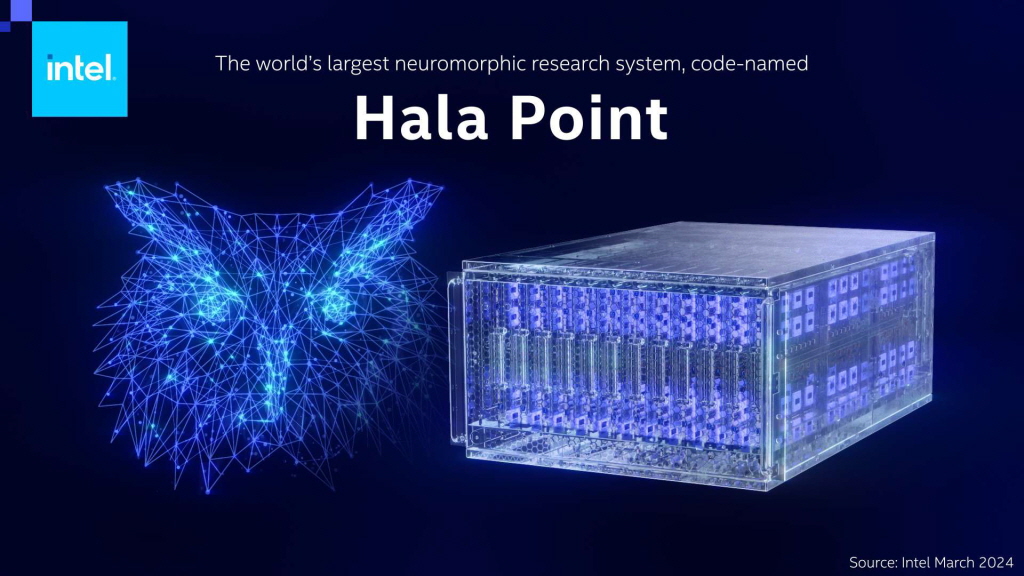
Supports up to 1.15 billion neurons and 128 billion synapses
Supporting AI research and solving challenges that mimic future brain structures
Intel unveils the world's largest neuromorphic system, which boasts a neuron capacity comparable to that of an owl's brain. This is expected to support research into artificial intelligence that mimics the structure of future brains and address challenges related to the efficiency and sustainability of artificial intelligence.
Intel announced the world's largest neuromorphic system on the 18th.
This large-scale neuromorphic system, codenamed "Hala Point," was first built at Sandia National Laboratories.
The goal is to support AI research that mimics the brain structure of the future, leveraging Intel's Loihi 2 processor, and to address challenges related to the efficiency and sustainability of current AI.
Hala Point builds on Intel's first-generation large-scale research system, Pohoiki Springs, with architectural improvements that increase neuron capacity by more than 10x and improve performance by up to 12x.
Hala Point packages 1,152 Loihi 2 processors produced on Intel's 4-processor node into a microwave-sized, 6-rack-unit data center chassis.
This system supports up to 2,It supports up to 1.15 billion neurons and 128 billion synapses distributed across 145,444 neuromorphic processing cores that consume 600 watts of power.
The system also includes more than 2,300 embedded x86 processors for auxiliary operations.
Hala Point integrates processing, memory, and communication channels into a massively parallel fabric, delivering a total of 16 petabytes per second (PB/s) of memory bandwidth, 3.5 PB/s of inter-core communication bandwidth, and 5 TB/s of inter-chip communication bandwidth. The system can process more than 380 trillion 8-bit synapses and 240 trillion neuron operations per second.
Applied to a bio-inspired spiking neural network model, the system can run 1.15 billion neurons at full capacity, 20 times faster than the human brain, and up to 200 times faster at lower capacities.
Although not intended for neuroscience modeling, the Hala Point has a neuronal capacity roughly equivalent to that of an owl brain or the cortex of a capuchin monkey.
Loihi-based systems can perform AI inference and solve optimization problems up to 50 times faster and using 100 times less energy than conventional CPU and GPU architectures.
Hala Point is the first large-scale neuromorphic system to demonstrate state-of-the-art computational efficiency when applied to mainstream AI workloads.
The analysis results show that it can support up to 20 trillion operations per second, or 20 petaops, with an efficiency exceeding 15 TOPS/w 8-bit operation processing (TOPS is a unit operation that can be performed per second, and 1 TOPS is 1 billion unit operations performed per second) when running existing deep neural networks.
This figure rivals or surpasses what GPU- and CPU-based architectures have achieved.
Hala Point's unique capabilities can enable real-time continuous learning for AI applications such as scientific and engineering problem solving, logistics, smart city infrastructure management, large language models (LLMs), and AI agents.
Researchers at Sandia National Laboratories plan to use Hala Point for advanced brain-scale computing research. The institute will focus on solving scientific computing problems in device physics, computer architecture, computer science, and informatics.
“The compute costs of today’s AI models are increasing at an unsustainable rate. The industry needs a fundamentally new approach that can scale,” said Mike Davies, director of the Neuromorphic Computing Lab at Intel Labs. “That’s why Intel developed Hala Point, combining deep learning efficiency with novel brain-like learning and optimization capabilities. We hope that research using Hala Point will advance the efficiency and adaptability of large-scale AI.”

Comments
Related news
Intel Unveils 'Pohoiki Springs' Providing 100 Million Neuron Computations
Intel has unveiled the status of Pohoiki Springs, its latest neuromorphic research system that delivers 100 million neuron operations. Pohoiki Springs is a system mounted in a rack for data centers, housing 76.9 billion Loihi neuromorphic chips within a physical frame equivalent to the size of five conventional servers.
2020.03.19by 최인영 기자

Intel: "AI-accelerated PC supply will be a priority, with 100 million units to be delivered by next year."
Intel stated that AI represents a new opportunity for the PC industry, and that devices must be supplied in large quantities as a priority for AI advancement. The company announced that it will make every effort to ensure sufficient product supply to deliver approximately 100 million devices by next year.
2024.02.19by 배종인 기자

Intel Launches Systems Foundry...1nm Shipments in 2025
The advanced semiconductor foundry market is prepared to expand from a two-way competition into a three-way battle. Intel has launched a full-fledged systems foundry business, revealing ambitions to establish ecosystem leadership by leveraging advanced process nodes and cutting-edge packaging technologies.
2024.02.22by 권신혁 기자
.jpg)
Intel and OSC Double AI Processing with HPC Clusters
AI and machine learning are being actively utilized to solve complex research problems in the fields of science, engineering, and biomedical studies. As the effectiveness of these technologies continues to be demonstrated, their application is expanding into academic disciplines such as agricultural science, architecture, and sociology.
2024.02.23by 명세환 기자

Intel Unveils Edge Platform, Simplifying On-Device AI Development
Competition among companies is intensifying to expand AI at the edge device layer that interfaces with consumers and end users. In this context, Intel has newly introduced an open software platform that facilitates the development, deployment, and execution of edge AI solutions for developers, operators, and enterprises.
2024.02.27by 명세환 기자











