



Microchip Expands Radiation-Resistant MCU Lineup for Aerospace and Defense
 Published2024.05.17 11:24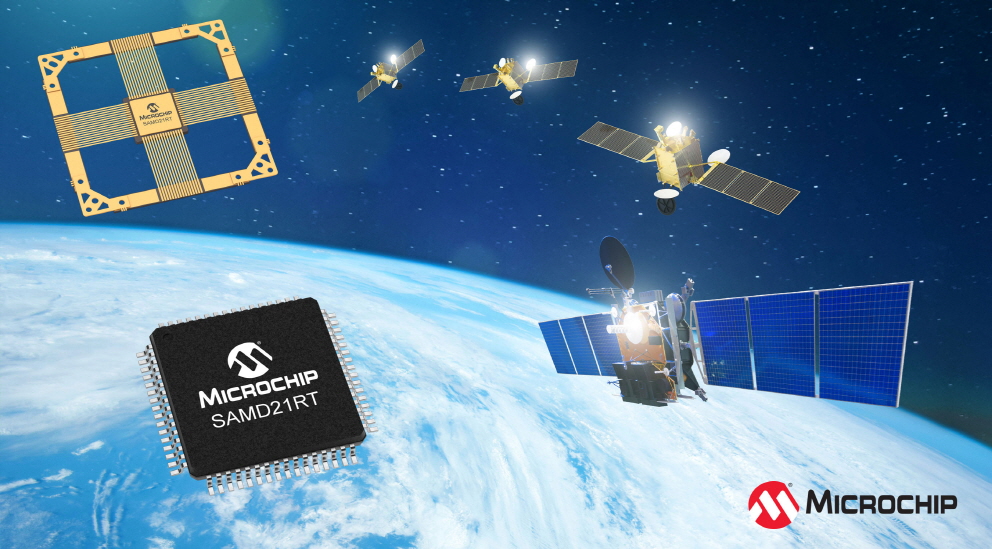
▲ Launch of Radiation-Resistant Microcontroller (MCU) SAMD21R / (Image: Microchip)
The field of space exploration is showing signs of revival, regaining vitality with NASA’s Artemis 2, which is attracting much anticipation ahead of its lunar exploration mission, Japan’s Aerospace Exploration Agency (JAXA)’s SLIM probe, which recently succeeded in landing on the moon, India’s Chandrayaan 3, and new satellites deployed in Low Earth Orbit (LEO).
Due to these changes, developers needed electronic components that comply with strict radiation and reliability standards to operate smoothly even in the harsh environment of space.
Microchip Technology (hereinafter Microchip), a global company in MCUs and analog solutions, announced on the 17th that it has launched the SAMD21RT, a radiation-resistant (RT) Arm® Cortex®-M0+ based 32-bit microcontroller (MCU) equipped with 128KB Flash and 16KB SRAM in a 64-pin ceramic and plastic package.
The SAMD21RT is a low-power MCU equipped with a sleep mode, standby sleep mode, and sleepwalking peripherals. Other peripheral devices include a 12-channel DMAC (Direct Memory Access Controller), a 12-channel event system, a control multiple timer/counter (TCC), a 32-bit real-time counter (RTC), a watch timer (WDT), and a USB 2.0 interface, and support serial communication (SERCOM), I2C, SPI, and LIN methods to communicate with various devices.
The SAMD21RT is designed to operate in space-constrained applications where size and weight are critical, such as spacecraft, and is provided with a small footprint of 10mm × 10mm. It operates at speeds up to 48MHz, providing high-performance processing even in harsh environments. It integrates analog functions, including up to 20 channels of analog-to-digital converters (ADCs), digital-to-analog converters (DACs), and analog comparators.
The SAMD21RT device is built on Microchip's existing SAMD21 MCU family, which has already been proven and is widely used in the industrial and automotive markets. It is built based on commercially available off-the-shelf (COTS) devices and maintains pinout compatibility, which can significantly simplify the design process when transitioning to radiation-resistant devices.
Microchip offers a wide range of devices that can be used with the SAMD21RT MCU, including FPGAs, power and discrete devices, memory products, communication interfaces, and oscillators, with various options according to a wide range of certification levels to provide comprehensive system solutions for space industry applications.
To withstand harsh environments such as radiation and extreme temperatures, the SAMD21RT is designed to operate in a temperature range of -40°C to 125°C and provides a total ionization dose (TID) performance of up to 50 Krad and a high level of Single Event Latch-up (SEL) resistance of up to 78 MeV.cm²/mg.
“We are continuously introducing the latest technologies such as Ethernet, AI, and ML that have advanced in the commercial and industrial markets, and improving radiation performance to meet the requirements of space exploration missions,” said Bob Vampola, Vice President of Aerospace and Defense at Microchip. “We are also continuously developing products that reduce weight and size by integrating higher computing performance and the latest technologies into smaller packages.”

Comments
Related news

Microchip Expands Automotive Networking Market with VSI Acquisition
Microchip has acquired domestic fabless startup VSI, expanding its automotive semiconductor portfolio.
2024.04.12by 명세환 기자

Microchip Acquires Neuronics AI Labs
Cases of applying AI technology to semiconductors to achieve power efficiency at the edge are increasing. Recently, Microchip demonstrated efforts to strengthen its AI-based edge solution capabilities by acquiring an AI technology company that achieves neural network optimization.
2024.04.16by 명세환 기자

Microchips Help Rapidly Respond to Aircraft Electrification
Microchip Technology, a global leader in microcontrollers, mixed-signal, analog semiconductors, and flash-IP solutions (Asia General Manager and Korea Representative: Han Byung-don), has launched an integrated drive power solution for aircraft electrification, which is expected to help developers designing aviation power systems respond quickly to rapidly changing market demands.
2024.04.18by 배종인 기자

Microchip Launches maXTouch Touchscreen Controller Family
As the number of electric vehicles (EVs) operating on roads increases, the charging infrastructure that supports this growing demand must also be expanded. For this reason, the European Union has mandated that EV chargers include credit card payment options that meet PCI (Payment Card Industry) security standards, and this is becoming standard practice in many countries as well.
2024.04.26by 명세환 기자
Microchip Launches PIC32CK Family of 32-bit MCUs, Integrating Embedded Security
New global regulations mandating stricter cybersecurity requirements for everything from IoT consumer appliances to critical infrastructure are being enforced from 2024 onwards. Complying with these new security regulations from a product and supply chain perspective is not only a complex process, but also requires significant cost and time investment.
2024.04.30by 명세환 기자











