



[NextRise 2024 Visit Report] Korean Fabless Companies, Promising Potential with Innovative Technology
 Published2024.06.14 14:04
모빌린트, 신규 저전력 AI SoC 출시

국내 시스템반도체 생태계 육성 기조는 2019년부터 본격 가동되기 시작했다. 1%대의 세계 시장 점유율에 불과한 한국 팹리스 산업을 강화하기 위해 정부는 2030 반도체 비전 및 글로벌 스타팹리스 육성 사업 등 다양한 지원책을 마련해 지원해 왔다.
육성 기조와 산업 생태계 지형 변화 등으로 국내 팹리스 기업들의 기술력에 큰 발전이 이뤄지고 있다. 유망 스타트업들의 전시 행사인 NextRise 2024에서 국내 팹리스 기업들의 기술력을 탐구해봤다.
■ 세계 최초 능동 EMI 필터로 시장 정조준...대기업 PoC 진행 中
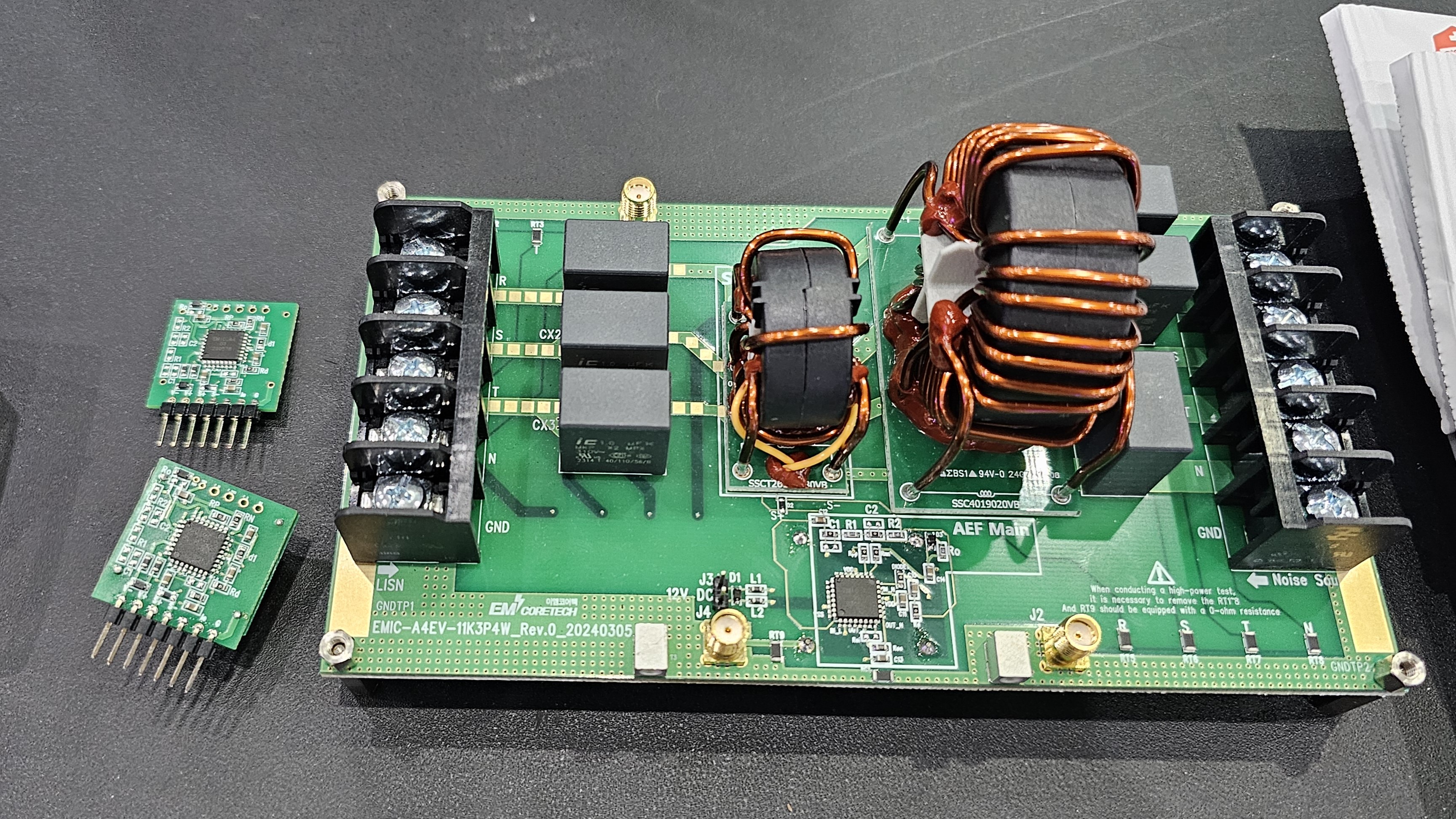
▲이엠코어텍 능동 EMI 필터 모듈(왼쪽 2개)와 기존 수동 필터(오른쪽 코일이 감긴 부품)와의 비교
이엠코어텍은 세계 최초로 능동 EMI 필터를 시장에 내놓은 기업으로 전도성 전자파 노이즈 상쇄가 가능한 EMI 필터 관련한 다수의 특허와 IP 포트폴리오를 가지고 있다.
글로벌 칩 제조사 텍사스인스트루먼트(TI)에서도 비슷한 시기 능동 EMI 필터를 상용화했지만 비절연 구조를 취하고 있어 완전자기절연형 구조인 이엠코어텍 제품이 고전압 신뢰성에서 훨씬 우수한 특성을 가지고 있다.
능동 필터는 전자파가 들어왔을 때 이를 자체적으로 분석해 반대 신호를 내보냄으로써 전자파를 감쇄할 수 있다. 수동 필터는 초크 코일이 감겨있어 제품의 크기가 크고 무거우며 발열에 취약한 단점이 있다. 능동 필터는 더 작고 가벼우며 상대적으로 발열에서도 유리한 특성을 가진다.
주신애 이엠코어텍 차장은 “150kHz에서 수 MHz 대역에 이르는 최대 34dB까지 CE 전자파 노이즈를 저감할 수 있다”면서 “삼성, 현대, LG 등 차세대 제품 적용을 위해 신뢰성 테스트를 진행하고 있다”고 밝혔다.
능동 EMI 필터는 특히 전기차·태양광 인버터·ESS 애플리케이션을 타겟하면서 전력전자 분야에서 유망할 것으로 기대되고 있다.
■ 글로벌도 탐내는 IP...관악아날로그, 온디바이스 AI 칩 구현
.jpg)
▲관악아날로그 GW2110 칩
관악아날로그는 이날 CNN 아키텍처 기반 온칩 추론 가속기(IX)를 탑재한 시스템온칩(SoC)를 공개했다. Arm Cortex-M4F 아키텍처를 기반으로 설계된 관악아날로그의 GW2110은 저전력·저비용으로 실시간 TTS(텍스트 음성 변환) 및 키워드 인식 기능을 구현한다.
특히 클라우드 서버에 의존하지 않고 로컬에서 AI를 수행하는 온디바이스 AI 칩으로 아날로그 전압 입력 채널을 포함해 다중 인터페이스를 갖춰 다양한 센서 정보들을 처리할 수 있다. 예컨대 CO 및 CH4 감지용 가스 센서부터 압력, 온습도 센서 등에 이르기까지 다양한 센싱 모니터링 제공이 가능하다.
이를 통해 AI 추론 가속기와 센싱 융합으로 다양한 애플리케이션 기능 구현과 지원, 데이터 분석 등의 활용이 가능할 것으로 예상된다. 글로벌 기업에서 IP를 팔라는 제안이 들어올 정도로 탁월한 설계를 자랑한다는 후문이 들릴 정도이다.
정용식 관악아날로그 상무는 “키 포인트는 싱글 코어에 D램이 없다는 것이다”라면서 기존 AI 프로세서는 멀티 코어에서 연산 처리를 위해 외부 D램으로부터 데이터를 주고 받을 수밖에 없지만 관악아날로그의 GW2110은 AI를 구현하면서도 D램 없는 구조에 MCU 베이스로 설계해 5달러 이하의 굉장히 저렴한 가격 및 저전력 구현이 가능한 것이 큰 매력포인트인 것으로 전해졌다.
온디바이스 AI 칩을 활용한다면 TV, 냉장고, 에어컨 등 가전의 메인 프로세서를 깨우지 않고도 주변 센싱 정보 및 음성 정보를 처리해 메인 프로세서의 동작으로 이어질 수 있으며, ESS 애플리케이션에서도 여러 센싱 정보를 바탕으로 화재 예측 감지 구현이 가능한 것이다.
■ 엔비디아 GPU 대체하는 엣지 NPU 칩
.jpg)
▲(왼쪽부터)모빌린트 ARIES AI 가속기 칩, 새로운 REGULUS AI SoC, NPU PCIe Card가 전시된 모습
모빌린트는 AI 추론 성능을 제공하는 엣지 NPU 칩을 2종을 이날 전시 부스에서 선보이고 있었다. ARIES AI 가속기 칩과 새로운 REGULUS AI SoC를 소개했다.
ARIES AI 칩은 올해부터 본격 양산에 돌입하며 세미파이브와 삼성전자 파운드리의 협업으로 제품을 출시했다. 기본 64TOPS AI 추론 성능에 최대 80TOPS까지 부스트할 수 있다. 모빌린트는 ARIES 칩이 엔비디아 지포스 RTX 4090에 달하는 AI 성능을 보여준다면서 △스마트 팩토리 △로보틱스 △지능형 CCTV 등의 애플리케이션을 타겟하는 고성능 AI 칩이라고 소개했다.
반대로 새로운 REGULUS AI SoC 보다 저전력의 경량화된 칩으로 2W 미만의 전력 소모로 더 소형화된 애플리케이션을 타겟했다. 엔비디아 Jetson Orin Nano과 동급 성능으로 전해졌다.
REGULUS AI SoC는 올해 말부터 양산에 들어갈 계획으로 내년 초부터 본격적으로 시장에 판매될 것으로 기대했다.
김준엽 모빌린트 팀장은 “소프트웨어를 포함한 엔비디아의 개발 생태계가 워낙 잘 갖춰져 있어 이에 대응하는 모빌린트의 SDK 지원도 UI 및 임베디드 구현에 필요한 수준들을 더 높이려고 하고 있다”면서 “모빌린트가 가지는 강점은 하드웨어에 있다”고 강조했다.
모빌린트의 칩은 경쟁 제품 대비 2배 높은 AI 성능을 구현함으로써 가격 효율은 절반으로 낮추고 소비전력은 15% 수준으로 크게 낮춰 하드웨어적 메리트를 강조할 수 있었다.
Comments
Related news
EMI/EMC(2)-High-power products, finding solutions in active EMI filters
As product development continues to trend toward miniaturization and higher power density, EMI·EMC issues are inevitably arising. In response, efforts are being observed to overcome the limitations of passive EMI filters by researching and developing active EMI filters (AEF) and entering the market.
2023.12.14by 명세환 기자
AMD Embedded+ Launch, “Background for Rapid Increase in Edge AI Chips and Sensor Data Analysis”
Growing supply of AI inference chipsets is expected at the edge. Machine vision and sensor data analytics are projected to drive edge AI-related shipments, while AI semiconductors for edge AI devices are emerging in SoC form factors.
2024.02.06by 명세환 기자
NXP Launches MCX A MCUs for Edge AI Devices
As intelligent devices continue to proliferate in edge applications, there is growing demand for new and cost-effective approaches that can bring innovation to design.
2024.02.28by 명세환 기자

Ambarella Unveils Next-Generation Industrial AI SoC...Manufactured on Samsung Foundry's 5nm Process
Ambarella, a US-based edge AI semiconductor company, announced its next-generation industrial AI system-on-chip (SoC) CV75AX for in-vehicle telematics systems on the 21st.
2024.05.22by 명세환 기자

[EMI/EMC Expert Talk②] Professor Jin-Guk Kim, “Passive EMI Filters Face Limits, Active EMI Filter Semiconductor Mass Production Preparations in Progress”
[Editor's Note] Electromagnetic noise generated during IT product design causes critical defects such as product performance degradation and malfunction. Recently, electromagnetic noise in the environment has been increasing due to vehicle electrification, miniaturization of various IT devices, and paradigm shifts toward 5G and 6G communications, leading to malfunctions in various devices and systems. In response, through the planned series 'EMI/EMC Expert Dialogue,' we aim to shed light on the importance of EMI and EMC design for the development of safe and highly reliable advanced IT products, and have arranged opportunities to meet with EMI/EMC specialists active across various sectors and hear their latest insights.
2024.05.24by 권신혁 기자











