



Park Se-jin, CEO of Gamba Labs, said, "On-device AI: $1 Processor, $2 Module 'Daiso Strategy'"
 Published2024.06.18 16:05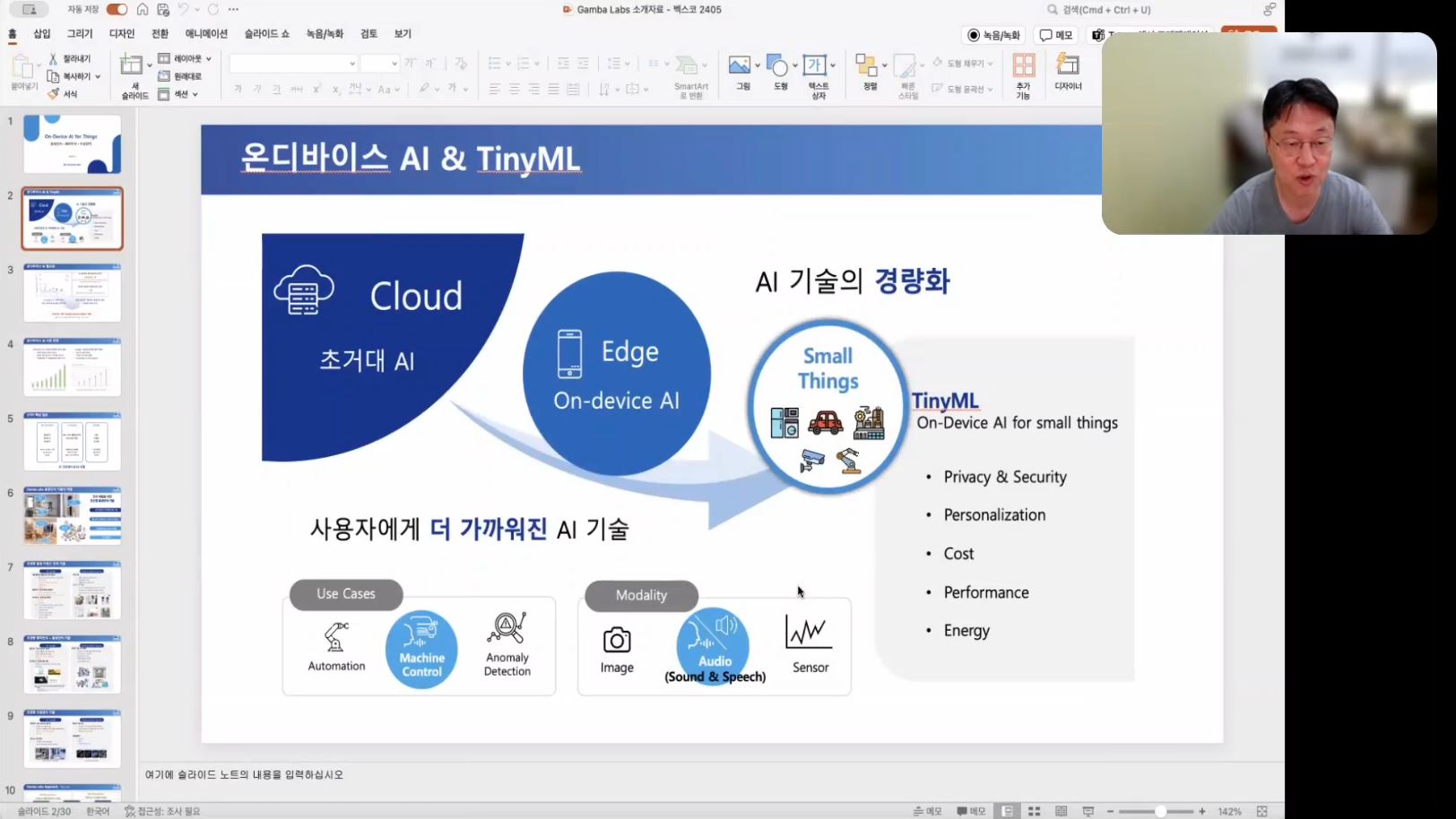
▲A Zoom interview with Park Se-jin, CEO of Gamba Labs.
Building a heterogeneous MCU and VIOLA framework
AI modeling must overcome misrecognition and noise challenges.
Recently, AI capabilities are being incorporated into everyday devices, such as home appliances and IoT products. In particular, AI systems in these edge devices can improve efficiency in power consumption and product lifespan by placing the AI-performing chip at the edge, reducing the need for the main module or processor to be constantly on.
Gambalabs is an on-device AI company with ultra-lightweight speech recognition and speaker recognition technologies, and has model lightweighting technology that enables porting AI models to edge chips such as MCUs. This lightweight AI model is an essential technology for on-device AI, requiring high levels of technical expertise and know-how to reduce model capacity to kilobytes while maintaining relatively similar performance.
Recent trends indicate that major home appliance manufacturers are preparing to incorporate keyword voice recognition into their next-generation home appliances and are reportedly seeking out AI technology solution providers.
Gamba Labs CEO Park Se-jin, whom we met through an online Zoom interview, said, “Gamba Labs’ approach is to prioritize price competitiveness over high-performance and high-efficiency AI models,” and revealed that they are currently developing their own hardware to optimize it.
CEO Park Se-jin, who aims to supply inexpensive on-device AI chips with the slogan of “$1 processor, $2 module,” cheerfully called it the “Daiso strategy,” but it was clear that this was a serious vision.
Currently, Gamba Labs has completed product testing of MCU companies such as Espressif, Renesas, and Nuvoton, and has built the VIOLA (Voice Interface Over Lightweight AI) framework that enables AI models to be automatically installed on heterogeneous MCUs.
There are a variety of MCU manufacturers, with dozens of MCUs released by a single manufacturer. To integrate AI models into these diverse MCUs, an AutoML framework that automates the process is essential.
Gamba Labs can quickly and efficiently convert AI models optimized for MCU hardware of various specifications through the VIOLA framework. Connecting this framework to business would make Gamba Labs a lightweight SaaS solution provider for AI models, but this is not the business direction we are pursuing.
.jpg)
▲Gamba Labs Demo Case Study / (Capture: Gamba Labs website)
Gamba Labs is preparing to conquer the market by utilizing the voice recognition AI model it has developed and optimizing the model to fit the hardware specifications and MCU desired by the customer, and supplying chips/modules equipped with this model or the AI model itself to the customer.
△It can be applied to various applications such as smart lighting, kiosks, robot vacuum cleaners, home and kitchen appliances, door locks, laptops, and automobiles, and the development of related products is progressing rapidly in the current market.
CEO Park Se-jin pointed out that “global MCU companies are providing AI modeling libraries and development frameworks, but they are merely providing a development environment,” and that “when we actually test them, we find that the performance is not satisfactory because they do not take into account misrecognition and noise environments.”
Currently, major issues in voice and speaker recognition include high misrecognition and response to noisy environments. Without development know-how in these areas, the market competitiveness of products will inevitably decline.
CEO Park said, “The AI model size that goes on the MCU must be small, and we have reduced the voice recognition model to 30 kbytes, and the appropriate size is around 50 to 60 kbytes.” He added, “The development of a mass-produced module optimized for voice recognition has been completed, and a module for speaker recognition has been developed.” “The module is in the final stages of development, and ultimately, we are also developing an ultra-small artificial intelligence processor that can recognize voices and speakers simultaneously,” he said, expressing his confidence.
As companies ranging from small and medium-sized manufacturers to large corporations begin developing on-device AI products, an ecosystem of companies equipped with lightweight AI solutions is blossoming. With startups expected to increasingly participate in the on-device AI ecosystem, it's worth keeping an eye out to see which AI startups will emerge as the "dagger in the bag."
Comments
Related news
[Webinar Review] “Easy to Implement Edge AI Even Without AI Experience”
With recent advancements and widespread adoption of artificial intelligence technology, demand for on-device AI processing that does not rely on cloud resources is rapidly increasing.
2023.12.05by 명세환 기자
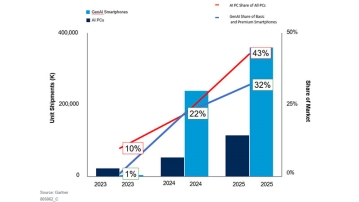
On-device AI device shipments stabilize... No demand without killer apps
The shipment increase of on-device AI devices in 2024 is expected to revitalize the PC and smartphone markets. Accordingly, the performance of mobile APs, which serve as the brain of smartphones, is rapidly improving and competition is intensifying. However, the shipment increase is difficult to regard as a full-fledged recovery, and without killer applications that can demonstrate the advantages of on-device AI, price increases beyond current levels appear unlikely.
2024.02.08by 김예지 기자
.jpg)
ST, “Contains all the industry know-how in ‘Edge AI Solution’”
ST Microelectronics (hereinafter ST) introduced software packages supporting ST's products and edge AI (on-device AI) solutions based on ST MCU and MPU.
2024.03.19by 성유창 기자
On-device AI: Chip Optimization Key to Cost Efficiency
On the 29th, at the launch ceremony of the 'Industrial AI Technology Committee' established by the Korea Industry Intelligence Association, a forum was held to exchange technologies related to industrial AI and share industry trends. With an introduction by Committee Chair Jo Young-im from Gachon University and keynote remarks on AI international standardization trends, speakers who participated as instructors emphasized aspects of industrial data utilization.
2024.06.03by 김예지 기자
[NextRise 2024 Visit Report] Korean Fabless Companies, Promising Potential with Innovative Technology
South Korea's domestic system semiconductor ecosystem development initiative began full operations starting from 2019. To strengthen the domestic fabless industry, which accounts for only around 1% of the global market share, the government has provided various support measures including the 2030 Semiconductor Vision and the Global Star Fabless Nurturing Project. Significant technological advances are being achieved by domestic fabless companies due to the nurturing initiative and changes in the industrial ecosystem landscape. We explored the technological capabilities of domestic fabless companies at NextRise 2024, an exhibition event for promising startups.
2024.06.14by 권신혁 기자











