


KERI, Hyundai, and Kia Join Hands for Infrastructure to Improve EV Charging Errors
 Published2024.07.17 10:14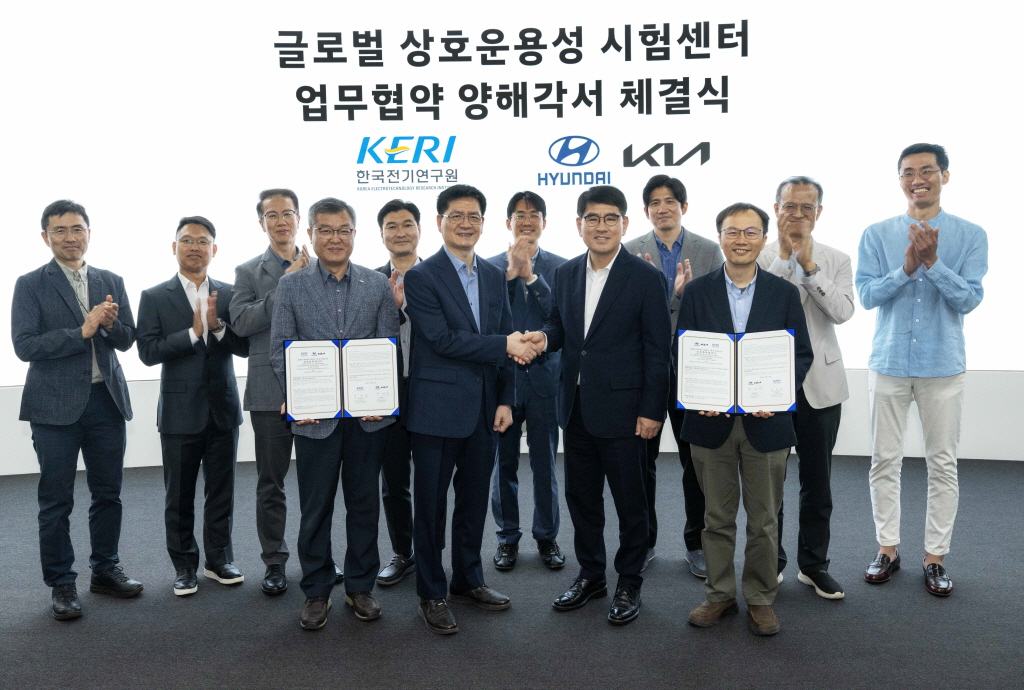
Enhancing technological capabilities and export competitiveness, leading international standards
The Korea Electrotechnology Research Institute (KERI), Hyundai Motor, and Kia are embarking on the full-scale construction of infrastructure to improve electric vehicle charging errors.
On the 16th, the Korea Electrotechnology Research Institute (KERI) signed a business agreement with Hyundai Motor and Kia to establish a 'Global Interoperability Test Center' related to electric vehicles. The event was held at Hyundai Motor's Namyang Technology Research Center in Hwaseong, Gyeonggi Province.
Interoperability refers to charging compatibility between electric vehicles and chargers. While there is a 'coupler' between the EV and the charger, which acts as a type of connection device and charging jack, there also exists an invisible communication protocol called a 'sequence.'
The coupler has secured compatibility after the Korean Agency for Technology and Standards recommended Combo 1.
On the other hand, despite the establishment of standards for sequences, errors occur frequently. This is because differences in the interpretation of standards arise among manufacturers, as numerous major domestic and international automakers and various charger companies are participating in infrastructure development.
In addition, if new technologies such as PnC (charging payment via certificate in electric vehicle) and V2G (bidirectional charging technology) are applied in the future, the frequency of errors may increase further due to increased technical complexity.
To address this, KERI has been hosting an international Test+Festival by inviting numerous companies to cross-verify electric vehicles and chargers, but there was a growing demand from the field for the establishment of a platform (infrastructure) where interoperability could be checked on an ongoing basis and improvement measures could be discussed quickly.
In response to these demands from the field, KERI, an internationally accredited power equipment testing and certification organization, and Hyundai Motor and Kia, Korea's leading automobile companies, have joined forces to establish a 'Global Interoperability Testing Center'.
Both parties will engage in cooperation including: △establishing test sites and supporting initial operations; △establishing test standards and applying new technologies; △promoting domestic and international activities to improve test site operations and disseminate results; △expanding test participants domestically and internationally; and △jointly identifying other cooperative projects related to electric vehicle charging systems. The center is scheduled to be established at the KERI Ansan branch with the goal of official operation in the first half of next year.
Once the center is successfully established, it will serve as a focal point where all stakeholders, including electric vehicle automakers, small and medium-sized enterprises manufacturing chargers, and charging service providers, can work together toward the common goal of securing interoperability.
Any company that passes the technical standards set by KERI can become a member of the Center and conduct interoperability checks with other member companies, and receive consultation on improvement measures based on test results and expert technical advice.
The list of participating companies and their activities are disclosed transparently, and test results (such as compatibility solutions) are shared with other member companies based on the manufacturers' consent. As such analytical data accumulates, it enables product quality improvement and lays the foundation for leading international standards.
KERI President Kim Nam-kyun stated, “Although similar test facilities exist in the Netherlands and Spain, they are all operated by private companies, so their public nature is low.” He added, “KERI will manage all testing procedures objectively and fairly from a third-party perspective, and plans to rapidly resolve interoperability issues between electric vehicles and chargers, and actively support domestic companies in securing export competitiveness.”
Hyundai Motor & Kia R&D Head Yang Hee-won stated, “Since electric vehicles and chargers must operate as a single charging system, they are inextricably linked. Therefore, the development of the electric vehicle market is only possible if all companies collaborate and make efforts from a broader perspective,” adding, “Hyundai Motor & Kia will provide unsparing cooperation to ensure that domestic electric vehicle-related companies can prosper together through the successful establishment of the test center.”
KERI plans to begin preparations for the opening of the test center, including deriving detailed operational processes through numerous working-level meetings with Hyundai Motor and Kia. In addition, the goal is to identify internationally renowned electric vehicle manufacturers and domestic charger manufacturers that could become members of the center and sign business agreements with them in the second half of this year.
Meanwhile, KERI is a government-funded research institute under the National Science and Technology Research Council of the Ministry of Science and ICT.

Comments
Related news
.jpg)
Three people who have contributed to science day, including the Korea Electric Power Research Institute and the Science and Technology Award
Doctors Ha Yun-chul, Jeon Yeon-do, and Kim Dae-ho from the Korea Electrical Research Institute (KERI) were selected as contributors to the advancement of science and technology and received the "Science and Technology Medal," "Prime Minister's Citation," and "Minister of Science and ICT Award," respectively.
2024.04.30by 배종인 기자
“Detecting Dementia Just by Analyzing Everyday Conversations”
Dr. Park Young-jin's team at the Auditory Cognition and Brain Function Research Group under the Electrical Medical Device Research Division of the Korea Electrotechnology Research Institute (KERI) is receiving significant attention for their challenge in developing technology that can early detect high-risk groups of 'mild cognitive impairment,' a general precursor stage to dementia, through analysis of daily conversation in elderly populations.
2024.05.07by 배종인 기자
.jpg)
KERI Seeks Excellent Technology Startups
The Korea Electrotechnology Research Institute, a core technology institution in the Gyeongnam Changwon Gangso Special Zone, is recruiting for the 'Innopolis Campus KERITOR (KERI+accelerator) 5th Cohort' until May 22nd, and for companies participating in the 'Regional Specialization Development Project' from May until the budget is exhausted.
2024.05.13by 배종인 기자
High energy density lithium-ion battery that is stable even with rapid charging
A research team led by Dr. Choi Jung-hee at the Electrical Materials and Process Research Center of the Korea Electrotechnology Research Institute (KERI), in collaboration with Professor Lee Jong-won's team at Hanyang University and Professor Park Min-sik's team at Kyung Hee University, has developed core technologies that can ensure charge-discharge stability and realize long-life performance of lithium-ion batteries even under rapid charging conditions.
2024.05.27by 배종인 기자
KERI and Gimhae Biomedical & Industrial Promotion Agency Join Hands for Regional Project
The Korea Electrotechnology Research Institute (KERI) and the Gimhae Institute for Bioscience and Industry Advancement have joined hands to promote regional business collaboration.
2024.05.29by 배종인 기자











