



[2025 e4ds Tech Day] "AI: A People- and Hardware-Centric Transformation"
 Published2025.10.20 09:54
.jpg)
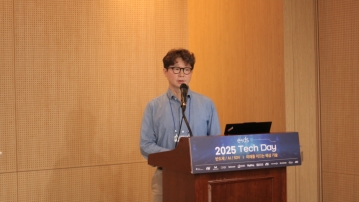
▲ Professor Kim Gyeong-gi of Daegu University is presenting on 'On-Device AI Technology Trends and Future Prospects.'
It's hard to beat the Korean money game; specialized agents and AI are gaining ground.
“AI is evolving from data-centric to human-centric, and from software-centric to hardware-centric. “As technologies like neuromorphic chips become commercialized, hardware-based AI that mimics the human brain will emerge, potentially marking a new turning point for on-device AI.”
Professor Kim Gyeong-gi of Daegu University presented on 'On-Device AI Technology Trends and Future Outlook' at the '2025 e4ds Tech Day' event held on September 9th, and emphasized the importance of hardware and small models, saying that AI is changing from the cloud to devices.
As digital transformation accelerates, the evolution of artificial intelligence (AI) is entering a new phase.
In particular, 'on-device AI' that enables learning and inference on the device itself is attracting attention, moving away from cloud-centric, centralized AI.
Professor Kim Gyeong-gi reviewed the development of AI technology, mentioning the full-scale start of deep learning in 2012, the emergence of AlphaGo, and the recent large-scale language model (LLM).
Professor Kim emphasized that “now, beyond simple generative AI, revenue models will be formed with agent-based AI,” and that on-device AI will play a key role in this.
On-device AI processes data on the device itself without going through a server, providing fast response and high security.
Professor Kim said, “We need AI that can respond in real time while protecting personal data,” and explained that reducing reliance on the cloud is essential in areas such as self-driving cars.
A video presented during the presentation showed a food scientist using AI to provide personalized support based on his work style and data.
Professor Kim cited this as an example, saying, “AI understands me and only I can understand it.“The era has arrived where we operate based on data,” he said.
A representative example is a service that learns and creates content based on personal files, such as Google's 'Notebook LM'.
This trend leads to ‘hyper-personalized AI.’
AI, which learns users' habits and preferences to provide customized services, is expected to play a significant role in resolving future security and privacy issues.
Hardware advancements are essential for implementing on-device AI.
Professor Kim pointed out that domestic small and medium-sized enterprises are having difficulties developing commercial-level chips, saying, “Low-power, high-efficiency chips such as MPUs and neuromorphic chips must be supported.”
“It’s not just performance that’s important, but power efficiency and peak power management,” he added.
On-device AI requires a “small language model (SLM)” rather than a large model.
SLM is a model with fewer than 8 billion parameters, has low inference cost, and is suitable for running on devices.
Professor Kim emphasized, “On-device AI can become a reality through SLM.”
Professor Kim noted that the United States and China are leading the way in AI technology by investing massive amounts of capital, and diagnosed that “it will be difficult for Korea to win the money game.”
On the other hand, if you develop specialized agents or on-device AI in a specific field, you can be quite competitive, he predicted.
He said, “On-device AI has various advantages such as real-time processing, low latency, reduced internet dependence, and reduced operating costs.”He emphasized that “this is a technology that must be paid attention to in order to secure long-term cost efficiency and autonomy.”

Comments
Related news
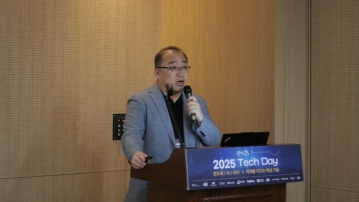
[2025 e4ds Tech Day] "Vehicle-to-Vehicle Cooperation and Communication Are Essential for Safe Travel: The Ultimate Goal of Autonomous Driving"
Kim Ho-jun, CEO of Ettifos, shared in-depth insights on communication infrastructure in the autonomous driving era, focusing on technological advances in 5G V2X communication and practical application cases at the '2025 e4ds Tech Day'. CEO Kim Ho-jun noted that as autonomous driving technology advances rapidly, the importance of Vehicle-to-Everything (V2X) communication is becoming increasingly prominent. He conveyed that 5G-based V2X communication in particular is gaining attention as a core technology that can dramatically improve the safety and efficiency of autonomous driving by offering faster speeds and lower latency compared to conventional LTE-based systems.
2025.09.16by 배종인 기자
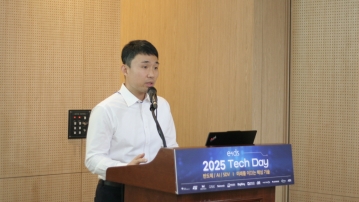
[2025 e4ds Tech Day] "The 'Software Factory' Will Drive the Paradigm Shift in Automotive Development."
Vector Korea FAE Oh Jun-hyung from the Embedded Business Division presented at the '2025 e4DS Tech Day' event held on the 9th, with the topic 'SW Factory in the SDV Era: Development Optimization Strategy Through Integrated and Deployment Automation', and stated, "In a situation where OEMs and third-party developers must repeatedly develop the same controllers, software factory will be a solution that dramatically reduces development time and improves quality."
2025.09.19by 배종인 기자
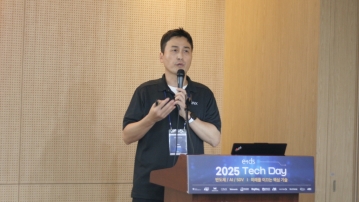
[2025 e4ds Tech Day] "Development and Testing in One Place on a Cloud Platform in the SDV Era"
QNX's Yoo Min-hee, Manager, presented on the topic of "Solutions for Securing Competitiveness in SDV-Centric Vehicle Development Environments" at the '2025 e4ds Tech Day' event, stating, "To accelerate automotive software development speed in the SDV (Software Defined Vehicle) era, we must reduce hardware dependencies and complete both development and testing simultaneously on a cloud platform." Based on this strategy, QNX Accelerate is a cloud platform that provides QNX OS and hypervisors in AWS and Azure environments.
2025.09.19by 명세환 기자
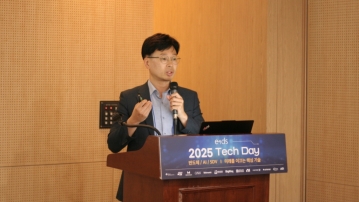
[2025 e4ds Tech Day] "High-Speed Interface and Measurement Technology: Core Competitive Edges of Future Mobility"
Park Young-jun, Executive Director of Tektronix, presented on "Verification for Automotive High-Speed Data Communication Technology and Power System Design" at the '2025 e4ds Tech Day' event. Executive Director Park stated, "Extending beyond 100Base-T1 and 1,000Base-T1 to 10Base-T1, all in-vehicle communication will be integrated into a single protocol," and emphasized that to ensure the reliability of high-speed interfaces, simulation-based eye diagram analysis using oscilloscopes is necessary beyond simple probing, and highlighted the importance of advanced measurement tools such as Tektronix's Serial Data Link Analyzer.
2025.09.19by 배종인 기자
[2025 e4ds Tech Day] "ADI GMSL Solutions: A Core Infrastructure for the SDV Era"
ADI (Analog Devices Inc.) Executive Director Son Sung-ho presented on "High-Speed Data Transmission Technology for SDV - ADI GMSL" at the '2025 e4ds Tech Day,' providing detailed information on SDV architecture and how ADI's GMSL (Gigabit Multimedia Serial Link) solution is applied within it. Executive Director Son Sung-ho stated, "The automotive industry is undergoing rapid paradigm shifts. There is accelerating transition away from traditional hardware-centric vehicle design toward software-centric 'Software Defined Vehicle (SDV)'" and added, "Within this trend, ADI is leading core technologies in future mobility through high-speed interface solutions optimized for the SDV era."
2025.09.19by 배종인 기자











