


[2025 e4ds Tech Day] "Using MCUs to Power AI in Low-Power Environments Expands Possible Application Development"
 Published2025.10.20 10:20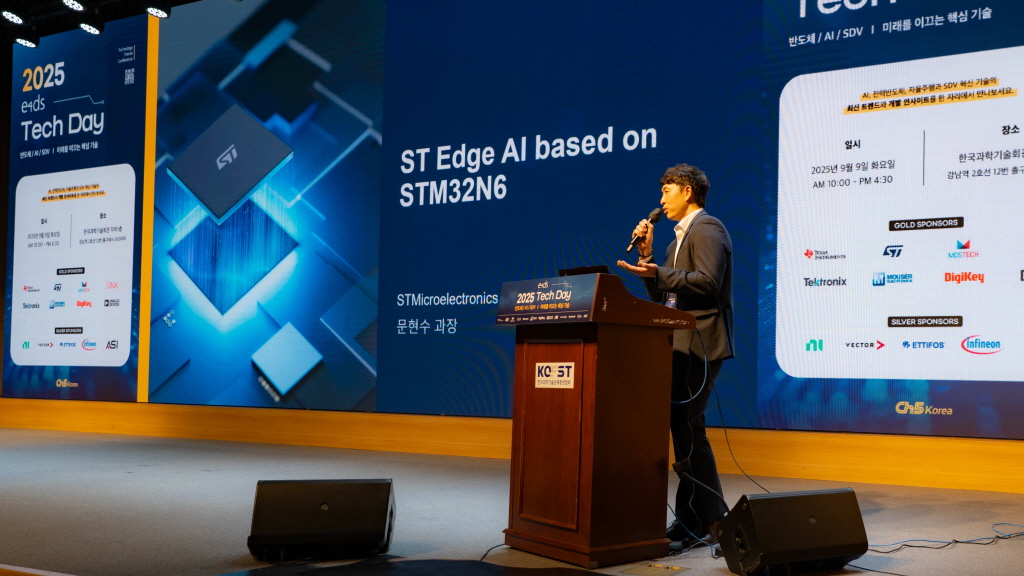
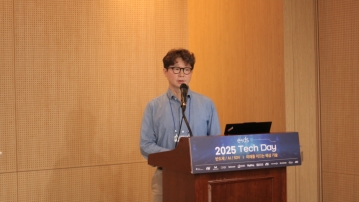
▲ Hyunsoo Moon, Manager of STMicroelectronics, is presenting on the 'STM32N6-based ST Edge AI solution.'
STM32N6 800MHz speed, built-in NPU, optimized for AI operations
“The ability to run AI models on power levels of a few milliwatts makes developing applications feasible with MCUs the most realistic approach possible.”
Hyunsoo Moon, Manager of STMicroelectronics, presented the 'STM32N6-based ST Edge AI Solution' at the '2025 e4ds Tech Day' event held on September 9, introducing technological advancements that enable the implementation of artificial intelligence algorithms even in low-power environments based on ST's flagship product line, the STM32 MCU.
ST is a global semiconductor company based in France and Switzerland that produces a variety of products, including power semiconductors, automotive MCUs, and analog and digital ICs.
In particular, the STM32 series is a globally widely used MCU product line, and has recently been attracting attention as a key platform for implementing edge AI.
Manager Moon Hyun-soo said,“Existing MCUs have been limited to simple hardware platforms for sensors and motor control, but they are now evolving into system-level intelligent platforms through AI algorithms,” he said.
He cited the core concept of AI as "machines performing human intellectual actions," and explained that algorithms capable of prediction and judgment are rapidly spreading across industries.
Edge AI is a method of performing inference on the device itself, as opposed to large-scale cloud-based computation.
ST focuses on this inference step and provides various solutions to enable AI functions to be implemented even on small platforms such as STM32 MCUs.
In particular, the STM32N6 series supports clock speeds of up to 800MHz and has a built-in NPU (Neural Processing Unit) to provide performance optimized for AI operations.
The advantages of edge AI are clear: real-time performance, no need for external transmission of sensitive data, and low-power operation.
ST is applying edge AI in three key areas.
The first is AI upgrades to existing MCU-based algorithms. For example, AI can be used to improve arc fault detection in solar power systems or to proactively identify signs of failure through predictive maintenance.
Second, the vision and voice recognition functions that were difficult to implement with existing MCUs are supplemented with the STM32N6 series.
The third area is the area of driving high-performance models that existing MCUs could not handle at all.
Actual cases were also introduced. An overseas home appliance company has commercialized a system that uses AI to determine the weight of clothes and whether they collide in a drum washing machine, implemented on an STM32G4 MCU.
Additionally, a Japanese electric bicycle manufacturer has developed a "virtual sensor" that uses motor data from an existing MCU to infer tire pressure. This is an example of expanding functionality solely through software, without separate hardware.
In 2018, ST launched STM32Cube.AI, which provides the ability to convert TensorFlow Lite or Keras-based models into C code suitable for MCUs.
In 2021, we launched NanoEdge AI Studio, enabling developers without machine learning experience to automatically create and deploy models using only a dataset.
“Implementing edge AI presents a variety of challenges, including model creation, data acquisition, performance management, security, and power consumption,” said Manager Moon Hyun-soo. “ST is helping customers easily access these challenges through hardware and software tools.”

Comments
Related news
[2025 e4ds Tech Day] "The 'Software Factory' Will Drive the Paradigm Shift in Automotive Development."
Vector Korea FAE Oh Jun-hyung from the Embedded Business Division presented at the '2025 e4DS Tech Day' event held on the 9th, with the topic 'SW Factory in the SDV Era: Development Optimization Strategy Through Integrated and Deployment Automation', and stated, "In a situation where OEMs and third-party developers must repeatedly develop the same controllers, software factory will be a solution that dramatically reduces development time and improves quality."
2025.09.19by 배종인 기자
[2025 e4ds Tech Day] "Development and Testing in One Place on a Cloud Platform in the SDV Era"
QNX's Yoo Min-hee, Manager, presented on the topic of "Solutions for Securing Competitiveness in SDV-Centric Vehicle Development Environments" at the '2025 e4ds Tech Day' event, stating, "To accelerate automotive software development speed in the SDV (Software Defined Vehicle) era, we must reduce hardware dependencies and complete both development and testing simultaneously on a cloud platform." Based on this strategy, QNX Accelerate is a cloud platform that provides QNX OS and hypervisors in AWS and Azure environments.
2025.09.19by 명세환 기자
[2025 e4ds Tech Day] "High-Speed Interface and Measurement Technology: Core Competitive Edges of Future Mobility"
Park Young-jun, Executive Director of Tektronix, presented on "Verification for Automotive High-Speed Data Communication Technology and Power System Design" at the '2025 e4ds Tech Day' event. Executive Director Park stated, "Extending beyond 100Base-T1 and 1,000Base-T1 to 10Base-T1, all in-vehicle communication will be integrated into a single protocol," and emphasized that to ensure the reliability of high-speed interfaces, simulation-based eye diagram analysis using oscilloscopes is necessary beyond simple probing, and highlighted the importance of advanced measurement tools such as Tektronix's Serial Data Link Analyzer.
2025.09.19by 배종인 기자
[2025 e4ds Tech Day] "ADI GMSL Solutions: A Core Infrastructure for the SDV Era"
ADI (Analog Devices Inc.) Executive Director Son Sung-ho presented on "High-Speed Data Transmission Technology for SDV - ADI GMSL" at the '2025 e4ds Tech Day,' providing detailed information on SDV architecture and how ADI's GMSL (Gigabit Multimedia Serial Link) solution is applied within it. Executive Director Son Sung-ho stated, "The automotive industry is undergoing rapid paradigm shifts. There is accelerating transition away from traditional hardware-centric vehicle design toward software-centric 'Software Defined Vehicle (SDV)'" and added, "Within this trend, ADI is leading core technologies in future mobility through high-speed interface solutions optimized for the SDV era."
2025.09.19by 배종인 기자
.jpg)
[2025 e4ds Tech Day] "Power Innovation in the AI Era: Improving Efficiency at Every Power Conversion Stage and Reducing Overall Losses Urgently"
Infineon Technologies Executive Vice President Kim Yong-jin presented at the '2025 e4ds Tech Day' event held on the 9th, speaking on the topic of "Infineon's Next-Generation Power Semiconductors for Energy-Efficient Power Management Solutions in AI Data Centers." He stated, "To achieve power innovation in the AI era, it is urgent to reduce overall losses by improving efficiency at each stage of the power conversion structure." To this end, he emphasized wide bandgap devices such as silicon carbide (SiC) and gallium nitride (GaN) as the core solution.
2025.09.26by 명세환 기자











