


[2025 e4ds Tech Day] “Lightweight Technology is Key to the On-Device AI Era”
 Published2025.10.20 10:50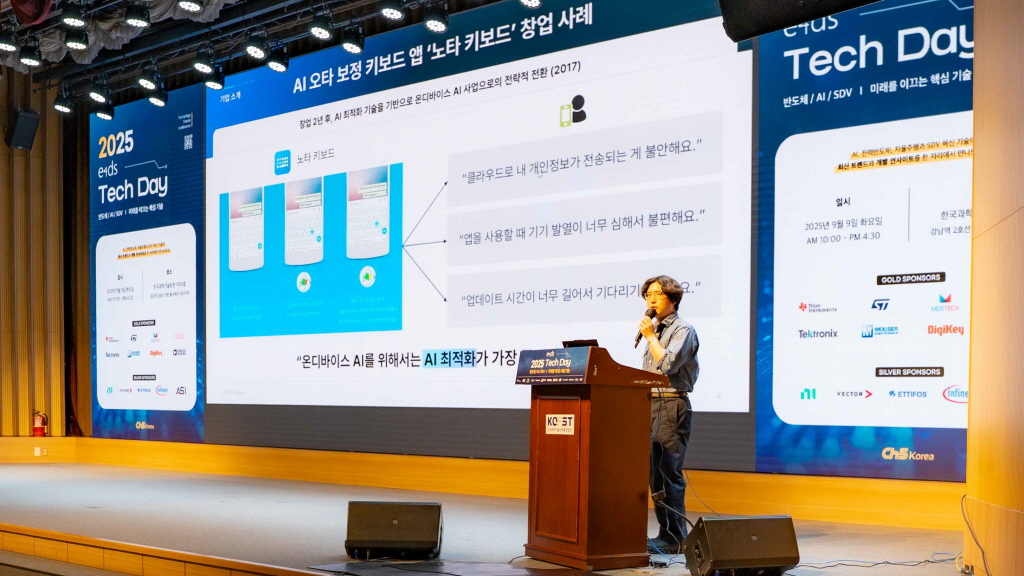
Jo Seok-young, AI Manager at Nota, is giving a presentation on 'Hardware Cognitive AI Model Optimization Solutions and Success Stories for On-Device AI' at the '2025 e4ds Tech Day'.
Operator list pre-analysis, automatic conversion of replaceable operators, optimization
Lightweighting is not simply about making models smaller. Running AI in real-time on low-power devices requires complex technologies that reduce computational load and optimize for the hardware. Especially in on-device AI environments, lightweighting is a necessity, not an option, because AI must be executed on the device itself without relying on the cloud.
Jo Seok-young, AI Manager at Nota, gave a presentation on "Hardware Cognitive AI Model Optimization Solutions and Success Stories for On-Device AI" at the "2025 e4ds Tech Day" event held on September 9, highlighting the importance of lightweight technology for AI models in the era of on-device AI.
As AI technology advances rapidly, the size and complexity of models are increasing exponentially.
In particular, since the emergence of large language models such as GPT, AI models have been growing tenfold every two years, whereas hardware performance has only grown twofold every two years, following Moore's Law.
'AI model lightweighting' technology is attracting attention as a solution to bridge this gap.
Nota AI's lightweight technology consists of four main components.
The first is 'structural pruning'. Conventional unstructured pruning reduces computational load by replacing unimportant weights with zeros, but in actual hardware, the computational structure remains intact, so the speed improvement effect is limited.
On the other hand, Nota AI substantially reduces computational load and maximizes hardware performance through structural pruning that reduces the number of channels itself.
The second is hardware-specific optimization.
It is difficult to improve performance by simply making AI models smaller. To maximize the speed of emergence, the optimal level of lightweighting must be set by considering the parallel processing characteristics of each hardware.
Nota AI analyzes the stepped computational structures of various hardware, such as CPUs, GPUs, and DSPs, to achieve maximum performance improvement with minimal compression.
The third is operator conversion technology.
Complex AI models require advanced mathematical operators such as roots and logarithms, but hardware from many semiconductor startups cannot support them.
Nota AI analyzes the list of operators for each hardware in advance and optimizes the model by automatically converting unsupported operators into alternative methods.
There are also cases where this has made models that were not previously run on the MPU executable and dramatically improved the speed of emergence.
The fourth is post-correction technology after quantization.
Quantization is a technique that simplifies models to increase speed, but the decrease in accuracy is a problem. Nota AI minimizes accuracy loss due to quantization through proprietary post-correction technology and restores performance close to the original model.
In addition, it supports a mixed-precision method that quantizes only some layers, providing optimization tailored to customer needs.
This technological capability is leading to results in actual industrial settings.
Nota AI collaborates with global semiconductor companies such as ARM and Renesas, and has a track record of making models that previously could not run on MPUs runnable and improving speed by more than five times.
In addition, it has been recognized for its technological capabilities by attracting investment from major domestic companies such as Samsung Electronics, LG, Naver, and Kakao, as well as VCs such as SoftBank and Stonebridge.
Manager Cho Seok-young stated, “On-device AI offers various advantages, such as privacy protection, reduced latency, and minimized network dependency. However, lightweight technology must be in place to support its implementation,” adding, “This is because while cloud-based AI can utilize high-performance servers, on-device AI must operate on devices with limited memory and computing power.”
He also stated, “Ultimately, AI lightweighting technology is the key to realizing on-device AI,” adding, “These technologies, which reduce model size, optimize computations, and adapt to hardware, enhance the accessibility and efficiency of AI and enable practical applications across various industries.”

Comments
Related news
[2025 e4ds Tech Day] "Vehicle-to-Vehicle Cooperation and Communication Are Essential for Safe Travel: The Ultimate Goal of Autonomous Driving"
Kim Ho-jun, CEO of Ettifos, shared in-depth insights on communication infrastructure in the autonomous driving era, focusing on technological advances in 5G V2X communication and practical application cases at the '2025 e4ds Tech Day'. CEO Kim Ho-jun noted that as autonomous driving technology advances rapidly, the importance of Vehicle-to-Everything (V2X) communication is becoming increasingly prominent. He conveyed that 5G-based V2X communication in particular is gaining attention as a core technology that can dramatically improve the safety and efficiency of autonomous driving by offering faster speeds and lower latency compared to conventional LTE-based systems.
2025.09.16by 배종인 기자
[2025 e4ds Tech Day] "The 'Software Factory' Will Drive the Paradigm Shift in Automotive Development."
Vector Korea FAE Oh Jun-hyung from the Embedded Business Division presented at the '2025 e4DS Tech Day' event held on the 9th, with the topic 'SW Factory in the SDV Era: Development Optimization Strategy Through Integrated and Deployment Automation', and stated, "In a situation where OEMs and third-party developers must repeatedly develop the same controllers, software factory will be a solution that dramatically reduces development time and improves quality."
2025.09.19by 배종인 기자
[2025 e4ds Tech Day] "Development and Testing in One Place on a Cloud Platform in the SDV Era"
QNX's Yoo Min-hee, Manager, presented on the topic of "Solutions for Securing Competitiveness in SDV-Centric Vehicle Development Environments" at the '2025 e4ds Tech Day' event, stating, "To accelerate automotive software development speed in the SDV (Software Defined Vehicle) era, we must reduce hardware dependencies and complete both development and testing simultaneously on a cloud platform." Based on this strategy, QNX Accelerate is a cloud platform that provides QNX OS and hypervisors in AWS and Azure environments.
2025.09.19by 명세환 기자
[2025 e4ds Tech Day] "High-Speed Interface and Measurement Technology: Core Competitive Edges of Future Mobility"
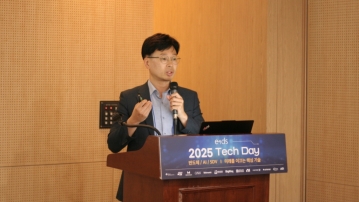
Park Young-jun, Executive Director of Tektronix, presented on "Verification for Automotive High-Speed Data Communication Technology and Power System Design" at the '2025 e4ds Tech Day' event. Executive Director Park stated, "Extending beyond 100Base-T1 and 1,000Base-T1 to 10Base-T1, all in-vehicle communication will be integrated into a single protocol," and emphasized that to ensure the reliability of high-speed interfaces, simulation-based eye diagram analysis using oscilloscopes is necessary beyond simple probing, and highlighted the importance of advanced measurement tools such as Tektronix's Serial Data Link Analyzer.
2025.09.19by 배종인 기자
[2025 e4ds Tech Day] "ADI GMSL Solutions: A Core Infrastructure for the SDV Era"
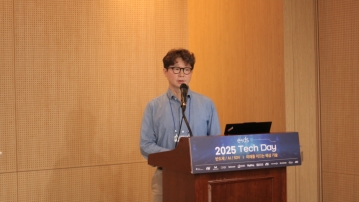
ADI (Analog Devices Inc.) Executive Director Son Sung-ho presented on "High-Speed Data Transmission Technology for SDV - ADI GMSL" at the '2025 e4ds Tech Day,' providing detailed information on SDV architecture and how ADI's GMSL (Gigabit Multimedia Serial Link) solution is applied within it. Executive Director Son Sung-ho stated, "The automotive industry is undergoing rapid paradigm shifts. There is accelerating transition away from traditional hardware-centric vehicle design toward software-centric 'Software Defined Vehicle (SDV)'" and added, "Within this trend, ADI is leading core technologies in future mobility through high-speed interface solutions optimized for the SDV era."
2025.09.19by 배종인 기자











