



[2025 e4ds Tech Day] "The Era of Physical AI: New Opportunities for the Semiconductor Industry"
 Published2025.10.20 14:08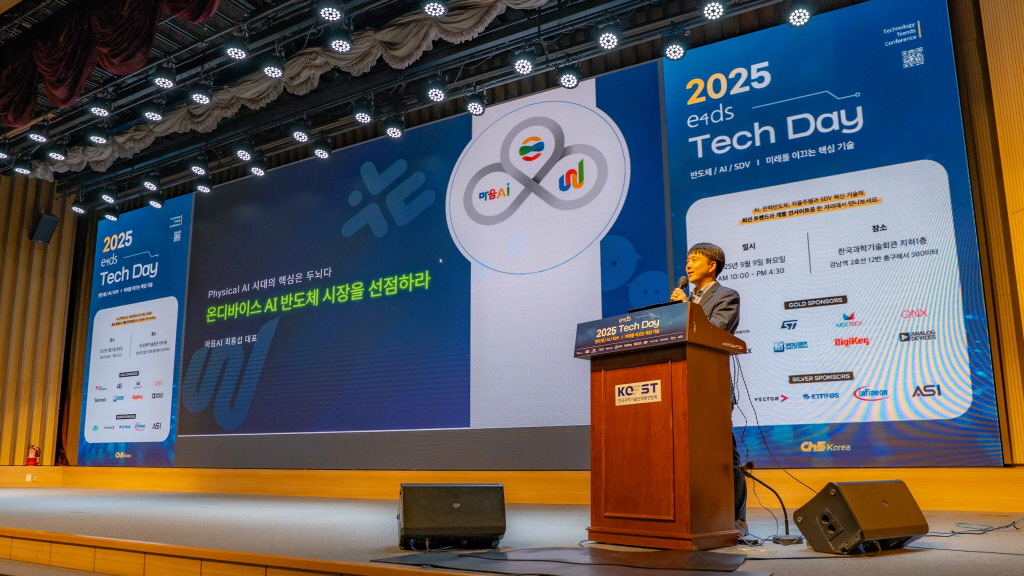
▲ Choi Hong-seop, CEO of Mind AI, is presenting on 'On-Device AI Technology and Strategy in the Era of Physical AI.'
Requires performance of over 100 TOPS, directly executing LLM-level model devices
"Physical AI and on-device AI are no longer optional, but essential technologies, and the development of semiconductors for these technologies will determine the competitiveness of the entire industry."
At the '2025 e4ds Tech Day' event held on September 9, Hongseop Choi, CEO of Mind AI, presented on 'Physical AI Era, On-Device AI Technology and Strategy', and gave an in-depth presentation on the definition of physical AI, market outlook, and the importance of on-device AI semiconductors.
CEO Choi Hong-seop first explained the concept of physical AI, defining it as “AI that acts in an actual physical environment, such as Tesla’s Optimus or Figure AI’s humanoid robots.”
While existing robotics relied on sophisticated programming and hardware control, physical AI is characterized by autonomous decision-making through data-based learning.
These technologies are not limited to humanoids.
Agriculture, defense, It can be utilized in various industrial fields such as construction, and in fact, Mind AI developed the first commercialized AI agricultural machine in Korea and signed a contract for mass production of 100 units.
The machine is a 'speed sprayer' that sprays pesticides in orchards and can be controlled in real time through on-device AI.
The core of physical AI is the 'Vision-Language-Action Model (VLA)'.
This is a form that integrates visual recognition and behavior control functions into the existing LLM (Large Language Model), and a single model performs the entire process of seeing, understanding, and acting.
“This model is not simply a combination of three functions, but operates as a single, integrated AI model,” CEO Choi emphasized.
On the other hand, commercializing these technologies requires overcoming the limitations of cloud-based AI.
Especially in areas with unstable communication environments, such as agriculture or defense, a loss of cloud connection can cause robot control to be interrupted, which can be a critical problem.
Accordingly, CEO Choi argues that on-device AI, that is, a method of performing AI calculations within the device, is essential.
High-performance AI semiconductors are required to implement on-device AI.
CEO Choi explained, “Currently, the computational performance of edge AI chips is typically around 10 to 20 TOPS, but to implement actual physical AI, performance of over 100 TOPS is required.”
Mind AI is preparing for mass production using Qualcomm's 100 TOPS chip, which is the choice for running LLM-level models directly on the device. />
Collecting data for physical AI is also a major challenge.
To mimic human behavior, we wear full-body sensor suits and collect data by having robots follow these actions. We are also actively utilizing digital twin-based simulation environments to reflect various environments and scenarios.
Mind AI calls this the ‘Digital Training Ground.’
CEO Choi predicted, “Physical AI could become the largest market in human history beyond a simple technology trend,” adding, “It has the potential to grow into an industry worth trillions of won, surpassing the automobile and smartphone markets.”
In particular, humanoid and autonomous driving technologies are considered key fields, and it is expected that robots with built-in AI will be deployed in all industrial sites in the future.
Finally, he advised semiconductor companies to “actively develop on-device AI semiconductors to prepare for the era of physical AI.”
We are currently collaborating with domestic and international semiconductor startups, sharing various technical requirements such as computational performance, power efficiency, and heat management.
Representative domestic companies such as DeepX, Mobilint, FuriosaAI, and Rebellions are challenging this field.

Comments
Related news
[2025 e4ds Tech Day] "ADI GMSL Solutions: A Core Infrastructure for the SDV Era"
ADI (Analog Devices Inc.) Executive Director Son Sung-ho presented on "High-Speed Data Transmission Technology for SDV - ADI GMSL" at the '2025 e4ds Tech Day,' providing detailed information on SDV architecture and how ADI's GMSL (Gigabit Multimedia Serial Link) solution is applied within it. Executive Director Son Sung-ho stated, "The automotive industry is undergoing rapid paradigm shifts. There is accelerating transition away from traditional hardware-centric vehicle design toward software-centric 'Software Defined Vehicle (SDV)'" and added, "Within this trend, ADI is leading core technologies in future mobility through high-speed interface solutions optimized for the SDV era."
2025.09.19by 배종인 기자
.jpg)
[2025 e4ds Tech Day] "Power Innovation in the AI Era: Improving Efficiency at Every Power Conversion Stage and Reducing Overall Losses Urgently"
Infineon Technologies Executive Vice President Kim Yong-jin presented at the '2025 e4ds Tech Day' event held on the 9th, speaking on the topic of "Infineon's Next-Generation Power Semiconductors for Energy-Efficient Power Management Solutions in AI Data Centers." He stated, "To achieve power innovation in the AI era, it is urgent to reduce overall losses by improving efficiency at each stage of the power conversion structure." To this end, he emphasized wide bandgap devices such as silicon carbide (SiC) and gallium nitride (GaN) as the core solution.
2025.09.26by 명세환 기자
.jpg)
[2025 e4ds Tech Day] "SiC Market to Grow Dozens-Fold by 2034, Requires Stabilization of Supply Chain and Domestic Mass Production Infrastructure."
Kim Hyung-woo, Director of the Next-Generation Semiconductor Research Center at Korea Electrotechnology Research Institute (KERI), presented on "Domestic and International Technology and Market Trends for SiC-Based Power Semiconductors" at the '2025 e4ds Tech Day' event held on September 9th. According to Director Kim Hyung-woo, silicon carbide (SiC) is establishing itself as a key material in the high-voltage, high-temperature, and high-reliability power electronics field due to its wide bandgap and excellent thermal conductivity.
2025.09.26by 배종인 기자
.jpg)
[2025 e4ds Tech Day] "GaN, the Future of Power Semiconductors, is Ready for Commercialization in 48V Power Systems."
Texas Instruments (TI) Manager Kim Seung-mok presented on the topic of "Implementing High Power Density and Efficient Digital Power Systems with TI GaN FET" at the '2025 e4ds Tech Day' event held on September 9th, emphasizing that power semiconductors are the core of next-generation industries such as electric vehicles, renewable energy, and high-efficiency power supplies. Manager Kim Seung-mok first reviewed the evolution of power semiconductors, stating, "Until 20 years ago, IGBTs were mainstream, but with the emergence of SiC, it began to be applied to high-voltage systems above 1,200V. However, there were limitations in terms of switching frequency. In contrast, GaN can switch up to 12MHz at voltage levels of 600-650V, making it possible to dramatically increase power density."
2025.09.29by 배종인 기자
.jpg)
[2025 e4ds Tech Day] "Verifying Power Semiconductors for Automotive Use for 10+ Years: Accelerated Testing Essential"
NI-Emerson T&M Director Sung Woong-yong presented on the topic of "High-Power Semiconductor Dynamic Reliability Test Solutions" at the '2025 e4ds Tech Day' event held on September 9th, proposing a new approach to reliability assessment methods for power semiconductors. Director Sung stated, "Since electric vehicles are products used for a minimum of 10 years or more, accelerated testing that can verify semiconductor lifespan in a short period is essential." He explained that NI has developed equipment reflecting both AQG324 and JEDEC test standards and is collaborating with major automotive and component companies in Germany. Through various test items including Dynamic Gate Stress (DGS), Dynamic Reverse Bias (DRB), and H3 TRB, the company is conducting precise analysis of semiconductor lifespan and performance.
2025.09.30by 명세환 기자











