



"In-cabin radar presents a new vehicle safety paradigm."
 Published2025.11.24 13:57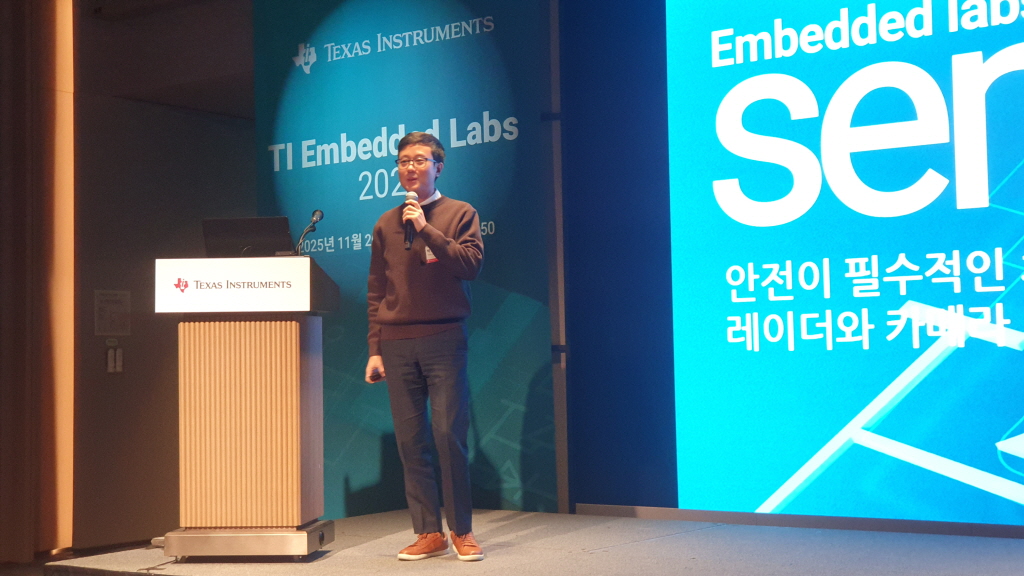
▲TI Vice President Park Seon-il is giving a presentation.
AWRL6844 MATLAB-based high-performance, precise passenger location detection and excellent human identification
Texas Instruments (TI) offers a variety of chipsets and processors that support radar and camera-based detection systems, and is leading the commercialization of in-cabin radar technology.
Texas Instruments (TI) held 'TI Embedded Labs 2025' at the Westin Seoul Parnas on the 20th.
On this day, Vice President Park Seon-il, who presented on the topic of “Combining Radar and Sensor Fusion in Safety-Critical In-Vehicle Applications,” stated that in-cabin radar technology installed inside a vehicle is expanding its scope beyond simple driving assistance to detecting and protecting passengers inside the vehicle, thereby suggesting a new safety paradigm.
The starting point of the Incabin Radar is the rear seat child detection system.
In South Korea, a 2018 incident sparked social debate after a toddler died after being left in a car.
Since 2019, rear seat monitoring devices have been mandatory for school buses, and related functions are gradually being expanded to general passenger vehicles.
Previously Although weight sensors and cameras were used, there were limitations in mistaking heavy objects for people or in detecting them in dark environments.
On the other hand, radar can determine the location and speed of an object through radio waves, so it has the advantage of not being greatly affected by light or environmental conditions.
Radar technology goes beyond simply detecting infants.
It is being expanded with various functions such as detecting intruders inside the vehicle and checking whether the seat belt is worn (SBR: Seat Belt Reminder).
In particular, SBR goes beyond simply detecting that a person is present, and can even determine which seat the passenger is sitting in and whether or not they are wearing a seat belt.
This can also be used to adjust the strength and direction of airbag deployment, playing a vital role in minimizing damage in the event of an accident.
While radar alone can implement many functions, it needs to be combined with a camera to monitor drowsy driving or driver alertness.
In fact, the European New Car Assessment Program (Euro NCAP) has recently strengthened its standards, no longer awarding points based on simple weight sensors, but rather requiring direct detection technologies such as radar and cameras.
Accordingly, the industry is moving toward achieving greater safety through a 'fusion solution' that combines radar and cameras.
TI's radar chipset plays a key role in implementing this technology.
According to Vice President Park Seon-il, TI's recently introduced AWRL6844 boasts high performance to the point that real-time operation demonstrations based on Matlab are possible.
It can precisely detect the position of a passenger sitting in an actual vehicle seat, and unlike simple weight sensors, it has an excellent ability to distinguish between objects and people. />
For example, even if a heavy object such as a water bottle is placed in the back seat, it will accurately distinguish it without mistaking it for a 'person'.
This allows for the stable implementation of various functions such as infant detection, intruder detection, and seat belt reminder.
TI also has a lineup of processors for camera-based monitoring, in addition to radar.
The AM27 series is suitable for radar processing based on MCU and can be used for relatively simple image processing, while the AM6 series is suitable for single camera use such as IR cameras.
The TDA series processes multiple cameras simultaneously and even supports AI-based image analysis.
These processors are essential for implementing advanced safety features such as driver monitoring systems (DMS), drowsiness detection, and distraction prevention.
Ultimately, the 'fusion' of radar and camera is required, and TI's product line provides the foundation to make this possible.
Currently, more than 15 companies around the world are developing Incain radar and are accelerating preparations for mass production.
This is not simply a technological competition; it is the result of the interplay between automotive safety regulations and consumer demands. Safety is no longer an option, but a necessity, and the technology that meets this requirement directly leads to market competitiveness.
Vice President Park Seon-il said, “Cars are no longer just ‘means of transportation’ but are evolving into ‘spaces that protect lives.’ Incabin radar is at the center of this, and is expanding its scope from rear seat child detection to intrusion prevention, seat belt reminders, and driver monitoring.”
He also said, “TI’s radar chipset and processor product line is the core engine that makes this technology possible,” and “In the future, Incavin radar will be established as a ‘safety eye’ that will be installed in all vehicles, not just as an option.”

Comments
Related news
“Continuous miniaturization and functional integration of semiconductor devices is the trend”
The trend toward developing smaller electronic products with more features is driving embedded systems developers to demand MCUs and embedded processors that are feature-rich and compact in size. To meet these demands, semiconductor manufacturers are making efforts to create products with compact form factors and multiple functionalities without compromising processor performance. In response, this publication examined a technical document titled "Small but Powerful: How Compact Packaging and Integration for MCUs Optimize Space-Constrained Designs," presented by Alex Grudzinski of Texas Instruments (TI), to understand how the integration of packaging and analog components can help reduce size without degrading embedded processor performance, as well as what impact optimized packaging has on manufacturing processes.
2025.06.24by 명세환 기자
TI Confirms Key Partner Status with Automobile Manufacturers
Texas Instruments (TI) recently won the "Operational Excellence" award at the 2025 Volkswagen Group Awards held in Wolfsburg, Germany, once again demonstrating its status as a key partner to automotive manufacturers.
2025.07.17by 명세환 기자
“The Future of Autonomous Driving Depends on Semiconductor Technology”
Today's automotive industry is evolving beyond being simply a means of transportation into a comprehensive collection of cutting-edge technologies. In particular, the proliferation of ADAS (Advanced Driver Assistance Systems) functions is serving as a full-scale turning point toward the autonomous driving era, with semiconductor technology at its core. According to Texas Instruments (TI), semiconductors are a key element enabling vehicle sensing, processing, communication, and power management, with their importance growing to the point where 1,000 to 3,500 units are now mounted in a single vehicle.
2025.07.23by 명세환 기자

Mouser Presents Vision for Industrial Automation… Collaborates with TI to Publish ‘Autonomous Mobile Robot’ E-Book
Mouser Electronics has published a new e-book in collaboration with Texas Instruments (TI) featuring expert analysis on autonomous mobile robots (AMRs). The book examines the current state and future prospects of AMR technology, which is driving innovation across diverse sectors including logistics warehousing, manufacturing facilities, and industrial automation, and is structured based on insights from 13 industry experts.
2025.07.24by 배종인 기자

TI's predictive battery management technology extends electronic device operating time by up to 30%.
Texas Instruments (TI) has officially announced the launch of single-chip battery fuel gauges 'BQ41Z90' and 'BQ41Z50' with the Dynamic Z-Track™ algorithm applied. These products feature embedded high-precision predictive modeling algorithms capable of accurately measuring state of charge (SOC) and state of health (SOH) with error margins within 1%, and provide an effect of extending battery operating time by up to 30%.
2025.07.30by 배종인 기자











