



Dell Technologies: "Governance and the Knowledge Layer are Key to the AI Era"
 Published2025.12.12 09:26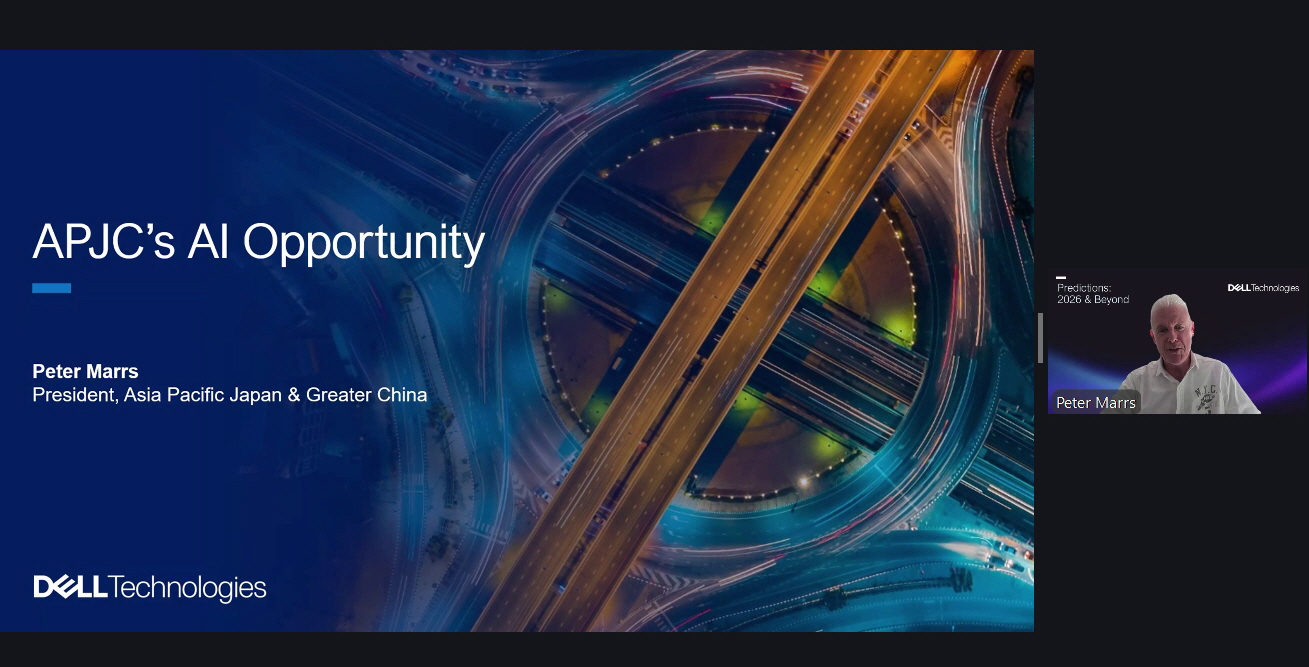
▲Peter Mars, President of Dell Technologies Asia Pacific, Japan, and China (APJC), is presenting AI opportunities in the Asia Pacific region.
AI is a tool accessible to all businesses; the key is scale.
Dell Technologies predicted that the growth of the AI economy will not be achieved simply through technological advancements, but will be achieved through five axes: governance, data, agents, resilience, and sovereign infrastructure. In particular, the Asia-Pacific region is accelerating the adoption of AI through close cooperation between governments and industries, and is expected to play a key role in the global AI competition.
Dell announced its 2026 artificial intelligence (AI) industry outlook through the 'Predictions APJC Media Briefing' on the 12th.
The event was attended by John Rose, Global Chief Technology Officer and Chief AI Officer, and Peter Mars, President of Asia Pacific, Japan, and China (APJC), who shared the current achievements and future challenges of the AI economy.
First, President Peter Maas introduced the third quarter 2025 performance, saying, “AI server shipments and storage demand have exploded, resulting in quarterly sales that are up year-on-year. “It grew by 11%,” he said.
Peter Maas, CEO, emphasized, “AI-related orders have accumulated to $30 billion this year, and shipments have grown 150% year-on-year to $25 billion,” adding, “This is not a one-time boom, but a sign of long-term growth.”
The performance of the APJC region was particularly notable.
SanDisk is leveraging its massive data infrastructure to prepare for an AI-driven future, while Indian software company Zoho is expanding its AI solutions across 150 markets.
Japan's GMO Internet is supporting industrial innovation by building the country's first GPU cloud service.
Peter Maas, CEO, said, “AI is no longer the exclusive domain of a select few, but a tool accessible to all companies, and the key is ‘scale-up.’”
Dell is also establishing AI innovation hubs in Singapore and Japan, collaborating with government, industry, and academia to cultivate talent and strengthen AI utilization capabilities.
We are also contributing to the expansion of the AI ecosystem through various programs such as student hackathons and 'Dell Innovate Fest.'
CTO John Rose then presented five AI trends that will shape 2026.
The first is governance.
“Technology and use cases alone won’t deliver ROI,” said CTO John Rose. “You need systematic governance to prioritize internally and reduce confusion.”
Additionally, “more than 1,000 government agencies around the world are proposing different AI regulations, making it difficult for businesses to operate.He pointed out that “an efficient and rational regulatory framework is urgently needed”, saying, “It is causing confusion in the market.”
The second is the importance of the Knowledge Layer.
CTO John Rose explained, “The data utilized by AI is not simply records from ERP or CRM systems, but a new knowledge structure converted into vector DB or graph DB.” He added, “This is always ‘hot data,’ so high-performance storage devices and refined data management are essential.”
The third is the proliferation of autonomous agents.
John Rose, CTO, defined autonomous agents as “complex software systems that have LLM-based communication, expertise and memory through knowledge graphs, utilization of external data and tools, and collaboration capabilities between agents.”
CTO John Rose predicted, “When agents are introduced into an organization, they will go beyond being mere tools and change the way work is done, significantly increasing productivity through collaboration between humans and machines.”
The fourth is the resiliency of the AI factory. “Simply replicating systems, like traditional IT, is very expensive,” he said. “We need a new resilience architecture that leverages the cloud, sovereign infrastructure, virtualization, automation, and even AI itself.”
The fifth and final one is the expansion of sovereign AI.
CTO John Rose emphasized, “Governments around the world are already discussing building AI infrastructure within their countries, and this will go beyond simply administrative services or model learning and become a core foundation for national strategic areas such as robotics, transportation, healthcare, and national defense.”

Comments 2
2 Comments:
Related news

Dell, SW-based separated infrastructure IT environment automation and security enhancement
Dell Technologies announced storage, cybersecurity resilience, and software updates based on a disaggregated infrastructure strategy to support data center infrastructure modernization, enabling secure and efficient management of modern workloads across on-premises data centers, cloud, and edge environments.
2025.05.26by 배종인 기자
Dell Launches Six 'Dell Pro Max' Mobile Workstations with RTX Pro Blackwell GPUs
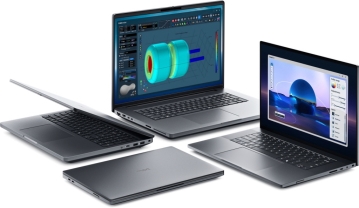
Dell Technologies has unveiled a new premium workstation brand 'Dell Pro Max' and introduced six mobile workstation models optimized for AI and high-performance computing tasks. These product lines feature NVIDIA RTX Pro Blackwell GPUs for powerful performance and are regarded as Dell's next-generation strategic products that combine portability, design, security, and sustainability.
2025.07.24by 배종인 기자

Dell Technologies Unveils Two Alienware Aurora Gaming Laptops
Dell Technologies has unveiled two new notebook series under its premium gaming brand 'Alienware,' the 'Alienware Aurora,' marking its full entry into the versatile computing market that encompasses gaming, work, learning, and entertainment.
2025.08.13by 배종인 기자
.jpg)
"We are now in an era of competition between AI and humans. We must overcome AI and leverage it."
Kim Kyung-jin, President and CEO of Dell Technologies Korea, reflected on how artificial intelligence is reshaping human life and the workplace, stating in his opening remarks at the "Dell Technologies Forum" on the 17th, "We are now in an era of competition between AI and humans. AI is not merely a tool, but an entity akin to a living being. Humans must not become subordinate to AI, but rather advance in a direction that leverages it."
2025.09.17by 배종인 기자
"The proof-of-concept for AI implementation is complete; we need to transition to on-premises."
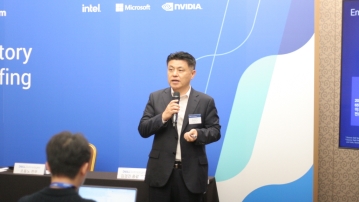
Dell Technologies Executive Vice President Jo Yong-no stated at the Dell AI Factory Media Briefing on the 17th that AI has now moved beyond simple technology demonstrations and entered a phase of practical application to real business tasks, emphasizing a focus on enterprise AI while recognizing the limitations of public cloud and advocating a transition to on-premises environments.
2025.09.17by 배종인 기자












유익한 글 감사합니다
유익한 글 감사합니다