



KERI Launches Korean Testing and Certification System in North America
 Published2026.02.02 09:01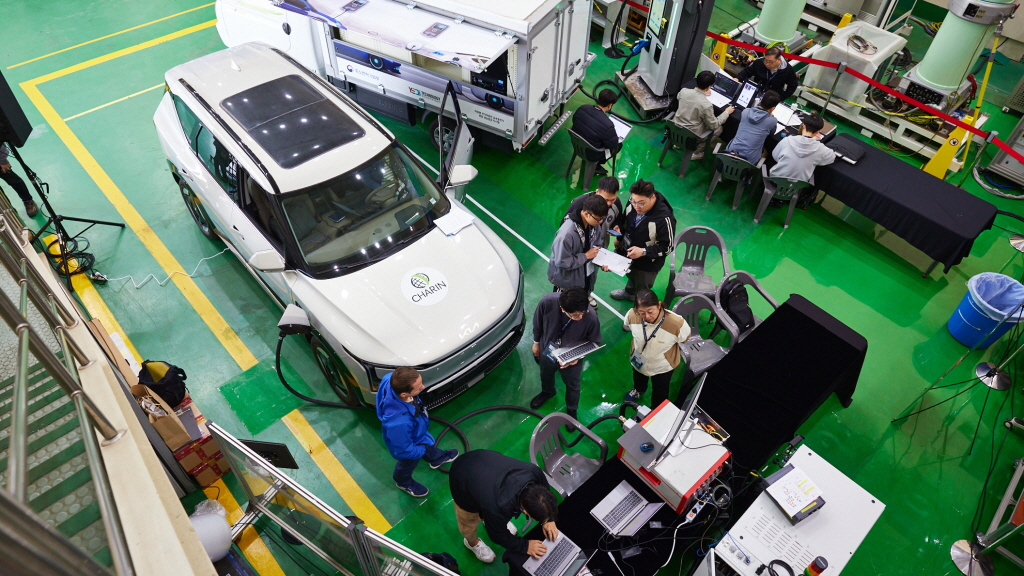
▲KERI is testing interoperability between electric vehicles and chargers with corporate representatives.
The Korea Electrotechnology Research Institute (KERI) is strengthening its presence in the global electric vehicle charging infrastructure market by winning a large-scale project to build a Korean-style electric vehicle charging interoperability test system in California, USA. This achievement is expected to directly assist domestic electric vehicle and charger manufacturers in entering the North American market.
KERI announced on the 2nd that it was finally selected as the execution agency for the 'Charge Yard' project worth 4 million dollars (approximately 5.6 billion won) recently commissioned by the California Energy Commission (CEC).
This project was successfully awarded through a joint team formed by KERI, the US non-profit organization Cal EPIC, and the International Electric Vehicle Charging Technology Association CharIN.
The 'Charge Yard' project is a large-scale interoperability testing and certification infrastructure project to resolve compatibility errors between electric vehicles and chargers.
As the spread of electric vehicles rapidly increased, problems such as charging interruptions or connection failures at specific chargers frequently occurred. As a policy solution, the CEC promoted the establishment of a permanent verification center.
KERI's experience in operating the 'Global Interoperability Test Center (GiOTEC),' the world's first, which opened at the Ansan branch last year, played a decisive role in receiving high marks for this project.
It has been reported that Patty Monahan, former chair of the CEC Mobility Division, visited KERI in person, witnessed the GiOTEC construction process, and highly praised its testing and certification capabilities.
Additionally, the fact that both KERI and Cal EPIC are non-profit organizations, which ensures fairness and objectivity in test results, was also a strength.
With this selection, the KERI joint team will establish a second interoperability test center in the Sacramento area of California after approximately one year of preparation.
This center is KERI GiOTEIt is designed based on C's system and operating process, and manufacturers who meet certain criteria can freely test compatibility with products from various manufacturers by permanently deploying their electric vehicles or chargers.
This will significantly reduce charging errors and secure data that will lead to international standards.
This project is particularly considered a significant boon for Korean companies entering the North American market. With testing conditions in Korea and the US now aligned, domestic manufacturers can conduct tests at KERI that meet US standards without having to travel to the US. This is expected to reduce product development costs and certification risks, thereby enhancing export competitiveness.
KERI's Seo Woo-hyun, head of the Intelligent Energy Testing Lab, emphasized, "Charge Yard will support various policies of the California CEC, and will play a particularly important role in securing interoperability of new technologies such as V2G (bidirectional charging). Since KERI oversees interoperability and conformity assessment technologies, it will be able to significantly reduce uncertainty for domestic manufacturers exporting to North America."
Kim Nam-gyun, President of KERI, also said, “As electric vehicle charging technology becomes more advanced, compatibility issues due to differences in standard interpretations between manufacturers are increasing,” and added, “Winning this project is an achievement that proves that KERI’s testing and evaluation capabilities are world-class, and it is an important stepping stone that supports domestic companies’ entry into the global market.”
Meanwhile, KERI, a government-funded research institute under the National Research Council of Science and Technology under the Ministry of Science and ICT, is expanding its key role in the global electric vehicle charging infrastructure sector, including by recently signing an agreement with EVgo, a leading U.S. electric vehicle charging network operator.

Comments
Related news
The Korea Electrotechnology Research Institute (KERI) shares photos of its research results, revealing the hidden value of its research sites.
The Korea Electrotechnology Research Institute (KERI) disclosed four research achievement photographs capturing the research sites of core technologies that will lead future industries, including semiconductors, batteries, electronic medicines, and wireless power transmission, thereby conveying the hidden value of research sites to the general public.
2025.12.22by 배종인 기자
Kim Nam-gyun, president of the Korea Electrotechnology Research Institute, declares a "power rush" in the era of electrification.
Kim Nam-gyun, President of the Korea Electrotechnology Research Institute (KERI), presented AI-based research innovation, response to mega-scale national projects, and strengthened open collaboration as core strategies through his New Year's address, declaring that "2025 will be a year in which KERI prepares for an even stronger leap forward as the national representative of electrical technology."
2026.01.05by 배종인 기자
The Korea Electrotechnology Research Institute (KERI) invites representatives from companies and institutions to strengthen regional innovation cooperation.
The Korea Electrotechnology Research Institute (KERI) held a discussion session on the 8th at its Changwon headquarters with approximately 30 regional leaders, sharing the institute's major achievements and future collaboration directions.
2026.01.09by 배종인 기자
Korea Electrotechnology Research Institute (KERI) introduces AI accessibility solution, becoming the first government-funded research institute to do so.
The Korea Electrotechnology Research Institute (KERI), a government-funded research institute under the National Research Council of Science and Technology, which is under the Ministry of Science and ICT, has undertaken a digital communication innovation by comprehensively redesigning its official homepage to commemorate its 50th anniversary.
2026.01.12by 배종인 기자
The Korea Electrotechnology Research Institute (KERI) sets a model for safety management among research institutions.
The Korea Electrotechnology Research Institute (KERI) has consecutively achieved top-tier ratings across three categories in the safety management field in 2025—including △Excellent Safety Management Laboratory △Outstanding Institution for Intensive Safety Inspection △Outstanding Institution for Disaster Response Safe Korea Training—thereby demonstrating the safety standards across its overall research environment.
2026.01.19by 배종인 기자











