



Infineon President Adam White: “Infineon Takes Responsibility for ‘Power Semiconductors,’ the Power Driving AI”
 Published2026.02.04 16:57
Equipped with core competitiveness including innovation speed, development, manufacturing, and supply capabilities
[Editor's Note] According to specialized market research firms, the global power semiconductor market is projected to grow at an average annual rate of 4.8% until 2037, reaching approximately $97.4 billion, driven by the expansion of AI data centers. To secure competitiveness in this market, advanced thermal management technology is essential, along with high power density, low voltage, and high reliability. Furthermore, semiconductor companies equipped with production capabilities to ensure stable supply even in situations of supply bottlenecks caused by surging demand can lead the market. Infineon Technologies, a representative global power semiconductor company meeting these criteria, has stated that its AI business is the fastest-growing sector within the company and is continuing strategic moves, such as investing in its Dresden plant. In this regard, through an interview with Adam White, President of Infineon’s Power & Sensor Systems division, we examined Infineon’s power semiconductor strategy as well as future growth opportunities expanding into robotics and quantum computing.
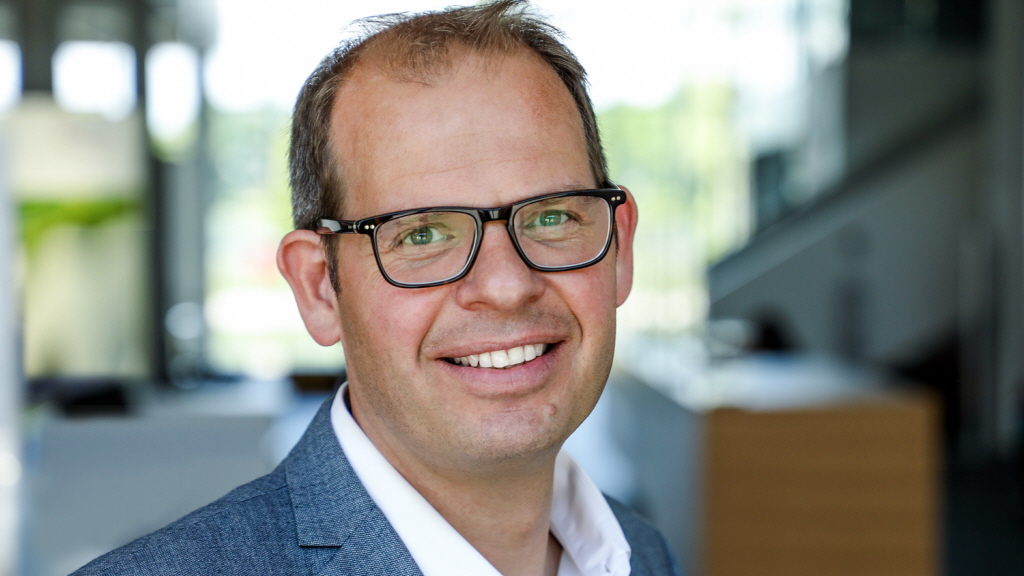
Adam White, President of Infineon's Power & Sensor Systems
■ How do you assess the growth of Infineon's AI business?
I have worked in the semiconductor industry for 20 years, but this is the first time I have seen a market moving at such a rapid pace.
Even five years ago, it was difficult to predict that AI applications would develop this rapidly.
However, it was clear that the power requirements of future processors would increase significantly, and Infineon has been accumulating relevant expertise since early on in preparation for this.
Currently, the AI business is the fastest-growing business within Infineon.
■ If you were to summarize Infineon's AI business in one word
Global investment in AI infrastructure is increasing rapidly, and accordingly, the demand for power supply solutions for AI data centers is also growing significantly.
Infineon expects sales of approximately 1.5 billion euros in this sector in fiscal year 2026, and estimates that the market size it can target will reach 8 billion to 12 billion euros by 2030.
Speed of innovation, development capabilities, manufacturing competitiveness, and a broad customer base are key competitive advantages.
■ Infineon's perspective on AI chip supply bottlenecks
The bottleneck of the current AI boom is production capacity, not demand.
The semiconductor industry is still operating under a Just-in-Time (JIT) order structure, making long-term demand forecasting difficult and the supply chain highly complex.
If hyperscalers further expand their investment in AI data centers in 2027, bottlenecks are likely to persist for the time being.
Under these circumstances, the 5 billion euro investment in Infineon's new Dresden plant is a very appropriate decision.
■ How are power semiconductors for AI different from existing applications?
AI has unique load characteristics that require high power density and low voltage compared to other power semiconductor applications.
Higher reliability, redundancy, fast switching speeds, and low losses are required throughout the entire power transmission process, from the power grid to the core.
In addition, AI data centers require much more advanced thermal management than existing renewable energy solutions.
■ What is the value share of Infineon chips in data centers?
Currently, a single server rack uses high-power semiconductors worth approximately $15,000.
In next-generation racks, this amount is expected to increase significantly and is likely to exceed $100,000 by 2030.
Tens of thousands of racks will be installed in AI data centers, and Infineon's solutions will be applied to a significant portion of them.
■ How do you expect the sales proportion of AI data center chips to change?
It was about 5 percent in the last fiscal year, and is expected to be around 10 percent this year.
If the expansion of AI infrastructure continues, Infineon's core competencies over the next few yearsIt will establish itself as a major business.
■ Where do you see future growth opportunities?
The AI business is expected to continue growing very strongly in the future.
Furthermore, there is great potential in robotics fields such as mobile AI-based robots, and in quantum computing in the long term.
■ What can Infineon contribute to the robotics field?
Since robots are not significantly different from software-defined vehicles in terms of architecture, very similar products can be supplied.
For example, it can help humanoid robots move, or support functions such as particularly difficult finger control.
It also enables robots to perceive their surroundings through sensors and provides communication and power management solutions.
Assuming the semiconductor cost per robot is over $1,400, up to $500 of that could be Infineon products.
Following automobiles, robots are the second major category of so-called 'physical AI'.
Once robots begin to be utilized on a large scale, this could become an important growth area for Infineon.

Comments
Related news

"Humanoid robots are humanity's next leap forward." Infineon presents key solutions.
Humanoid robots have potential for application across various fields including manufacturing, healthcare, and service industries. Infineon Technologies AG is presenting key solutions such as high-efficiency power semiconductors, intelligent MCUs, advanced sensors, and reliable battery management systems, helping robots establish themselves as collaborative partners working with humans rather than mere machines. To this end, Infineon offers diverse power semiconductor solutions including OptiMOS™ and StrongIRFET™ power MOSFETs, MCUs with embedded AI accelerators, 3D Time-of-Flight (ToF) sensors, RADAR and pressure sensors, among others.
2025.11.27by 명세환 기자
Infineon supports more accurate system-level simulation
Global semiconductor company Infineon Technologies (Korea CEO Lee Seung-soo) has newly added SPICE-based model generation functionality to its power simulation platform IPOSIM (Infineon Power Simulation Platform), enabling more accurate system-level simulation across diverse applications where switching power and thermal performance are critical, including EV charging, photovoltaic, motor drive, energy storage systems (ESS), and industrial power supply units.
2025.11.27by 배종인 기자
Infineon and Lenovo Accelerate Autonomous Driving with AI-Integrated SDV Architecture
Infineon Technologies (Korean Representative Director Lee Seung-soo) and global technology company Lenovo have strengthened strategic cooperation for autonomous driving and smart mobility innovation, aiming to implement a high-performance automotive computing platform capable of AI integration in preparation for the SDV era. Lenovo's flagship autonomous driving domain controller units AD1 and AH1 leverage Infineon's AURIX™ microcontroller product family to support advanced driver assistance systems (ADAS), energy efficiency, and high-speed data exchange between in-vehicle networks.
2025.12.17by 배종인 기자
'GaN' Positions Itself as a Core Pillar of Future Power Technology… Infineon’s Medium-Voltage GaN Bidirectional Switches and 300mm Power GaN Technology Lead the Paradigm Shift in Power Electronics
Infineon Technologies AG's medium-voltage GaN bidirectional switch (CoolGaN™ BDS 40V G3) and 300mm power GaN technology are being recognized as "game changers" in the industry and are emerging as a core pillar of next-generation power systems.
2026.01.05by 배종인 기자
.jpg)
Infineon switches to eco-friendly power at 100% of its global operations, reducing CO₂ emissions by 80%.
Power semiconductor company Infineon Technologies is leading the sustainability transformation of the global semiconductor industry as it transitions to using 100 percent renewable energy across all of its facilities worldwide.
2026.01.12by 배종인 기자











