


Professor Cho Seong-jae ⑥, “Sensors Ultimately Read as Voltage”
 Published2026.02.10 09:20
Caution advised against blindly trusting datasheets; additional consideration of real-world environments is required.
[Editor's Note] Recently, the e4ds Electrical and Electronic Lifelong Education Center held the '2025 Advanced Engineer Practical Master Class' as an offline course. Targeting current developers who have completed the intermediate course and engineers with practical experience in circuit design, this course covers advanced topics in electronic circuit design and real-world problems in precision measurement environments. Accordingly, we interviewed Professor Cho Seong-jae of the Department of Electrical and Electronic Engineering at Shinhan University, who is teaching this course, to learn about the course's direction and engineering education. This interview will be published in a six-part series.
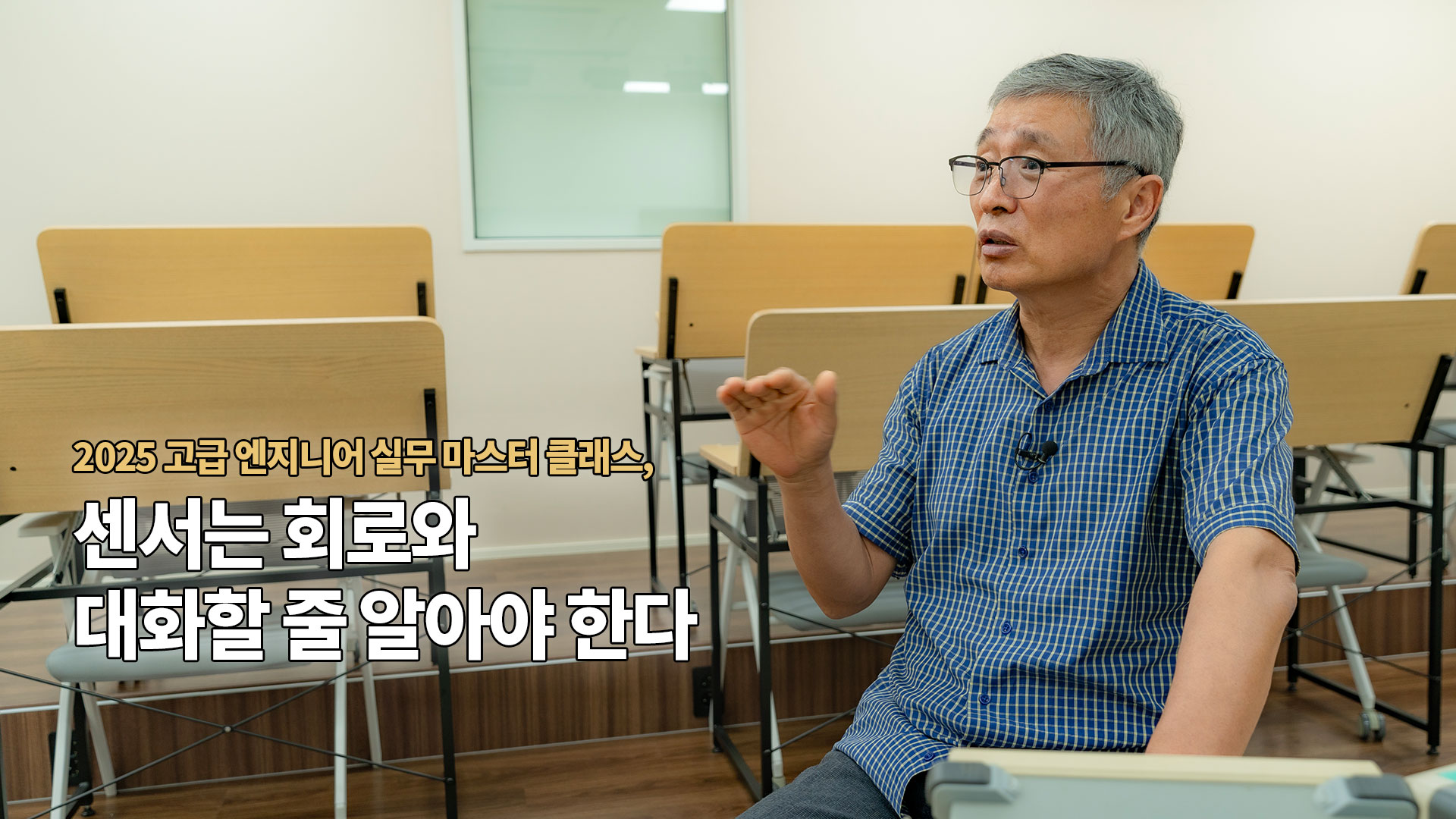
Sensors ultimately read as voltage
In a recent interview with this publication, Professor Cho Seong-jae of Shinhan University emphasized the importance of basic concepts, stating, “If you do not understand the essence of a sensor, the design ultimately becomes a ‘patchwork.’”
Sensor technology is a core foundation of industries across the board today. Sensors that measure various physical quantities such as temperature, humidity, pressure, and light are utilized in almost all electronic systems, including semiconductors, communications, automobiles, and medical devices.
On the other hand, the process of utilizing sensor signals in an actual system is more complex than expected.
According to Professor Cho, sensors are broadly divided into three types based on their output form.
The first is a sensor that expresses physical quantities through changes in resistance, the second is a sensor that appears through changes in current, and the third is a sensor that outputs through changes in voltage.
The problem is that not all of these sensor signals can be read directly by the microcontroller or AD converter.
What we are actually reading is voltage. Ultimately, whether it is resistance or current, everything must be converted into voltage. This is the first goal of sensor interface design.
Resistive sensors convert changes in resistance into changes in voltage by forming a voltage divider circuit using a combination of a fixed resistor and a sensor.
Current output sensors use an IV converter to convert current into voltage. Voltage output sensors also cannot be used as is.
Since the output voltage is very small, amplification and level conversion are required to match the reference voltage range of the AD converter, for example, 0 to 3.3 V or 0 to 5 V.
Professor Cho points out that many engineers struggle with this process.
There are many cases where people rely on experience or arbitrarily configure circuits because they do not know how to convert them. On the other hand, there are intuitive methods and clear rules.
He explained that through his extensive teaching and practical experience, he has compiled design principles that allow anyone to solve problems in a short amount of time.
In actual training, students are given a sensor output range and directly perform the design to accurately match it to the AD converter input range.
For example, when the sensor output changes within a specific voltage range, design a circuit to linearly convert it to 0–3.3V, and visually check through a sine wave input whether the output comes out exactly in the 0–3V range.
If you go through this process, you can immediately tell if the design is done correctly.
Another point Professor Cho emphasizes is that one must be wary of blindly trusting data sheets.
"Datasheets often state that something 'works,' but it frequently doesn't in actual circuits. You must understand why it doesn't work to develop true proficiency."
He explained that datasheets are often written based on ideal conditions, so additional consideration is needed in real-world environments.
Professor Cho says that this kind of education is necessary for all engineers majoring in electronic engineering.
Properly understanding the basics makes a significant difference in design speed and quality. You will feel that this training alone is worth the cost of the advanced course.
He plans to continuously improve the educational content based on student evaluations.
Sensor interface design goes beyond simple circuit technology and determines the reliability of the entire system.
Professor Cho Seong-jae's message is clear. More important than complex formulas is the ability to understand the nature of sensor signals and accurately translate them into the common language of voltage.

Comments
Related news
Electronic Engineers Announces Five "2019 Technicians of the Year"
Ahead of 2020, e4ds News conducted the '2019 Engineer of the Year Award' evaluation targeting electronics engineers across eight categories including development leadership, global competency, and technology dissemination. As a result, five individuals were selected from five fields and awarded the '2019 Technology Excellence Award'. The recipients are Yoo Myung-hwan, CEO of AccessLab; Park Kyung-jin, CEO of Cracka; Cho Sung-jae, Professor at Shinhan University; Bae Ju-shik, CEO of iWells; and Kim Hak-yong, CEO of IoT Strategy Research Institute.
2019.12.18by 명세환 기자
"Need to pay attention to pattern design according to signal flow"
Professor Cho Sung-jae won the '2019 Engineer of the Year Award' in the high-efficiency power supply design category through the '2019 Engineer of the Year Evaluation' conducted by e4ds News in December. e4ds News asked him about his acceptance remarks and inquired about the current state and future of the high-efficiency power supply design field.
2020.01.06by 명세환 기자
[Interview] Professor Jo Seong-jae of Shinhan University - “EMC/EMI, the eternal homework of circuit design, training of experts is essential”
Professor Jo Sung-jae of Shinhan University, who recently conducted an interview with this publication, stated that EMI is a common issue among circuit designers, and emphasized the importance of education provided by specialized institutions, noting that solving EMI requires accumulating experience by encountering and resolving diverse problems over an extended period.
2021.09.14by 배종인 기자
[Interview] Professor Cho Seong-jae ①: "Practical circuit design issues ultimately boil down to fundamentals."
Recently, e4ds Electrical and Electronics Lifelong Education Institute held an offline course titled "2025 Advanced Engineer Practical Masterclass." This course is designed for practicing developers who have completed intermediate-level courses and engineers with practical circuit design experience, covering advanced topics in electronic circuit design and real-world problems in precision measurement environments. In this regard, this publication conducted an interview with Professor Cho Sung-jae from the Department of Electrical and Electronics Engineering at Shinhan University, who is teaching this course, to discuss the course direction and engineer education. This interview will be serialized over six installments.
2025.11.20by 배종인 기자
[Interview] Professor Cho Seong-jae ②, “Electronic Circuits Are Learned by Hand, Not Theory”
Recently, e4ds Electrical and Electronics Lifelong Education Institute held an offline course titled "2025 Advanced Engineer Practical Master Class." This course targets current developers who have completed intermediate-level coursework and engineers with practical circuit design experience, covering advanced topics in electronic circuit design and real-world problem-solving in precision measurement environments. Through an interview with Professor Jo Sung-jae of the Department of Electrical and Electronics Engineering at Shinhan University, who is instructing this course, we inquired about the direction of the course and engineer education. This interview will be serialized over six installments.
2025.12.11by 배종인 기자











