



SKT and Panesia Jointly Develop Next-Generation AI Data Center Architecture Based on CXL
 Published2026.03.04 11:24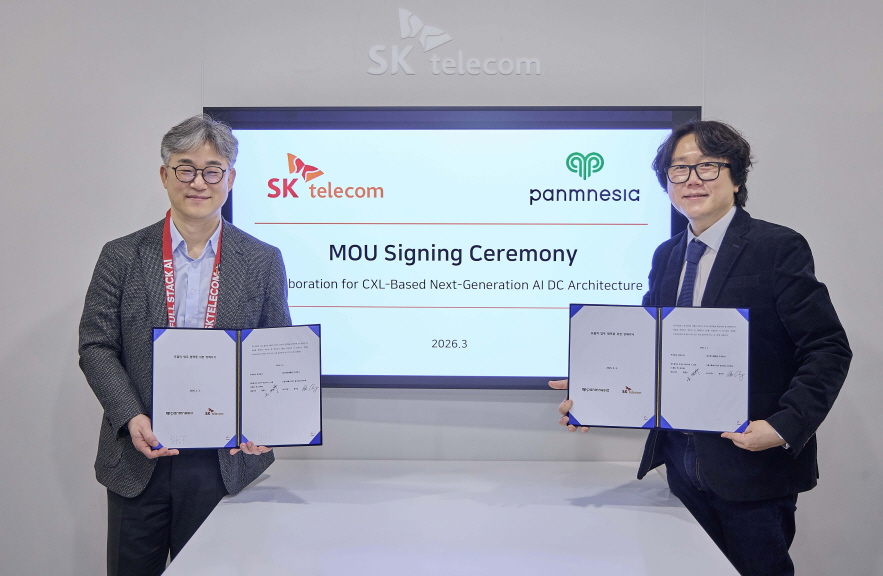
MOU signed at MWC26… Pursuing efficiency improvements by changing resource connection structure instead of expanding GPU capacity
SK Telecom is moving to improve the efficiency of its AI data centers (DCs) by fundamentally changing the way computing resources are connected. This decision stems from the assessment that expanding solely by increasing the number of GPUs is insufficient to resolve the issues of rising memory demand and resource utilization imbalances.
SK Telecom announced on March 4 (local time) that it signed a Memorandum of Understanding (MOU) with Pannesia at MWC26 in Barcelona, Spain, for the joint development of a 'CXL-based next-generation AI DC architecture'.
The two companies are pursuing a structural transition based on CXL (Compute eXpress Link) to flexibly connect and combine resources, aiming to reduce inefficiencies arising from the existing architecture where CPUs, GPUs, and memory are fixed at the server level. The plan is to alleviate the limitation where other servers struggle to utilize surplus resources even when one server is empty, and specifically to reduce the need to expand GPU capacity alongside memory when demand increases.
We are also considering a method to selectively utilize necessary resources by extending the scope of resource connectivity beyond the internal server to the rack unit, which groups multiple servers together. The explanation is that the goal is to create a structure that connects the CPU, GPU, and memory more densely by utilizing CXL.
The initiative also included attempts to change the connection path itself. While it was previously common practice to exchange data via general-purpose networks such as Ethernet during GPU collaborative computing, a plan to implement CXL-based connections is being pursued, considering that data copying and software intervention during this process can cause latency.
A division of roles was also presented. SK Telecom will lead the structural design optimized for commercial environments based on its capabilities in building and operating large-scale AI DCs and its experience in developing and commercializing AI models, while Panesia will provide the technical elements necessary to expand the connection structure based on CXL-related link semiconductor technologies, such as fabric link switches and link controllers.
The two companies plan to comprehensively verify GPU and memory utilization, latency, and throughput while running actual AI models, and then unveil the results of the next-generation AI DC structure by the end of 2026. Afterward, they plan to pursue commercialization and business development following large-scale AI DC environment demonstrations.

Comments
Related news
SKT CEO Jeong Jae-heon: "As Korea's leading AI provider, we will dedicate ourselves to becoming one of the top three AI powerhouses."
Jung Jae-heon, CEO of SK Telecom, announced an AI infrastructure construction roadmap at the 'SK AI Summit 2025' held on the 3rd, presenting a vision to strengthen South Korea's AI competitiveness as the nation's representative AI business operator. Through a keynote speech, CEO Jung unveiled the 'AI Infra's Now & Next' strategy, which includes expansion of the Ulsan AI Data Center (DC), establishment of a manufacturing AI cloud, and technology collaboration in edge AI and AI-RAN.
2025.11.03by 배종인 기자
.jpg)
SKT and Samsung Electronics Jointly Develop 6G AI-RAN Technology
SK Telecom (CEO Jung Jae-heon) and Samsung Electronics are moving forward to strengthen global 6G competitiveness through joint development of 6G AI-RAN (Artificial Intelligence-based Radio Access Network), a next-generation mobile communication technology.
2025.11.27by 배종인 기자
SKT's massive AI 'AX K1' receives rave reviews both domestically and internationally.
SK Telecom's 'A.X K1', the country's first 500B-class ultra-large AI model, has surpassed 8,800 downloads just four days after its technical report was released on the 7th, drawing rapid attention both domestically and internationally following its public release.
2026.01.12by 명세환 기자
SKT's self-developed LLM recommendation model, "One Model 4.0," selected the top 4% of papers.
SK Telecom (CEO Jung Jae-heon)'s research paper on "One Model" version 4.0, an LLM (Large Language Model)-based AI recommendation model, has been selected for an "Oral Session" presentation, ranking in the top 4% at the global AI conference AAAI 2026.
2026.01.26by 배종인 기자
.jpg)
SKT Implements Special Communication Measures in Preparation for the Lunar New Year Holiday and Winter Olympics
SK Telecom will implement special communication measures to maintain the stability of telecommunications services during the Lunar New Year holiday and the Winter Olympics period. A special communication control room will be operated for six days from February 13 to 18 during the Lunar New Year holiday, and capacity inspections of base stations at approximately 1,200 major locations nationwide have been completed. Free video call services and intensive management of international roaming will be implemented during the holiday period, while wired and wireless network management in preparation for increased Winter Olympics content will also be conducted in parallel. Additionally, a 24-hour security monitoring system centered on the integrated security center will be operated, including responses to hacking, DDoS, and smishing attacks.
2026.02.09by 명세환 기자











