



Rockwell: "The future of manufacturing is autonomous factories that combine human expertise and AI intelligence."
 Published2026.03.04 11:42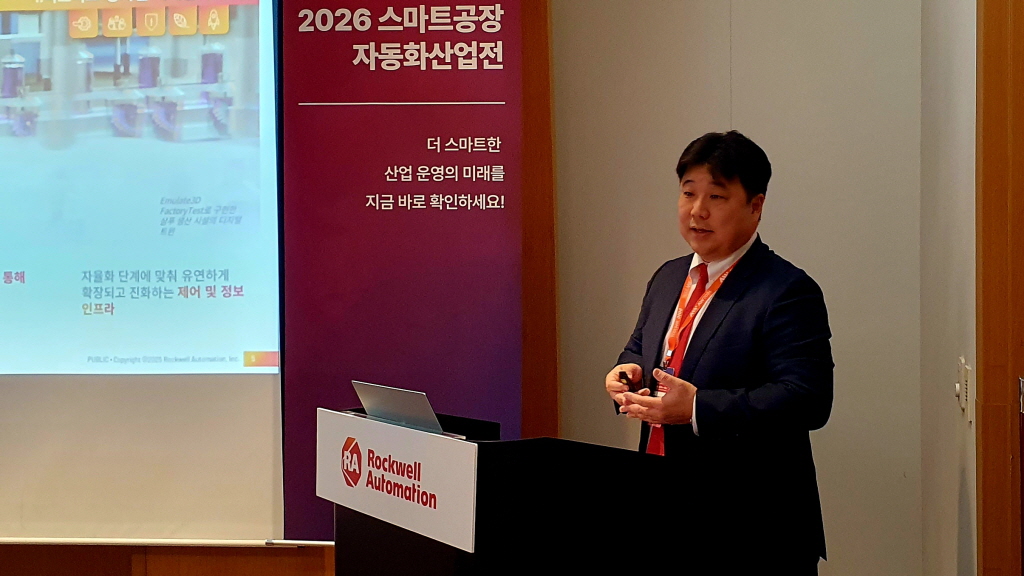
Kim Nak-hyun, Head of Industry & OEM Sales at Rockwell Automation
AI-based solutions deliver real results, including quality improvements and energy savings.
Rockwell Automation, a global industrial automation company, announced that the manufacturing industry is rapidly transitioning from traditional automation-centered operations to AI and data-driven autonomous operations, and that it is actively working to make autonomous operations a reality.
On the 4th, Rockwell held a press conference at COEX in Seoul and unveiled its vision for 'Autonomous Operations' along with changes in the manufacturing environment.
On this day, Kim Nak-hyun, Head of Industry & OEM Sales at Rockwell Automation, and Lee Won-seok, Head of Market Access Sales, took the stage to explain the realities facing the manufacturing industry and technological solutions using specific examples.
Kim Nak-hyun, CEO of the headquarters, stated, “A complex mix of risks, including rising energy costs, a shortage of skilled workers, supply chain instability, and inflation, is putting pressure on the manufacturing industry as a whole. Even in this environment, fundamental changes in manufacturing operations are required to ensure sustainable productivity and efficiency.”
He particularly noted that rapid advances in AI, high-performance computing, and robotics technologies are impacting manufacturing.
/> He emphasized that the transition from conventional hardware-centric automation to AI-based software-driven autonomous manufacturing is already becoming a reality, saying that it is opening up new possibilities in the manufacturing sector.
The autonomous operation proposed by Rockwell Automation goes beyond simply automatically moving equipment.
The key is for AI to analyze the massive amount of data generated from processes and facilities in real time, predict problems in advance, and independently derive and apply optimal operating plans.
“Many customers have already adopted AI-based solutions and are achieving tangible results, including quality improvements, energy savings, and predictive maintenance,” explained CEO Kim.
In fact, in the tire manufacturing process, AI was used to derive optimal cutting patterns, reducing defects and scrap, and in the semiconductor equipment field, energy efficiency was significantly improved through digital twin-based simulations.
In the food process, there was also a case study introducing AI predictive maintenance that significantly reduced unexpected equipment downtime.
Another axis of autonomous operation is logistics.
“No matter how fast the process equipment gets, if logistics cannot keep up, the productivity of the entire factory will reach its limit,” said CEO Kim, emphasizing the importance of “autonomous logistics,” which combines autonomous mobile robots (AMRs) and intelligent motion technology.
In fact, global consumer goods factories facing serious labor shortages have implemented AMRs to address labor shortages while simultaneously reducing the risk of safety accidents. Furthermore, by automating the movement of materials between processes, they have created an environment where workers can focus on high-value-added tasks.
Lee Won-seok, Head of Sales, Market Access, Rockwell Automation
Director Lee Won-seok explained the technological foundation that supports this vision.
“Industrial AI operates on essentially the same principles as AI applied to smartphones and self-driving cars,” he said. “The difference is that it applies to factories, facilities, and production processes.”
Rockwell Automation explains that it is embedding AI throughout the manufacturing lifecycle, from design to operation and maintenance, providing integrated solutions that are not limited to a single process or specific stage.
During the design phase, AI learns engineers' design data to automatically generate parameters, and performs test runs and verification in a virtual environment through a digital twin.
In the operation phase, the AI engine built into the PLC and controller analyzes process data in real time to derive optimal control values and supports the achievement of production goals in conjunction with the MES.
During the maintenance phase, edge AI continuously monitors equipment status, detects abnormalities early, and automatically guides workers to take necessary actions.
“The important thing is that AI doesn’t just detect problems, but implements a closed loop that leads to actual control and operation,” said the head of the headquarters. “Rockwell Automation is making this autonomous operation a reality by flexibly connecting existing facilities and heterogeneous systems based on an open architecture.”
Rockwell Automation will continue to expand its autonomous operation ecosystem through collaboration with global partners and transform from a hardware-centric company to a software and data-based industrial solutions company.The strategy is to accelerate the transition.
“The future of manufacturing is not a factory where people are excluded, but an autonomous factory that combines human expertise and AI intelligence,” said Kim Nak-hyun, CEO of the headquarters. “The market is already moving in that direction.”

Comments
Related news
Rockwell, “Accelerate AI Smart Manufacturing Adoption for Life Science Manufacturers”
According to the "2025 Smart Manufacturing Status Report: Life Sciences Edition" recently released by Rockwell Automation, Inc., a global leader in industrial automation and digital transformation, life sciences manufacturers are facing complex challenges including economic uncertainty, enhanced quality and regulatory compliance requirements, and workforce shortages. In response, they are accelerating the adoption of AI-based smart manufacturing technologies.
2025.06.26by 명세환 기자
Rockwell, Kia Slovakia enhance production efficiency and stability
Rockwell Automation, a leader in industrial automation and digital transformation, is upgrading the lifter system, a key production facility at Kia Slovakia's body shop, with the latest servo technology.
2025.07.04by 명세환 기자
Rockwell Maximizes Design Efficiency for Small Automation Systems
Global leader in industrial automation and digital transformation Rockwell Automation, Inc. officially launched free design software specialized in micro control systems, "FactoryTalk® Design Workbench™," on the 29th, setting a new standard for small automation system design.
2025.10.29by 명세환 기자
Rockwell Automation Announces Innovations in its Flexible MES Portfolio
Rockwell Automation, Inc., the world's leading industrial automation and digital transformation specialist, serves as the modern manufacturing digital backbone with its cloud-native interoperable MES platform.
2025.12.10by 배종인 기자
Rockwell Automation Named to Gartner's Hype Cycle for 20 Categories
Rockwell Automation, Inc., the world's largest industrial automation and digital transformation specialist, has been featured across 20 different domains in Gartner®'s 'Hype Cycles' report, receiving recognition for global technology leadership in manufacturing, AI, cybersecurity, and energy sectors.
2025.12.17by 배종인 기자











