



77% of companies adopting AI report increased hiring... Data is a barrier to its expansion.
 Published2026.03.11 09:59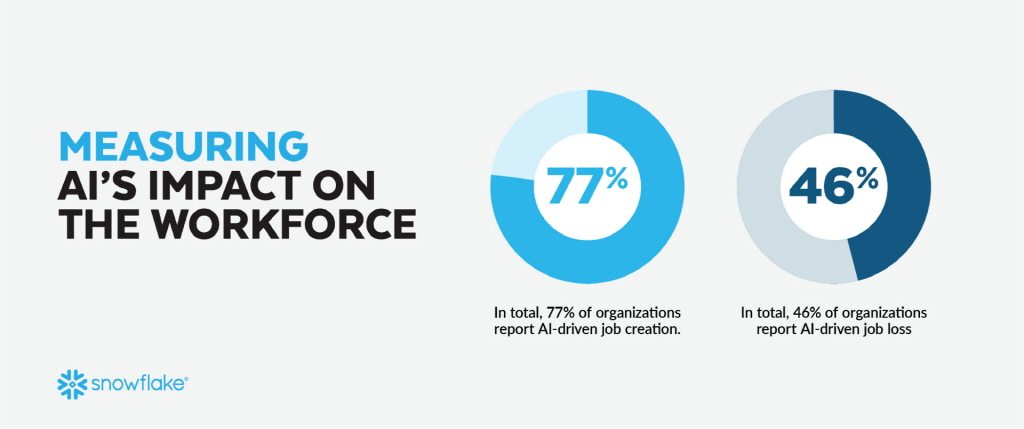
96% of companies struggle to scale… Data readiness and governance are key.
Contrary to concerns that generative artificial intelligence (AI) will reduce jobs, a survey found that actual hiring increases are more prevalent in businesses. While 77% of companies that adopted AI reported increased hiring, only 46% reported job losses. This suggests that the spread of AI is leading to organizational restructuring and job restructuring, rather than simply downsizing.
According to a joint report by Snowflake and Omdia released in Seoul on March 11, the survey surveyed 2,050 business decision-makers across 10 countries. Among companies experiencing both increased hiring and job losses, 69% said AI had a positive impact on overall employment.
Specifically, 42% of respondents reported that AI created new jobs, while 11% reported only job losses. Thirty-five percent reported both job creation and job loss. Organizations with multiple AI use cases experienced a greater net positive effect on employment. Seventy-five percent of organizations with multiple use cases reported seeing positive effects, compared to only 56% of those in the early stages of adoption. By job category, the net increase effect was most pronounced in IT operations, cybersecurity, and software development.
The problem, apart from profitability, is that the scaling phase remains challenging. While the survey found that companies are seeing an average return of $1.49 for every dollar invested in AI, 96% of respondents said they face challenges during the actual scaling process. The main obstacles cited were breaking down data silos, measuring and monitoring data quality, and preparing data for AI use. Only 7% of organizations reported that more than half of their unstructured data was AI-ready.
Governance issues were also revealed. Fifty-seven percent of all employees and 66% of executives reported using unapproved AI tools, and 60% indicated the need for additional investment in data infrastructure and monitoring software. This suggests that the bottleneck in AI adoption lies not in model performance itself, but in data reliability, controllability, and management systems.
The scope of AI adoption is already expanding across core business processes. Ninety-two percent of early adopters reported a positive return on investment and planned to allocate 22% of their total technology budget to AI over the next year. Utilization was high in IT operations, data analytics, cybersecurity, and software development, with some respondents stating that approximately 48% of all code was generated by AI. The report emphasized that while AI is moving beyond the experimental stage and into operational systems, data readiness and governance capabilities must precede it to lead to sustained results.

Comments
Related news

Snowflake: A Case Study of AI Data Cloud Innovation
Global AI data cloud company Snowflake will host "Snowflake World Tour Seoul," its largest domestic conference, at COEX Convention Center in Samsung-dong, Seoul on September 9th. Under the theme "A Step Toward the Future of Data and AI," the event will showcase the latest AI data cloud technologies driving business innovation across industries and share various customer success stories.
2025.08.20by 배종인 기자
Snowflake Solves Customer Technical Difficulties with Easy, Connected, and Trust Platform
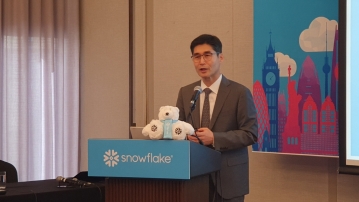
Snowflake held a press briefing on the 8th at the Grand Intercontinental Seoul Parnas, emphasizing how its platform is revolutionizing enterprise data utilization in ways that are simple, accurate, and strong in security. The press briefing was held to explain what topics will be covered ahead of the "Snowflake World Tour Seoul" on September 9th. During the press briefing, Choi Ki-young, Country Manager of Snowflake Korea, stated that Snowflake is focused on simplifying complex data processing procedures.
2025.09.08by 배종인 기자
Snowflake Unveils Cortex, a Financial AI Platform
Snowflake has unveiled "Cortex AI for Financial Services," an AI platform specialized for the financial industry. Through newly introduced MCP servers, enterprises can securely connect internal data and external agents, and integrate structured and unstructured data to automate various financial operations such as anomalous transaction detection, insurance underwriting, and customer analysis. This enables financial institutions to build an ecosystem capable of rapidly securing high-precision AI-driven insights while maintaining security and regulatory compliance.
2025.10.15by 명세환 기자

Snowflake Intelligence Increases Productivity by 98%
Snowflake announced Snowflake Intelligence through a press briefing on "Snowflake Intelligence Launch," stating that Snowflake Intelligence provides insights to all stakeholders, reduces downtime analysis time, and improves productivity.
2025.11.20by 배종인 기자

Snowflake: "Agentic AI reliability and data strategy determine corporate competitiveness."
AI data cloud company Snowflake recently released the 'AI + Data Forecast 2026 Report,' projecting that agentic AI and data strategy will be the key focus areas for enterprise AI in 2026.
2026.01.16by 명세환 기자











