



TI Usheres in the Era of "Edge AI for Every Device" with TinyEngine™ NPU-Integrated MCUs
 Published2026.03.11 11:12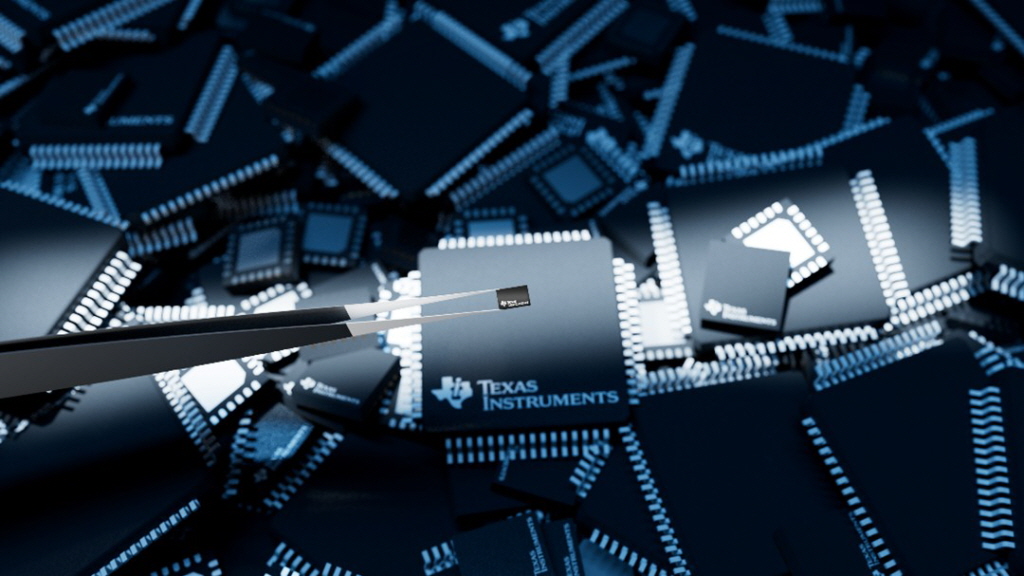
MSPM0G5187, Ultra-low-power, compact, and low-cost design for edge AI applications in everyday electronic devices.
Texas Instruments (TI) has unveiled a new microcontroller (MCU) portfolio that significantly lowers the barrier to implementing edge AI.
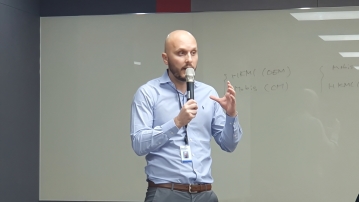
TI held an online press conference on the 11th and introduced the TinyEngine™ NPU integrated MCU that will be unveiled at Embedded World 2026, and announced its strategy to “support developers in implementing edge AI on any device.”
“AI is no longer a technology limited to the cloud or high-performance processors,” said TI Technical Support Director Jeong-hyeok Huh, who gave the presentation that day. “By performing AI inference at the edge closest to the sensor, we can drastically reduce latency and power consumption, and even lower system complexity.”
The core of TI's newly unveiled MCU is the TinyEngine™ NPU. This hardware accelerator, integrated within the MCU, operates independently of the CPU and is dedicated to neural network inference.
This can reduce inference latency by up to 90 times and energy usage by up to 120 times compared to existing software-based AI.
It can implement AI functions without a network connection, making it particularly suitable for real-time control and battery-powered products where responsiveness is critical.
The general-purpose MCU, 'MSPM0G5187', enables the application of edge AI to everyday electronic devices such as wearables, smart homes, and small sensor modules based on its ultra-low power, small size, and low-cost design.
It is available for less than $1 per thousand units and can process various AI functions such as voice call recognition, motion detection, and anomaly prediction on the MCU level.
“The biggest advantage is that adding AI has little effect on battery life,” explained Director Huh.
The 'AM13Ex' MCU, aimed at the industrial market, combines the high-performance Arm Cortex-M33 core and TinyEngine™ NPU to implement motor control and AI simultaneously.
It can control up to four motors in real time, while performing AI functions such as bearing defect detection, load imbalance recognition, and predictive maintenance on a single chip.
This leads to a reduction in the number of parts and costs in complex systems such as home appliances, industrial equipment, and humanoid robots.
TI is focusing on strengthening its software ecosystem as well as its hardware.
The newly reorganized CCStudio and Edge AI Studio based on VS Code support the entire process from model learning, optimization, and deployment, and provide generative AI-based development. It also provides auxiliary functions.
“Even developers without AI expertise can easily implement edge AI using examples and tools,” said Director Huh.
Starting with this MCU, TI plans to expand edge AI acceleration across wireless, radar, and processors.

Comments
Related news
.jpg)
TI CEO Park Joong-seo: "Embedded innovation through more products, innovation, and expanded production capacity."
Texas Instruments (TI) held 'TI Embedded Labs 2025' on the 20th at the Westin Seoul Parnas, unveiling innovative technologies and product portfolios in the embedded systems field, with a focus on how TI is addressing the latest trends including SDV, AI, radar, and wireless connectivity. In his keynote address, Park Joong-seo, President and Representative Director of TI Korea, stated that alongside technology development tailored to market demands, TI is actively expanding internal capacity through expanded global manufacturing facilities to ensure supply chain stability.
2025.11.20by 배종인 기자
AM26 MCU-Based Ethernet Ring Architecture Key to Automotive Zone Architecture Innovation
At 'TI Embedded Labs 2025' hosted by Texas Instruments (TI), Park Sung-il, Director at TI, presented "Simplifying Zone Architecture through Ethernet Ring Architecture Design Using AM26 MCU," stating that "the industry has recently been paying attention to ethernet ring architecture utilizing AM26 MCU as a solution that dramatically reduces the complexity of zone architecture."
2025.11.21by 배종인 기자
"In-cabin radar presents a new vehicle safety paradigm."
Texas Instruments (TI) held 'TI Embedded Labs 2025' on the 20th at The Westin Seoul Parnas. On that day, Park Sun-il, Senior Manager, who presented on the topic of 'Combining Radar and Sensor Fusion in Safety-Critical In-Cabin Applications,' stated that in-cabin radar technology mounted inside vehicles is expanding its scope beyond simply assisting drivers to detecting and protecting passengers inside the vehicle, thereby presenting a new safety paradigm.
2025.11.24by 명세환 기자
High-performance SoCs, accelerating the era of autonomous driving, are rapidly emerging as a key player in the automotive industry.
According to a Technical Article from Texas Instruments titled "Why Scalable High-Performance SoCs Are the Future of Autonomous Vehicles," automotive manufacturers are accelerating their transition to software-defined vehicles (SDVs) by adopting centralized computing platforms instead of distributed electronic control unit (ECU) architectures, enabled by high-performance systems-on-chip (SoCs) that simultaneously offer scalability and performance.
2026.01.27by 명세환 기자
TI Launches System-Level Solutions Strategy for the Robotics Market
Texas Instruments (TI) held a press briefing where Giovanni Campanella, Vice President of Industrial Automation and Robotics, visited Korea to unveil changes in robotics technology and TI's product and policy direction in response. Campanella positioned the robotics market as a next-generation core growth area and announced that TI will fully accelerate its "system-level" solution strategy beyond individual semiconductor components.
2026.02.09by 명세환 기자











