


AI Changes Hiring Standards… Gartner Forecasts Reorganization of Data and Analytics Organizations
 Published2026.03.16 14:12
As artificial intelligence moves beyond merely assisting work tools to begin changing the very standards of organizational operations, it is predicted that corporate recruitment methods, data management systems, and technology investment priorities will also be restructured. The assessment is that the focus of corporate competitiveness is shifting from simply adopting AI to the sophistication of talent selection, governance structures, and data interpretation frameworks.
In its data and analytics outlook released in Seoul on March 16, Gartner predicted that the proliferation of AI will bring about cascading changes across leadership, talent strategies, and market structures. According to this forecast, by 2027, 75% of all hiring processes will include evaluation factors that verify a candidate's ability to utilize AI in the workplace.
Talent acquisition was cited as the area that will change the fastest. This means that for organizations to secure personnel suited for an AI-centric work environment, procedures to verify actual application capabilities—in addition to career history or job experience—will become necessary. Rita Salam, a senior VP analyst at Gartner, explained that companies must measure the gap between their AI adoption goals and the readiness of their internal workforce in a more rigorous manner.
Changes in the business software market have also been predicted. Gartner forecasted that the proliferation of generative AI and AI agents will bring about structural changes worth approximately $58 billion in the productivity software market by 2027. This means there is a high possibility that document creation and editing, user interfaces, various plugins, and even file formats will be redesigned around AI.
In the mid-to-long term, the sources of data are also expected to change. Gartner predicted that by 2029, data generated by AI agents operating in physical environments will reach ten times the amount of data from digital AI applications. Furthermore, it forecasted that by 2030, half of organizations will utilize autonomous AI agents to automate the enforcement of governance policies. However, a lack of execution management and issues with system integration were identified as obstacles to widespread adoption.
Along with this, Gartner predicted that by 2030, AI startups generating $2 million in annual recurring revenue per employee will emerge, and that executives who prioritize interpersonal skills are highly likely to lead the securing of AI competitiveness. Furthermore, it forecasted that the Universal Semantic Layer will establish itself as a core digital infrastructure alongside data platforms and security systems.

Comments
Related news
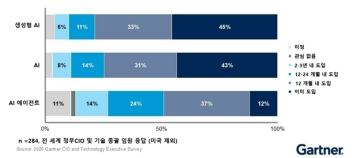
52% of Global Government CIOs to Increase AI Budget by 2026
Global business and technology insights firm Gartner announced on the 27th that 52% of government Chief Information Officers (CIOs) worldwide, excluding the United States, plan to increase their IT budgets for AI and key technology areas in 2026.
2025.11.27by 명세환 기자
Rockwell Automation Named to Gartner's Hype Cycle for 20 Categories
Rockwell Automation, Inc., the world's largest industrial automation and digital transformation specialist, has been featured across 20 different domains in Gartner®'s 'Hype Cycles' report, receiving recognition for global technology leadership in manufacturing, AI, cybersecurity, and energy sectors.
2025.12.17by 배종인 기자
.jpg)
Gartner: "AI Investment Success and Failure Depend on Human Capabilities and Organizational Maturity, Not Size"
Global research firm Gartner forecasts that worldwide AI spending will reach $252.78 billion (approximately 3,736 trillion won) by 2026, representing a 44% increase year-over-year.
2026.01.16by 명세환 기자
Gartner: “Global PC Shipments to Reach 270 Million Units in 2025, Up 9.1% Year-on-Year”
Global PC shipments in 2025 are expected to reach approximately 270 million units, representing a 9.1% increase compared to the previous year, indicating a clear recovery trend.
2026.01.21by 배종인 기자
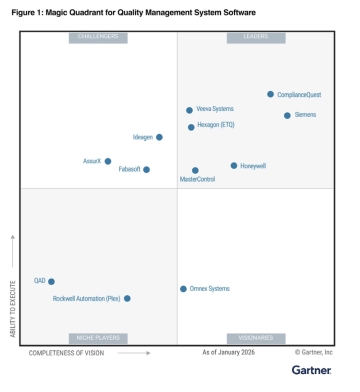
Siemens Named a Leader in Gartner's Magic Quadrant for Quality Management System (QMS) Software
Siemens has announced that it has been selected as a Leader in Gartner's Magic Quadrant for Quality Management System (QMS) Software. Gartner defines leaders as comprehensive QMS providers that support broad requirements including regulatory compliance, risk management, and process improvement. Siemens explained that it connects design, manufacturing, and operations based on Teamcenter X Quality and Opcenter X Quality, supporting enhanced traceability and workflow standardization. The company also emphasized its approach of integrating technologies such as generative AI, predictive analytics, XR, digital twins, and IoT into the quality lifecycle.
2026.02.04by 명세환 기자











