


ETRI Develops 200Gbps Photodetector… Initiates Localization of Optical Receivers for AI Data Centers
 Published2026.03.19 13:28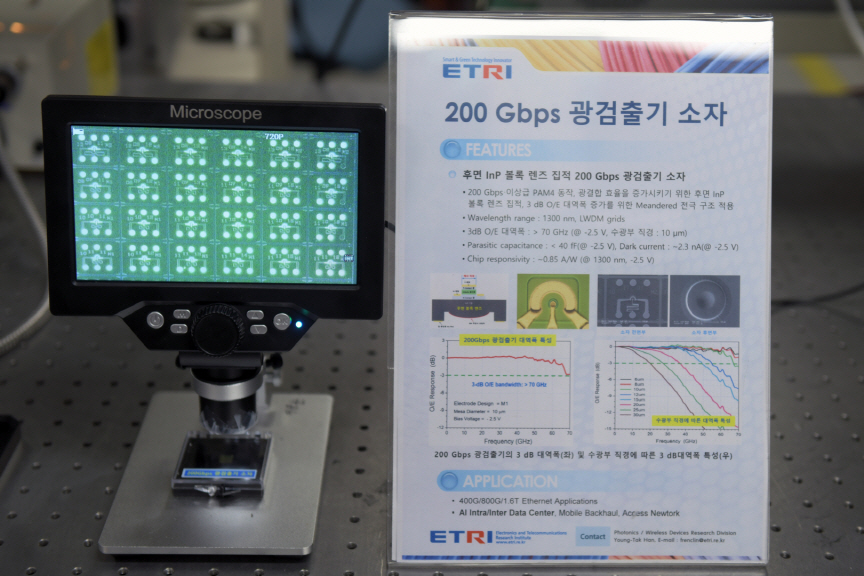
Improved reception efficiency through rear lens integration… Expected to be applied to next-generation optical modules
This achievement was unveiled at OECC 2025 and was recently published in the international academic journal 'Optics Express'. ETRI explained that by demonstrating the possibility of processing optical signals up to 224 Gbps per channel, it has increased the processing capacity per channel by approximately double compared to 112 Gbps-class photodetectors widely used in data centers.
The core of the technology is a structure that simultaneously increases speed and light reception efficiency. The research team secured a bandwidth of over 70 GHz and a photoresponse of over 0.75 A/W, and applied a method of integrating an indium phosphide (InP) convex lens on the back of a 0.5 mm × 0.4 mm chip. It is a structure that helps simplify packaging by improving alignment convenience and light reception efficiency without the need for a separate light-receiving lens.
This device is expected to be applied first to the receivers of optical transceivers for internal networks in AI data centers. Since multiple optical transceivers are housed inside data center racks, component unit costs and integration efficiency have a significant impact on the overall system cost. ETRI anticipates that the rear lens integration structure will enable cost reduction in the manufacturing process of 800Gbps and 1.6Tbps optical modules.
The significance is also considerable from an industrial perspective. 200Gbps-class photodetector chips are considered a highly challenging field with few developers worldwide. ETRI announced that it implemented the entire process, from design to fabrication, using domestic technology based on its Indium Gallium Arsenide (InGaAs) photodetector technology and experience in compound semiconductor foundry operations. The related technology has been transferred to the domestic company Wooriro, and ETRI plans to continue supporting its commercialization.
The demand for optical components for data centers continues to grow due to the proliferation of AI, cloud computing, OTT, and VR/AR. This development is expected to serve as an opportunity to reduce dependence on imports while expanding the supply capabilities of the domestic optical device and component industry in the next-generation high-speed optical module market.

Comments
Related news
ETRI selects nine national R&D excellence achievements, the most for seven consecutive years.
ETRI was selected for 9 outstanding achievements in the 2025 National R&D Excellence Awards, including 7 in the information and electronics sector, 1 in the energy and environment sector, and 1 in the convergence sector, achieving the highest number of selections for seven consecutive years and receiving recognition for its future core technology achievements in 6G, AI, and metaverse.
2025.12.24by 명세환 기자

ETRI President Bang Seung-chan, “Opening the Next 50 Years with National Mission-Oriented R&D”
The Electronics and Telecommunications Research Institute (ETRI, President Bang Seung-chan) announced its 2026 New Year research and management plan to mark the beginning of the year of the Horse, expressing its commitment to leap forward as a national mission-oriented research institute, taking its 50th anniversary as a turning point.
2026.01.05by 배종인 기자
ETRI overcomes the "memory barrier" for large-scale AI learning.
The Electronics and Telecommunications Research Institute (ETRI) has developed a new memory technology called "OmniXtend" that addresses GPU memory limitations and data bottleneck issues, which have been identified as the most critical challenges in large-scale AI training. This breakthrough fundamentally resolves the GPU memory shortage problem that has been a major obstacle in large-scale artificial intelligence training processes.
2026.01.08by 배종인 기자
.jpg)
ETRI develops digital twin-based wearable robot evaluation software.
The AI Robot UX Research Division, AI Robot Research Headquarters, AI Creative Research Institute at the Electronics and Telecommunications Research Institute (ETRI), has developed digital twin-based evaluation software (SW) called "Integrated Evaluation Technology for Wearable Robots Based on Digital Human-Device Twin," which enables verification of performance and usability before actual users wear wearable robots. This development is expected to significantly shorten the development period of wearable robots and achieve breakthrough cost reduction.
2026.01.23by 배종인 기자

ETRI ushered in an era of autonomous driving transportation with speeds of up to 80 km/h.
The autonomous driving artificial intelligence (AI) and vehicle-to-infrastructure communication technology developed by the Electronics and Telecommunications Research Institute (ETRI) are being applied to actual public transportation, marking the full opening of the era of wide-area autonomous driving transportation connecting Daejeon and Sejong.
2026.01.30by 배종인 기자











