



Cisco Unveils Agentic AI Security Framework at RSAC 2026
 Published2026.03.24 10:52
Expanding the scope of enterprise AI agent protection from identity management to pre-verification and SOC automation
Cisco announced the related features at RSAC 2026, which opened in San Francisco, USA, on March 23 (local time). The company stated that in its survey, 85% of major enterprise customers are testing AI agent pilots, but only 5% have expanded to the actual production stage.
At the heart of the technology is the application of zero trust for AI agents. Cisco has proposed a method that links Duo IAM with Secure Access to assign an identity to each agent, connect them with a human representative, and grant granular permissions for short periods only for necessary resources. In addition, it was designed to track agent behavior and access paths more precisely through a structure that passes all tool traffic through the MCP gateway.
Pre-deployment verification capabilities have also been enhanced. 'AI Defense: Explorer Edition' is a self-service tool that enables developers to test models and applications using multi-turn-based attack scenarios to check for vulnerabilities such as prompt injection or jailbreaking. Along with this, the Agent Runtime SDK, an LLM security leaderboard for comparing model risks, and the open-source framework 'DefenseClaw' were also released. DefenseClaw is expected to integrate with NVIDIA OpenShell to support the automation of security checks and asset inventory tasks.
The scope of application extends beyond the AI development phase. Cisco has presented an "Agentic SOC" concept based on Splunk, which includes exposure analysis, Detection Studio, federated search, and various specialized agents. This configuration focuses on enabling security operations centers to connect distributed data to identify threats faster and automate certain response procedures. Some features have already been released, while the remainder are scheduled to be unveiled sequentially between April and June.
This announcement can be seen as an example of presenting security standards necessary for companies to move generative AI experiments into actual business systems, amidst the visible proliferation of AI agents. In particular, there is a growing possibility that the trend of clarifying the identity and accountability of agents and incorporating control mechanisms across all stages of development, deployment, and operation will become a fundamental requirement for future enterprise AI adoption.

Comments
Related news
.jpg)
Cisco Expands Partnership with Nvidia to Accelerate Adoption of Enterprise AI
Cisco announced on the 25th that it is expanding its partnership with Nvidia to provide AI technology solutions to enterprises. The two companies are focusing on providing an integrated architecture that simplifies AI data center deployment.
2025.02.26by 명세환 기자

AMD, Cisco, Nokia Strengthen Collaboration in India...Build Open Telecom AI Platform
Geo Platform announced on the 3rd a plan to build an Open Telecom AI Platform at Mobile World Congress 2025 together with AMD, Cisco, and Nokia. The initiative aims to support telecom operators and service providers with efficiency, security, and revenue generation through AI-based solutions.
2025.03.04by 권신혁 기자
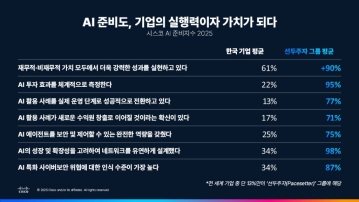
AI leaders commercialize four times faster than competitors and realize 50% higher value.
Global networking and cybersecurity technology company Cisco announced the "2025 Cisco AI Readiness Index," revealing that "Pacesetter" companies leading in AI adoption are achieving commercialization of pilots four times faster than competitors and realizing 50% higher value.
2025.10.15by 배종인 기자
.jpg)
AMD, Cisco, and Humain Establish World-Class AI Infrastructure Joint Venture
AMD, Cisco, and Huemain are establishing a joint venture to build world-class AI infrastructure. They plan to combine the Instinct MI450 GPU with state-of-the-art data centers and core infrastructure solutions to provide scalable AI solutions to global customers.
2025.11.24by 명세환 기자
The combination of simulation and AI is a key driver of accelerating innovation in industrial settings.
Global engineering simulation company ANSYS Korea held an 'Industry-Customized Simulation AI Solution Seminar' at COEX Seoul on the 22nd and shared strategies for leveraging AI based on simulation.
2026.01.23by 배종인 기자











