



Schneider Electric Expects Energy and Chemical Industries to Expand Investment in Autonomous Operations Amidst AI Spread
 Published2026.04.02 10:34
Increased Power Demand Driven by AI Faces Cost and Manpower Burdens, Leading to Full-Scale Transition to Autonomous Operations
Schneider Electric Korea released the results of the related study on April 2. The 'Global Autonomy Maturity Report,' which the company previously announced through its global headquarters on March 23 and released as a document on March 26, is based on a survey of 400 senior executives in the energy and chemical industries across 12 countries. The same survey scale and report title were presented in the materials released in Korea.
In the survey, 31.5% of respondents viewed the advancement of autonomy as a top priority within the next five years, and this figure rose to 44% over a 10-year timeframe. Conversely, less than 5% viewed it as a low priority. Factors of concern regarding delays in implementation included increased operating costs (59%), talent shortages (52%), and decreased competitiveness (48%). Initial investment costs (34%), limitations of existing systems (30%), organizational resistance (27%), cybersecurity (26%), and regulatory uncertainty (25%) were cited as obstacles to diffusion.
The backdrop highlighted in this report is the combination of AI and power demand. Schneider Electric projected that the expansion of hyperscale clouds and data centers is placing a heavy burden on energy systems, and that related power demand could nearly double to 1,000 TWh by 2030. In this context, 49% of respondents identified AI as the biggest driver of accelerating autonomy.
The company also presented a direction to enhance real-time visibility and AI-based digital twins through a software-defined architecture that combines process control, power management, and Aveva's digital technologies.

Comments
Related news
Schneider Electric Korea Presents Field-Oriented Infrastructure Strategy Integrating Automation, Power, and BESS
Schneider Electric Korea has announced a field-focused integrated infrastructure strategy that consolidates industrial automation, smart power management, and battery energy storage systems (BESS). The portfolio unveiled on February 25th centers on connecting equipment control, power protection, and energy storage functions through an integrated operational structure rather than individual systems. As the power density and operational complexity of industrial sites increase due to the widespread adoption of AI-based equipment and the expansion of renewable energy integration, the company determined that a system capable of simultaneously managing automation and power infrastructure is necessary. It has presented a structure that links high-precision control systems, smart distribution equipment, and protection devices compatible with 1500V DC with the EcoStruxure platform to enhance power availability and operational visibility while supporting carbon management.
2026.02.25by 명세환 기자
.jpg)
SKT Partners with Supermicro and Schneider to Build Modular AI Data Centers at MWC26
SK Telecom has signed a three-party Memorandum of Understanding (MOU) with Supermicro and Schneider Electric at MWC26 held in Barcelona, Spain, to build an AI data center (AI DC). The three companies will jointly review an integrated solution using a "Pre-fabricated Modular" approach, in which servers and equipment such as power and cooling systems are integrally designed in module units, pre-manufactured, and then assembled on-site. SKT will participate in promoting the integrated model based on its operational experience, while Supermicro will take on the role of GPU server and cluster configuration capabilities, and Schneider will be responsible for MEP (Mechanical, Electrical, and Plumbing) design and operational solution services. Specific construction timelines and cost reduction figures have not been disclosed.
2026.03.04by 명세환 기자
Schneider Electric Korea Unveils AI- and Digital Twin-Based Integrated Automation Strategy at AW 2026
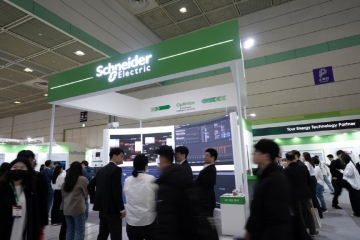
Schneider Electric Korea presented an integrated automation strategy centered on AI-based data visualization, electrical digital twin, and software-defined automation at the '2026 Smart Factory and Automation Industry Exhibition (AW 2026)' held at Seoul COEX. At the exhibition booth, the company introduced hardware portfolios including Lexium Servo, SM AirSeT, and EasyPact MVS DA1 alongside AVEVA, EcoStruxure Automation Expert (EAE), ETAP, and EcoStruxure Power Monitoring Expert (PME). With the event itself placing manufacturing AX agendas such as 'autonomy' and 'sustainability' front and center, the company emphasized an open architecture-based approach that enables phased transformation while maintaining existing equipment.
2026.03.05by 배종인 기자
.jpg)
Schneider Electric Releases Five-Year ESG Performance Report, Improving Supply Chain and Energy Access Indicators
Schneider Electric has disclosed major achievements as it concludes its ESG program 'SSI,' which it has operated from 2021 to 2025. The company recorded a comprehensive score of 8.86 points as of the fourth quarter of 2025, and reported that customer contributions to carbon dioxide reduction reached 862 million tons, while operational emissions reduction among key suppliers was calculated at 56%. The number of people who benefited from expanded energy accessibility reached 61 million, and those who received energy management education exceeded 1 million. Based on these results, the company stated it will continue with its 2030 sustainability strategy.
2026.03.10by 명세환 기자
Schneider Electric Unveils AI Data Center Infrastructure Vision at GTC 2026
Schneider Electric revealed its roadmap for building large-scale AI data center infrastructure alongside NVIDIA at GTC 2026. The presentation focused on enhancing design and operational efficiency of AI data centers through the integration of power and cooling systems, control systems, and digital twin technology. An Omniverse-based digital twin architecture was also presented through expanded collaboration with AVEVA. The announcement reflects a trend toward pre-simulating and optimizing data center infrastructure in response to rapidly growing AI computing demands.
2026.03.18by 배종인 기자











