



ADI Unveils A²B 2.0… The Solution to Low Latency, Ethernet Integration, and Cost Reduction in the SDV Era
 Published2026.04.29 08:45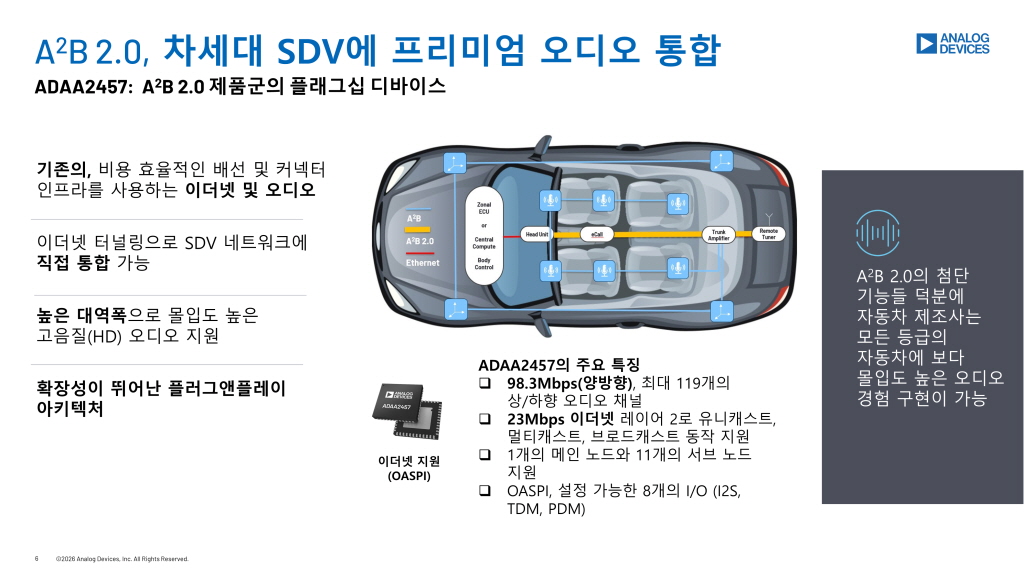
SDV Network Completed with 62μs Deterministic Low-Latency Audio and Ethernet Tunneling
As the automotive industry is being reshaped into software-centric vehicles (SDVs), a new challenge is emerging regarding how to transfer audio, sensor, and control signals within the vehicle 'without delay' while simultaneously 'naturally' integrating them with the vehicle's Ethernet-based network. In this context, Analog Devices (ADI) has provided a 'realistic upgrade path' through a new audio chip that incorporates more channels and functions without artificially increasing the complexity of the network growing during the transition to SDVs.
ADI officially announced A²B 2.0 (Automotive Audio Bus 2.0) on the 28th (US time).
The core of this announcement is an approach that allows the two worlds to coexist within a single system, with A²B handling the deterministic, low-latency, and synchronous performance required for audio transmission, while connecting the Ethernet integration demanded by SDV via 'tunneling'.
Market interest in this technology stems from the fact that 'audio' is evolving beyond a simple convenience feature into a factor that determines the interior experience, such as quietness, safety, and responsiveness.
ADI said that A²B last 10It emphasizes that it has been widely adopted across the automotive industry over the years and has established a foundation by being applied to numerous finished vehicles.
The most obvious change presented by A²B 2.0 is 'direct integration' into SDV networks.
A²B 2.0 is designed to support Ethernet data tunneling through the industry standard OASPI (Open Alliance SPI) interface, enabling the audio bus to be seamlessly connected to the vehicle Ethernet architecture.
This represents an evolution that takes into account the diagnostic and update paths that have become critical in SDVs, a change that allows the dedicated audio network to operate as part of the vehicle network rather than remaining an 'isolated island' as before.
Prior to the official announcement, Andy Lanfear, who oversees automotive audio and networking strategies at ADI’s automotive business unit, introduced A²B 2.0 at a press conference, explaining that “while Ethernet is effective for asynchronous data processing, applications where synchronization, timing, and feedback loops are critical, such as audio, require deterministic and low-latency connections.”
He stated, “There is no ‘magic bus’ that solves all problems with a single bus,” and also expressed the view that the design should be optimized by leveraging the role each bus excels at.
The performance changes of A²B 2.0 also target the demands of the SDV era.
According to ADI, A²B 2.0 increases bandwidth fourfold to provide up to 98.3 Mbps (bidirectional) and supports up to 119 audio channels each for upstream and downstream.
Latency, an important indicator in audio systems, presented a low and constant latency of 62μs.
This groupHap serves as the foundation for reliably implementing various functions that constitute the in-cabin experience—such as advanced multi-channel audio, Road Noise Cancellation (RNC), Personalized Sound Zones (PSZ), acoustic warnings, and emergency calls—on a single network.
The changes brought about by A²B 2.0 also directly affect the vehicle development process.
ADI explained that A²B 2.0 is compatible with existing A²B 1.0 cables and connectors, and allows branching into A²B 1.0 networks, thereby maximizing the reuse of existing modules.
In addition, it was suggested that system costs can be reduced by up to 30% through expanded integration capabilities and a reduction in external components, and that the number of necessary external components can be reduced by more than 50% at the product family level.
In other words, the claim is that it provides a 'realistic upgrade path' that accommodates more channels and functions without artificially increasing network complexity as it transitions to SDV.
From a consumer perspective, the 'spread of premium audio' stands out.
ADI emphasized that A²B 2.0 enables the provision of premium audio not only in premium classes but also in entry-level vehicles.
In the era of SDVs where vehicle functions are defined by software, A²B 2.0 is evaluated as a foundational technology that supports 'invisible competitiveness,' given that quality such as interior quietness and immersion can be key to brand differentiation.
ADI announced that the A²B 2.0 (ADAA245x series) has already entered mass production and stated that it will support OEMs and Tier 1 suppliers transitioning to SDV architecture in realizing next-generation in-room audio experiences.

Comments
Related news
ADI Accelerates Smart Factory Network Integration with Industrial Ethernet TSN Switch ICs
Analog Devices, Inc. (ADI) announced that its industrial Ethernet TSN (Time-Sensitive Networking) switch ICs, the ADIN6310 and ADIN3310, have obtained CC-Link IE TSN recommended network wiring component testing (Class A·B) certification from the CC-Link Partner Association (CLPA).
2025.12.23by 명세환 기자
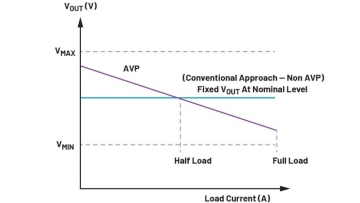
ADI: "High-Precision Serial AVP Control μModule Regulator Transient Response Improvement"
We spoke with Sin Keng Lee and Zhijun (George) Qian from Analog Devices Inc. about how to reduce the output capacitance of μModule regulators by half through precise active voltage positioning (AVP) control.
2026.02.05by 배종인 기자
.jpg)
ADI Targets Robotics Market with Sensor, Connectivity, and Power Solutions
Global analog semiconductor company Analog Devices (ADI) participated in the Smart Factory and Automation Industry Exhibition (AW2026) held at COEX from March 4-6, and unveiled a range of core technologies and solutions targeting the industrial automation and robotics markets.
2026.03.08by 배종인 기자
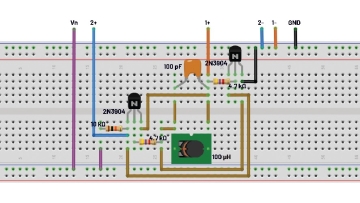
ADI: "'ADALM2000' LC Oscillator Resonance Characteristics Visually Confirmed"
We have arranged a session to hear from Antoniu Miclaus, Systems Application Engineer at Analog Devices, Inc., about hands-on practice with Colpitts oscillators using the ADALM2000 educational kit.
2026.03.09by 편집부

ADI Presents Evolution of Robotics with 'Physical Intelligence' at GTC 2026
Analog Devices (ADI) participated in 'NVIDIA GTC 2026' and unveiled 'Physical Intelligence (PI)' technology that enables robots to achieve human-like manipulation capabilities in real-world environments, thereby presenting the direction for next-generation robotics.
2026.03.17by 배종인 기자











