



Gartner: “60% of Companies Expected to Adopt Micro-teams in AI Era by 2029”
 Published2026.07.08 09:00
Gartner released an analysis of this content on the 8th.
Aliyah Camacho, a principal analyst at Gartner, stated, “AI is redefining the role of software engineering, and the resources required to meet the demand for software and complex AI-based applications will exceed the efficiency gains provided by AI.”
Micro teams emerged in an environment where AI handled repetitive technical tasks, allowing engineers to focus on solving complex problems.
Gartner explained that while the typical size is currently 4 to 5 people, some companies operate with 2 to 3 people.
Analyst Camacho emphasized, “Micro-teams must be small enough to move agilely, yet large enough to offer diverse perspectives.”
The team composition includes skilled personnel such as product managers, user experience (UX) and agent experience (AX) designers, and AI-based software engineers.
Micro teams operate with a structure that allows them to focus on high-value tasks, supported by platform engineering teams that provide standardized and automated workflows and self-service AI tools.
Gartner warned that hiring and developing new talent should not be stopped despite the proliferation of micro-teams.
This is because in micro-teams, each team member must assume various roles ranging from identifying business goals to product design and AI agent management, blurring traditional role boundaries.
Analyst Camacho stated, “Reducing entry-level hiring makes it difficult to transfer technology and know-how, shrinks the internal talent pipeline, and leads to side effects such as increased reliance on senior-level hiring. "It could happen," he said.
Gartner predicted that by 2028, companies reducing entry-level positions due to AI will face gaps in their software engineering talent pipelines.

Comments
Related news
Gartner: Global PC Shipments Up 4% in Q1... Impact of Expanded Inventory
According to Gartner, global PC shipments in the first quarter of 2026 reached 62.8 million units, representing a 4% increase year-over-year. However, this growth was largely driven by inventory expansion in anticipation of rising memory prices and potential increases in component costs, rather than actual demand expansion. Lenovo, HP, Dell, and Apple maintained their positions as the top four vendors, while ASUS surpassed Acer to claim the fifth position. Apple recorded the highest growth rate among major vendors, driven by MacBook Neo demand.
2026.04.13by 명세환 기자
Schneider Electric Rises as an Innovator with AI for Supply Chain Carbon Management
Schneider Electric has been selected in the Business Services category for Fast Company's "2026 Most Innovative Companies" list. The company has been building systems that connect data collection and execution by applying AI to supply chain carbon emissions management. The Xaigo Hub, launched in 2025, was integrated as a supply chain product of Resource Advisor+ in January 2026, providing both supplier emissions management and decarbonization program operation capabilities. Schneider Electric raised the operational emissions reduction rate for its top 1,000 suppliers to over 50% in 2025, and ranked first for three consecutive years in Gartner's Top 25 Supply Chains in the same year. Annual revenue also exceeded €40 billion for the first time.
2026.04.14by 명세환 기자
.png)
Group IB Selected as 'Leader' in Gartner Cyber Threat Intelligence
Cybersecurity firm Group-IB has been selected as a 'Leader' in Gartner's 2026 Cyber Threat Intelligence Technology Magic Quadrant. The evaluation was conducted across 18 companies, assessing the completeness of vision and execution capability. Group-IB presented attacker-centric research, proprietary data-based threat intelligence, dark web monitoring systems, and cooperation experience with international law enforcement agencies as evaluation factors. The company explained that it is strengthening a proactive security system through an integrated analysis structure that combines threat intelligence with fraud response data.
2026.05.06by 배종인 기자
.jpg)
Gartner identifies 'semantic foundation' as key condition to boost AI agent performance.
Gartner has identified a semantic foundation as a key requirement for improving the accuracy and cost efficiency of AI agents. The analysis indicates that AI agents can deliver contextually appropriate results only when the meaning, relationships, and rules of data within an organization are clearly defined.
2026.05.12by 배종인 기자
Gartner Identifies Deepfakes and Prompt Injection as Top 4 Cyber Threats in the AI Era
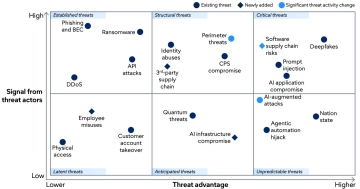
Gartner has identified deepfakes, AI application breaches, prompt injection, and software supply chains as key threats where attackers could gain an advantage in the cyber threat landscape between 2026 and 2027. Gartner explained that with the widespread adoption of generative AI and agentic AI, the attack surface that corporate security teams must manage is expanding. Accordingly, Gartner advised that cybersecurity leaders should establish a multi-layered defense strategy that includes identity verification, AI application protection, LLM security testing, and development pipeline controls.
2026.06.09by 명세환 기자











