



SKT and SK Biopharmaceuticals shorten early-stage research period for new drugs for intractable cancer by 60% using AI
 Published2026.07.15 09:00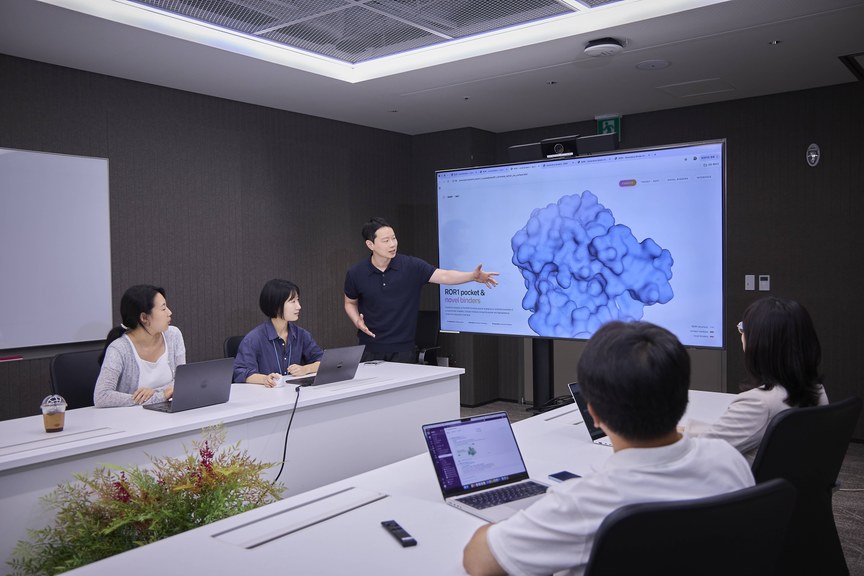
Completed in 5 months using machine learning and reinforcement learning
SK Telecom announced on the 15th that it has secured two initial active substances (hits) that showed the potential to bind to the cancer cell surface protein 'ROR1' in an AI-based drug discovery study conducted jointly with SK Biopharmaceuticals.
ROR1 is a tumor-associated cell surface protein that is overexpressed in various types of cancer, such as blood cancer and solid tumors (cancers that form as lumps in organs or tissues), and is a target of interest in the field of anticancer targeted therapy research.
In this study, SK Biopharmaceuticals established a strategy for discovering new binders based on its experience in new drug development.
A binder is a substance designed to bind to specific targets, such as cancer cells, and must satisfy complex conditions including target binding affinity and structural stability.
SKT generated a large number of new binder candidates by applying machine learning that combines and expresses protein fragments in various ways.
Here, reinforcement learning (RL) was combined to induce the search for the optimal structure by assigning high rewards to combinations with high structural stability.
The two companies explained that this approach complements the limitation that research exploring new material structures faces the challenge of securing sufficient data for AI training, which inevitably restricts the range of candidate search using existing data-dependent methods.
In the candidate selection stage, multiple candidates were processed in parallel using SKT's GPU resources, and the combination structure and possibility with ROR1 were rapidly predicted and analyzed through an AI model to narrow down the targets for laboratory verification.
In actual laboratory verification, two of these were as initial active substances It was confirmed that it shows potential.
The two companies stated that the research period took about five months, which is more than 60% shorter than SK Biopharmaceuticals' existing method.
Cho Dong-yeon, Head of AI Convergence at SK Telecom, said, “Based on this achievement, we are also considering expanding the scope of technological cooperation across the entire bio AI field, including the development of bio-specialized LLMs (Large Language Models) utilizing our proprietary AI foundation model.”
Comments
Related news
SKT Launches 3 'Google AI Plans' on T Uju
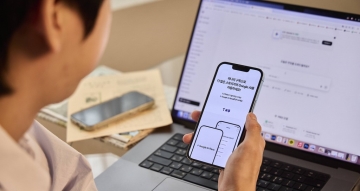
SK Telecom has launched a three-tier subscription product featuring Google AI functions including Gemini through its T Universe platform. With monthly discounts of up to 2,100 won, it is available to anyone regardless of carrier, and subscribers to the Best Pro and Max plans can receive benefits of selecting one from five OTT services including YouTube Premium and Netflix along with the Google AI plan.
2026.07.03by 명세환 기자
SKT Pushes to Build 15GW AI Data Center… Aims for Asia Hub
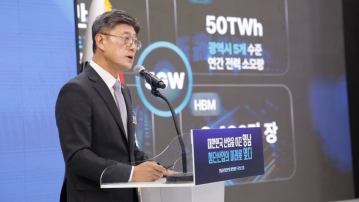
SKT is advancing the construction of AI data centers with a maximum capacity of 15GW to address the shortage of AI computing domestically and internationally. With Ulsan as its base, the company plans to expand in phases to 5GW by 2029 and 15GW by 2035, while jointly constructing a hyperscale-grade data center with AWS. The strategy aims to foster Korea as an Asia AI hub by mobilizing the full-stack AI infrastructure capabilities of the SK Group.
2026.07.06by 배종인 기자
.jpg)
SKT 'Haein' Cluster Acquires CSAP Certification... First Case in Korea Based on Blackwell GPUs
SK Telecom's Blackwell GPU-based AI data center cluster 'Haein,' which is in operation, has become the first in Korea to obtain CSAP (Cloud Service Security Certification) IaaS category certification, which is administered by the Korea Internet & Security Agency. The Haein cluster, composed of over 1,000 Blackwell GPUs, meets public cloud requirements including network segmentation and data isolation, and is currently being utilized for training government AI foundation models. Through this certification, SKT plans to expand into the public and financial sectors in the sovereign AI cloud market.
2026.07.06by 배종인 기자
SKT Transitions All T World Stores to AI… Phased Introduction by 2027
SKT is converting customer service at approximately 300 T world stores nationwide to an AI-based system. Starting in June, it will disclose star rating information collected through STT technology, and begin pilot operation of an AI agent for franchisees from September. By 2027, it will gradually introduce customized store search, AI consultation analysis, and T crew task support agents to enhance customer trust.
2026.07.08by 배종인 기자
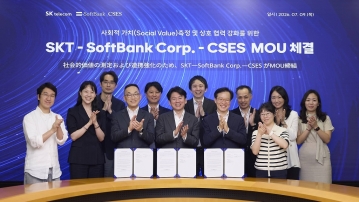
SKT, SoftBank, and CSES Sign MOU to Measure Social Value of AI
SK Telecom, SoftBank, and the Institute for Social Value Research are launching an initiative to establish a global standard measurement system for quantifying the social utility of AI and ICT technologies. Through an MOU, the three parties plan to visualize socially beneficial contributions that are difficult to monetize—such as support for vulnerable populations and disaster response—through objective indicators, and jointly develop standard methodologies applicable across various industries.
2026.07.09by 배종인 기자











