



Operating Profit of 20 Global Automakers Declined 70% in Two Years
 Published2026.09.30 14:12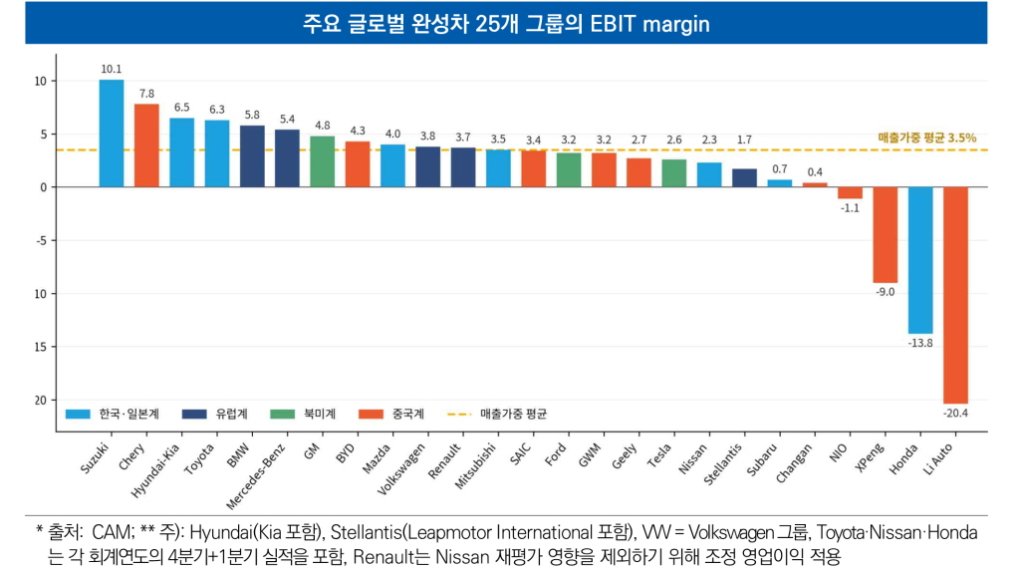
Profit Structure Shaken by Electrification, China's Offensive, and Changes in Trade Environment
The global automaker industry is facing a double burden of slowing sales growth and deteriorating profitability. Analysis has emerged indicating that it has become difficult to maintain the high profitability of the past as investments in electrification transition and increases in software (SW) development costs, expansion of supply by Chinese companies, and strengthening of protectionist trade policies work together in a complex manner.
Kim Han-sol, Senior Researcher at the Korea Automotive Research Institute, diagnosed in an industry analysis report released on the 30th that the recent deterioration in profitability in the global automotive industry has a structural character.
According to the report, the combined operating profit of 20 major global automakers recorded $196 billion in 2023 and has since shifted to a declining trend. By 2025, it shrank to $59 billion, down 62.9% year-on-year. The operating margin also declined from 7.9% in 2023 to 2.3% in 2025.
Electrification Investment and Intensified China Competition
The report cited the burden of operating multiple powertrain systems that occurs during the electrification transition as the background for the deterioration in profitability.
As the transition to battery electric vehicles (BEV) progresses more gradually than expected, automakers are facing a situation where they must simultaneously maintain production systems for internal combustion engine vehicles (ICE), hybrid vehicles (HEV), and electric vehicles. In this process, platform development and production facility investment costs continue to occur.
Additionally, investments in autonomous driving, software-defined vehicles (SDV), and artificial intelligence (AI) are also expanding. However, the analysis indicates that as the monetization pace of related technologies falls short of expectations, the cost burden increases while revenue generation is delayed.
Moreover, the expansion of Chinese companies into overseas markets is also intensifying global competition. Chinese automakers are increasing production volumes despite accepting lower profitability, and are rapidly expanding their market share in Europe.
Profitability Recovery Difficult with Sales Increases Alone
The report forecasts that the competitiveness of automakers in the future is likely to be determined more by production flexibility and investment efficiency than by sales volume expansion.
In particular, the analysis highlighted that establishing a multi-powertrain production system capable of producing internal combustion engine vehicles, hybrid vehicles, and electric vehicles in a single factory is important to respond to differences in electrification speed by region.
Additionally, the report suggested that in the process of investing in future technologies such as SDV and AI, joint development and standardization strategies are needed to reduce redundant investments and concentrate resources on fields requiring core competencies.
The report evaluated that the future task of the automotive industry is not simply sales expansion but securing the execution capability to link future investment results to actual sales and profits while maintaining profitability of existing operations.

Comments
Related news
.jpg)
Korea Autonomous Driving Institution Designated as Korea's First Accredited Testing Agency
The Korea Automotive Research Institute has established the nation's first nationally accredited testing system for low-speed autonomous vehicles. By expanding the accreditation scope of the Korea Laboratory Accreditation Scheme (KOLAS) based on the international standard ISO 22737, it is now possible to verify the performance and safety of autonomous shuttle buses and last-mile mobility in an accredited manner. The institute plans to evaluate the perception, decision-making, and control functions of autonomous driving systems through test scenarios that reflect actual road environments. With this designation, domestic companies are expected to be able to obtain internationally recognized test reports, which will reduce certification burdens in the process of entering overseas markets.
2026.03.16by 배종인 기자
Hanjayeon Collaborates with Vietnam's VEAM MOTOR on Manufacturing Technology... Promoting Smart Factory and Workforce Development
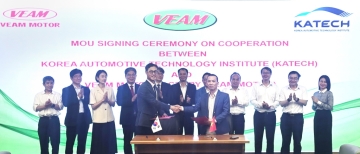
The Korea Automotive Research Institute is moving forward with automotive manufacturing and production technology cooperation with VEAM MOTOR, a Vietnamese state-owned enterprise. The two parties signed a memorandum of understanding in Hanoi, Vietnam, and agreed to pursue cooperation in improving automobile production technology, smart factory transformation, technical education and human resource development, and business development in the commercial and special-purpose vehicle sectors. This cooperation is interpreted as being aimed at enhancing local manufacturing capabilities and addressing digital transformation in line with Vietnam's industrial policies. The Korea Automotive Research Institute views this as an opportunity that could lead to expanded cooperation prospects for domestic companies in Vietnam.
2026.03.25by 명세환 기자
BYD Weakness and Structural Changes in the Chinese Auto Market Accelerate Tech Competition and Restructuring
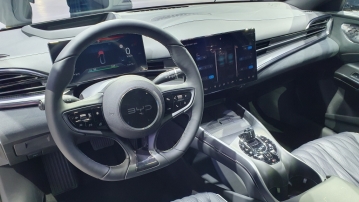
According to an industry analysis report released by the Korea Automotive Research Institute (KATECH), BYD's Chinese passenger vehicle sales growth stalled at the end of 2024, and in February 2026, both sales volume and market share declined significantly.
2026.03.27by 배종인 기자
Hanjayeon Transfers LMFP and Sodium Battery Electrode Technology to JR Energy Solution
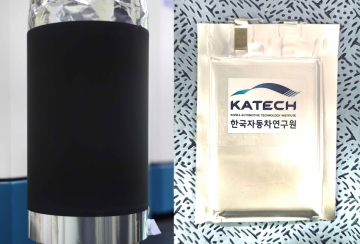
The Korea Automotive Research Institute transferred two electrode technologies for LMFP and sodium-ion batteries to JR Energy Solution. These technologies focus on reducing the manganese dissolution problem in LMFP batteries and the initial capacity loss issue in sodium-ion batteries. A key characteristic is that they can be applied to existing electrode manufacturing processes, thereby reducing additional capital investment burdens.
2026.05.27by 배종인 기자
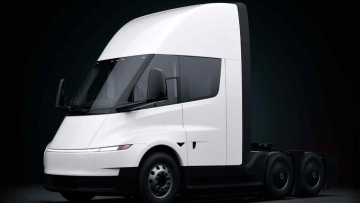
Tesla Semi Mass Production Begins in Earnest… Signal of Transition to Electrified Heavy Trucks
According to a recent report released by the Korea Automotive Research Institute titled "(Industry Analysis Vol.167) Semi: Opening the Curtain on Large Truck Electrification," signs suggest that commercial vehicle electrification conversion is beginning in earnest as Tesla enters mass production of its large electric truck "Semi."
2026.06.08by 배종인 기자











