



[Planning] Visiting MCU Companies ③ TI, If you need an MCU that is strong in low power and real-time operations…
 Published2015.12.14 15:02
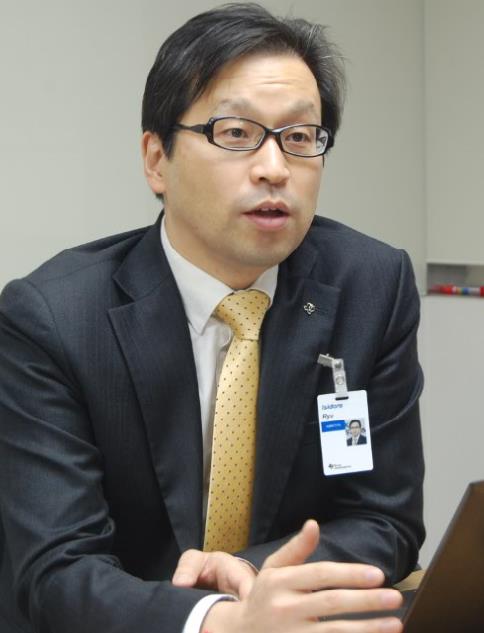
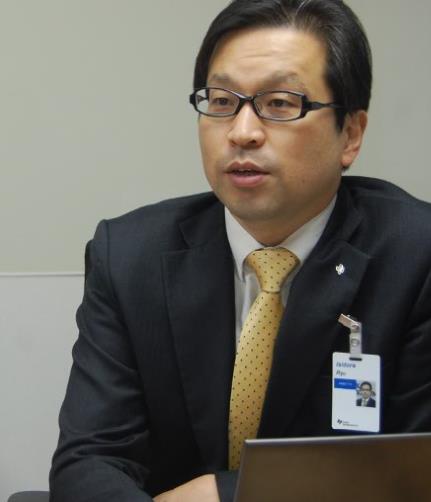
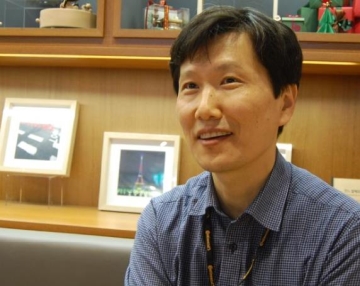
[Interview / Reporter Shin Yun-oh, Reporter Kim Su-jin] The third company in 'Going to MCU Companies' is TI, aka 'Texas Instruments', which is starting to stand out in the automotive field. Above all, readers must have been curious about what kind of synergy effect TI, known as a DSP chip powerhouse, can have with MCUs. This will be a time to check out everything about TI MCUs and kits for developers through Seungyoon Ryu (pictured), who is in charge of TI's MCU technical support.
Low-power MCU suitable for IoT, MSP series
Unrivaled DSP capabilities capable of real-time computation
 - First, could you briefly introduce TI's MCU portfolio?
TI MCU products are largely composed of four product groups: Ultra Low Power MCU, 32-bit Real-time MCU, 32-bit ARM MCU, and 32-bit ARM Safety MCU. To explain in more detail, the representative product of Ultra Low Power MCU is 'MSP430', which is widely used in battery-operated or low-power consumption applications due to its ultra-low power characteristics. C2000, a 32-bit real-time MCU, is a product optimized for digital power systems and real-time control.
The 32-bit ARM core-based MCUs are equipped with a variety of communication peripherals with a focus on connectivity. The last safety MCU product line is the Hercules product line. This product is used in applications requiring safety standards such as automobiles, aviation, and railways, as well as in patient monitoring systems requiring medical safety standards.
- How does the MSP series, which has low power as its strength, differ from other companies’ low-power products?
Its features include low power consumption, also known as 'Ultra Low Power', and the replacement of flash memory with FRAM memory over a period of two years. By applying FRAM memory, power consumption was reduced by about half compared to flash memory-based MCUs. In addition, flash memory may become unusable after being erased and written approximately 10,000 to 100,000 times, which is called 'endurance timing', but FRAM, which can be written approximately 10 trillion times, has the advantage of being able to be used almost infinitely. Designed for data logging in this way, this product can implement approximately 500 different products with various peripheral device combinations.
- Is the technology that applies FRAM to MCUs TI’s own technology?
Although there are semiconductor companies that are releasing FRAM on their own, TI is currently the only company to have developed an MCU with FRAM applied. It is differentiated from flash memory-based MCUs in terms of product life and durability.
-So, you are saying that the MSP430 is the MCU optimized for battery-based products, but specifically where is it mainly used?
Currently, it is widely applied to E-metering of smart grid. Now, meter reading is changed to electronic reading, and the collected data can be provided. This is because there is a core processor such as CLA inside MSP430, so only the amount of power is calculated. There are applications that require a 24-bit sigma-delta ADC for more precise measurements, and this can also be said to be specialized compared to other companies.
It must be battery operated and consume low power.
Used in e-metering and blood glucose meters in the medical field.
- What other applications are there besides e-metering?
One of the most common uses of MSP430 is in blood glucose meters. Blood glucose meters used by diabetics are mostly battery-operated devices. Therefore, power consumption must be low, and specific op amps, DACs, and peripheral devices are integrated into a single chip.
In addition, as IoT security has become important recently, blood glucose meters are also required to have security technology. When transmitting internal personal information data to the outside, encryption is required as a security technology so that it cannot be viewed from the outside. MSP430 provides high security functions by including an encryption descriptor module that supports up to AES256 in the hardware accelerator module. In addition, MSP430 is also used in water meters and gas meters. Water meters need to operate for 6 years without battery replacement with a specific battery, so they require ultra-low-power MCUs.
- The advantage of the real-time MCU, C2000, is that it can perform calculations without delay time in motor control and digital power.
The most basic concept of real time is that feedback is processed without delay. The surroundings are quickly digitized by ADC, internal calculations are performed, and signals are processed by PWM. Then, the control is performed according to the surroundings and feedback is received from the ADC. This process must be processed with as little delay as possible. On the other hand, no matter how fast the operating clock of the ARM core is, it takes a very long time to receive a command and perform a calculation.
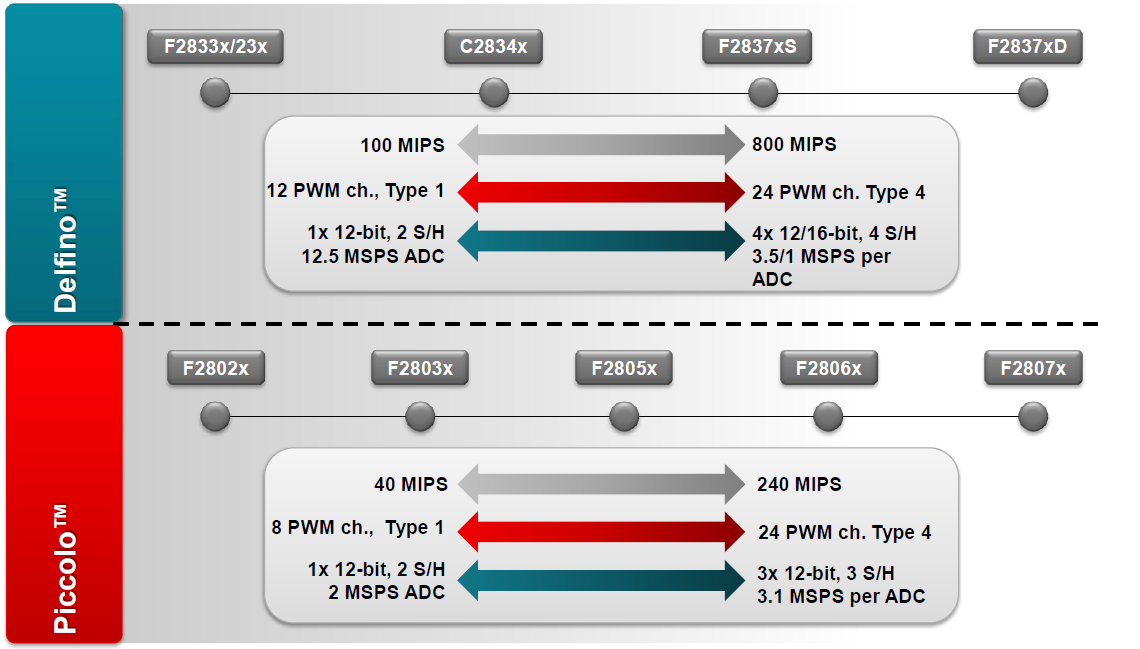
▲ Comparison of the specs of Piccolo and Delfino
- The C2000 series is divided into Piccolo and Delfino products. What is the standard?
The difference between these products is that Piccolo operates at up to 240 MIPS operating clock, while Delfino operates at up to 800 MIPS. The biggest difference is whether or not it supports floating point operations (FPU). The existing Piccolo product line only supports fixed point, while the Delfino product line supports floating point operations. However, many users of low-priced, low-performance Piccolos requested that floating point operations be supported, so an FPU was added starting with the Piccolo 6 series (F2806x). So now, the distinction is not made by the presence or absence of an FPU, but by performance.
- The applications of these two products also seem to be different.
Of course, the applications are also different. Piccolo is mainly used for home appliance motor control or motor control because it is low-priced, and high-performance products are used for sub-motor control or industrial sub-drive for industrial robot arm control. The recent industrial drive trend is that one sub-driver controls two motors. Until now, if you wanted to control two axes with one motor, you had to buy two motor drivers, but now you only need one drive with C2000 MCU applied.
In particular, C2000 can be applied to the automotive field as it supports up to ASIL-D level. It is ACQ100 certified and used for digital power and motor drive of hybrid cars.
“Lookup tables are not used for trigonometric function calculations.
“The computational processing function has been accelerated”
Vice President Ryu emphasized that the C2000 has optimized DSP operation instructions, so the operation processing time is significantly shorter than that of other companies’ products. This means that although there is DSP operation processing time, operation processing is possible in a shorter time compared to that of competitors’ products. The 7X series product line released this year has a built-in TMU (Trigonometric Math Unit). The TMU is a function for processing trigonometric function operations, but ARM-based products could not process trigonometric function instructions. Therefore, firmware engineers usually configured a lookup table, which took up a lot of memory capacity. However, the 7X series has a built-in TMU and powerline communication algorithm, as well as a complex mathematical operation accelerator, the Viterbi Complex Unit (VCU), to shorten the calculation time.
- I heard that DSP is the key in real-time MCU.
Yes. ARM recently increased the operating clock a lot and claims that it can achieve the same performance as DSP, but there is a significant difference between the time it takes to execute instructions by increasing the operating clock and processing them with DSP alone. By providing customers with benchmarks (that reflect these results), we are emphasizing the unique advantages of DSP.
- The TIVA series, targeting the connectivity market, is based on ARM cores. Why is that?
Even before the TIVA series, there was a lineup of ARM Cortex-based products. The TIVA TM4C series based on Cortex M4F has improved the manufacturing process and has more communication channels compared to other products. In particular, it has built-in Ethernet MAC & PHY, so users can connect the Ethernet cable to the MCU for Ethernet communication without having to add a separate external Ethernet Pi.
- How does Hercules, a representative MCU in the automotive field, handle the ‘safety’ function, which is an important element in automobiles?
Hercules operates at 20-200MHz and has a dual-core memory design. It consists of up to two Cortex R4s. It has an internal function that automatically corrects errors in ECC flash memory. One of the reasons for the dual-core design is for accurate calculations. If a malfunction (abnormal behavior) enters one core on the safety side, the command result is compared while executing a command one clock late. When a malfunction occurs, the lockstep of other MCUs ensures stability so that there is no problem with the function. In addition, automotive CAN and Ethernet are built-in as peripherals. It also supports ISO26262, ASIL -D level and IEC 61508 SIL-3 level. In particular, TI's 'SafeTI System Design Package' provides pre-certified documentation work to help developers easily get certified, and it provides a compiler qualification kit.
Get familiar with MCUs and shorten development time with low-cost launchpads
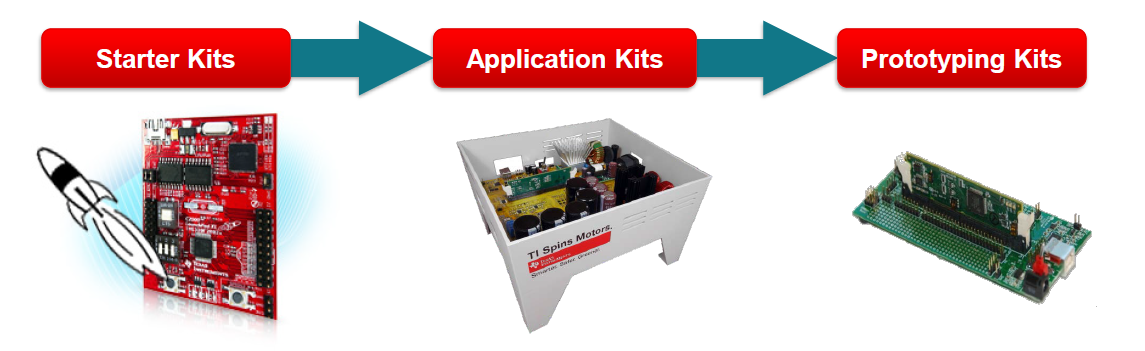
▲ TI's development kit stages according to developer environment
- What else can developers receive?
TI supports everything from low-cost kits like LaunchPad to prototypes and specialized kits. Users can reduce development time depending on the development environment they are supported with. We are providing a launch pad, a type of starter kit, at a low price so that customers can get used to it quickly.
The application kit is designed for MCU-specific applications. TI's reference technology supports the application kit at a level that can be applied to motor control, digital power, or E-metering. The prototype kit can be tested by directly connecting the board and jumper wires to the customer's evaluation board by pulling out all the pins of the peripherals built into the MCU.
- What are the convenient aspects of LaunchPad?
The launchpad's feature is that it has onboard debugging, that is, it has an emulator built in, so users do not have to purchase an external emulator separately. It is priced at around $10, so even college students can use it without any burden. Through the launchpad, customers can check the performance of the MCU they want to use or the performance of the MCU that their application requires, and then select and evaluate the product. Evaluate and become familiar with TI MCUs at an affordable price.
Implementing various applications using FRAM
Strengthening the high-speed processing technology of C2000
- You said that you also support 'BOOSTERPACKS'.
NFC is a recent development trend, and if you want to evaluate NFC, you can easily implement NFC functions with this module, and Bluetooth evaluation is also possible. It is also easy to implement a sensor hub application that applies various sensors such as light sensors and temperature sensors to wearables.
- There is a growing trend of support for things like launch pads and booster packs.
After all, providing MCUs only at the silicon IC level can be difficult in terms of firmware work and circuit implementation. For this reason, a total solution including a development kit must be supported to create an environment where MCUs can be easily used. It is not easy to provide application kits, but this is precisely the competitive edge of TI MCUs.
- Lastly, please tell us the direction in which TI MCUs are headed.
TI's MCUs have a lot of technology for their own cores as well as the Cortex MCU family, so the roadmap for the MSP series will continue. They also plan to develop them in a way that they can implement various applications by utilizing FRAM. The newly released Soprano C2000 has a TMU that can process trigonometric functions in the automotive field, a built-in high-speed ADC module, and enhanced PWM functions. Customers believe that the new C2000 Soprano lineup will enable them to implement more powerful applications.
[Introduction of TI's main MCUs]
1. MCU that simultaneously achieves ultra-low power and maximum performance
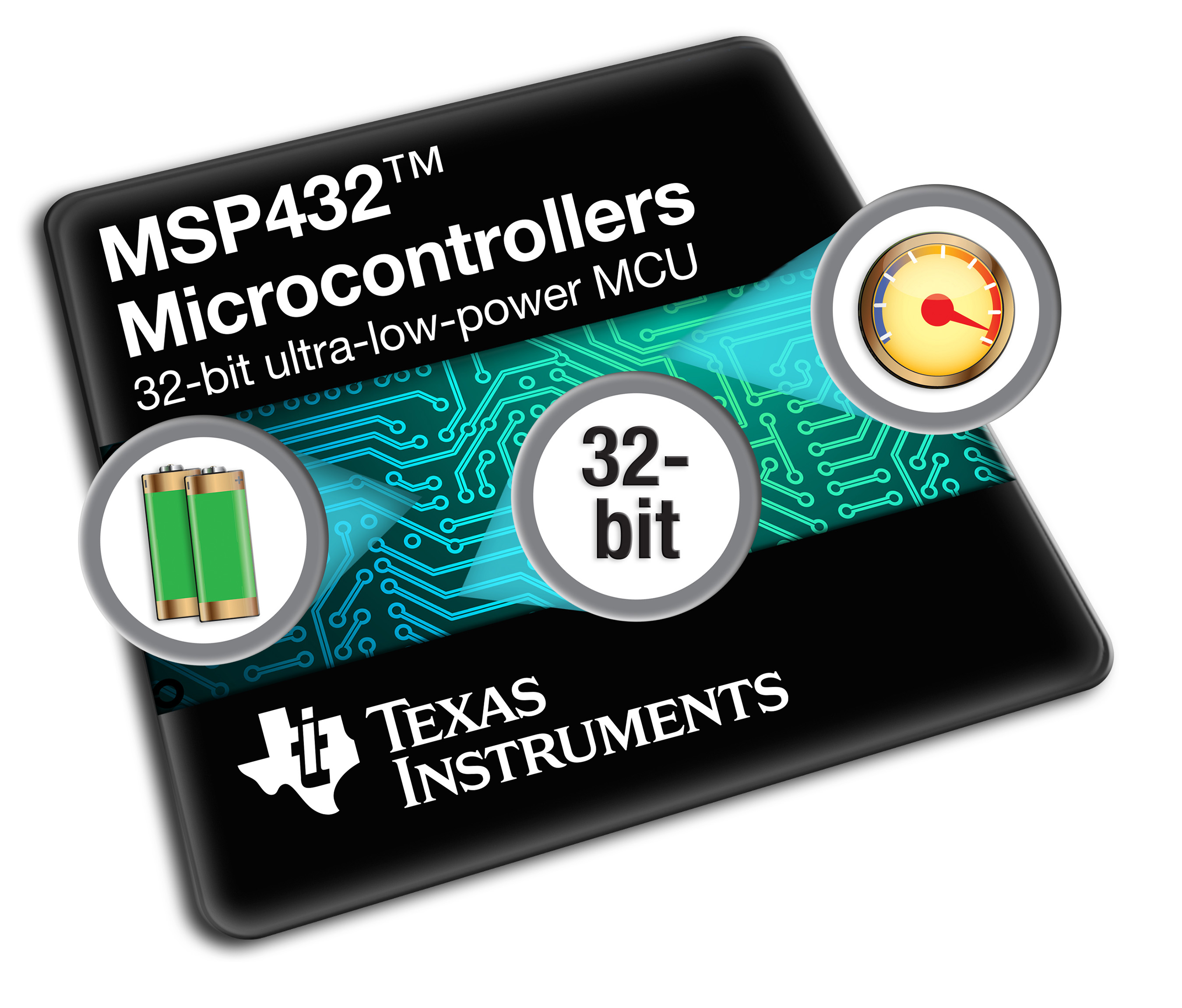
As an MCU that simultaneously achieves power loss and high performance through TI's accumulated ultra-low power technology, the operating power is only 95uA and the standby power is only 850nA.
The secret is an integrated Digital Signal Processing (DSP) engine and a floating-point core (FPU) of ARM Cortex-M4F cores, enabling a variety of high-performance applications such as signal conditioning and sensor processing. In addition, IoT-critical security can be configured with AES (advanced encryption standard) 256 hardware encryption accelerators to protect products and data, and IP protection functions can protect data and code in MSP432 MCUs. These functions enable processing more data and integrating advanced algorithms.
MSP432 MCUs are ideal for ultra-low-power embedded applications such as industrial automation, building automation, industrial sensing, industrial security panels, asset management, and consumer electronics that require efficient data processing and enhanced low-power performance.
2. Save/restore function in case of power outage
Specialized 'MSP430 FRAM' MCU for industrial systems
Automation of smart factories is expected to bring about significant changes in cost reduction and energy efficiency. As such, the demand for MCUs that control various performances is expected to increase, and TI's MCU solution that lowers system costs in industrial automation and metering applications is available.
The highly integrated MSP430 FRAM microcontroller implements context save and restore functionality. TI's innovative Compute Through Power Loss (CTPL) technology enables immediate wake-up with intelligent system recovery in the event of an unexpected power outage.
Additionally, the new MSP430FR6972 MCU, which utilizes TI’s CTPL technology, includes integrated smart analog and digital peripherals to reduce system cost, power consumption and size. These include a low-power segment LCD controller, a 12-bit differential analog-to-digital converter (ADC) with window comparator and a 256-bit AES accelerator.
3. Make real-time implementation easier
C2000™ High-Performance Delfino™ LaunchPad Development Kit
The most difficult thing for developers will be to implement specific and diverse functions of MCU. However, it can be quite difficult for beginners or users with limited development time. So each company is releasing development pads, but TI is consistently releasing kits that are reasonably priced and can be applied to various applications.
Among them, the C2000 Delfino F28377S MCU LaunchPad delivers higher performance than the existing C2000 LaunchPad, achieving 400 MIPS of floating-point performance with the powerful combination of the C28x core and the CLA real-time coprocessor.
Compatible with the Digital Power BoosterPack and Motor Drive BoosterPack, and providing a variety of software support, the Delfino LaunchPad dramatically lowers the barrier to entry for developing high-performance control systems in digital power, solar, motor control, and industrial drive applications.
Comments
Related news
[Planning] The Brain of Electronic Devices, Visiting MCU Companies ① Freescale, Automotive MCU Security ‘We Take Responsibility’
As the first company in 'Visiting MCU Enterprises,' we introduce Freescale Semiconductor, renowned for its automotive MCUs. We present Freescale products that feature MCUs with particular emphasis on automotive security, which is directly linked to human safety. The interview was conducted with Director Lee Jin-woo, who oversees automotive MCUs at Freescale Semiconductor.
2015.11.30by 신윤오 기자
[Cafe e-People] Visiting the MCU Community ① Embedded Workshop, MCU Helper Who Reads Beginners' Minds
E4ds News meets with community operators who share information related to MCUs (Micro Controller Units). The first community in 'Finding MCU Communities' is 'Embedded Workshop'.
2015.11.30by 명세환 기자
[Planning] MCU Company Tour ② Infineon: Will it Power Self-Driving Cars with High-Performance MCUs?
E4ds News seeks out major semiconductor companies specializing in MCUs (Micro Controller Units), known as the brains of various electronic products. As the scope of MCU applications expands from simple electronic devices to automobiles and robots in the IoT era, high-performance and low-power capabilities are increasingly being strengthened. Accordingly, we aim to intensively introduce the functions and features of various MCU products and, through coverage of major MCU manufacturers, examine the technologies and trends each company prioritizes to assist readers in their product selection. <Editor's Note>
2015.12.07by 신윤오 기자

Intel Unveils Next-Generation 'Core Ultra Series 3' and vPro Platform for Enterprise PCs
Intel has officially unveiled the "Intel Core Ultra Series 3" for next-generation enterprise PCs and the latest vPro platform, addressing a wide range of demands from enterprise notebooks to high-performance workstations.
2026.03.26by 배종인 기자

ROHM Launches ESD Protection Diode Compatible with High-Speed Interfaces of 10Gbps or Higher
Semiconductor specialist ROHM has developed the 'RESDxVx series' of ESD (electrostatic discharge) protection diodes capable of responding to next-generation high-speed data communication environments exceeding 10Gbps, simultaneously enhancing both signal quality maintenance required in high-speed interfaces and IC protection performance.
2026.03.26by 배종인 기자











