

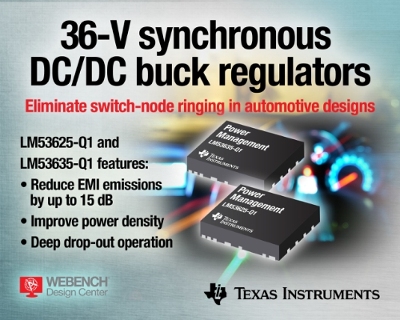
TI Launches Synchronous Buck Regulator that Eliminates Switch-Node Ringing
 Published2016.07.04 18:12
36V, 2.1MHz regulator product, meeting low EMI and high power density requirements
Texas Instruments (TI) (President and CEO Kent Jeon) announced the introduction of two new 36V, 2.1MHz synchronous buck regulator products.
These regulators can eliminate switch node ringing, provide low electromagnetic interference (EMI) and high power density, and operate under deep drop-out conditions.
The 2.5A LM53625-Q1 and 3.5A LM53635-Q1 regulators are designed for high-voltage DC/DC step-down applications such as automotive infotainment, advanced clusters, ADAS (advanced driver assistance systems), and body power supply systems.
Additionally, the adoption of wettable flank packaging enables optical inspection, reducing manufacturing costs. These step-down regulators utilize TI's WEBENCH® automotive design tools, enabling developers to quickly begin automotive designs.
Switch node ringing is a fundamental problem in all switch mode power supplies. The LM53625-Q1 and LM53635-Q1 regulators reduce parasitic inductance and capacitance, enabling these power solutions to reduce noise and EMI emissions at the system level by up to 15 dB.
This reduces external EMI filtering and printed circuit board (PCB) area, making it easier to meet CISPR 25 automotive EMI standards. Watch the video to learn more about how TI's LM53635-Q1 can address automotive EMI, thermal, and system challenges.
TI offers a comprehensive portfolio of controllers and regulators for automotive systems, delivering power from 0.65 A to 10 A, by adding the new LM53625-Q1 and LM53635-Q1 devices to the recently released LM53600-Q1, LM53601-Q1, LM53602-Q1, LM53603-Q1, and LM5140-Q1 buck converters. All of these devices operate at switching frequencies greater than 2 MHz, provide low IQ, and reduce EMI.

Comments
Related news

TI Launches Lowest Power, Low-Jitter Retimer IC
TI (CEO Kent Jun) announced the launch of three high-performance retimer products that enable signal range extension without signal integrity degradation through long-distance traces, connectors, and cables. These new products are part of TI's high-performance retimer portfolio, enabling flexible and cost-optimized system design that allows developers to reduce product development time while maintaining optimized performance.
2016.06.23by 명세환 기자
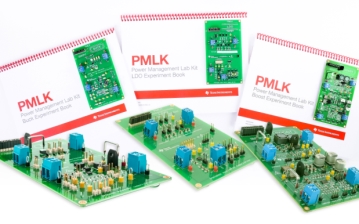
TI Helps Power Development with “Power Management Lab Kit” Series
TI (CEO Kent Chun) announced the launch of the TI Power Management Lab Kit (PMLK) series, which narrows the gap between power design theory and practical applications for engineering students and industry professionals. Every electronic system requires a power solution, and as demand for power continues to increase, the need for skilled power engineers is also growing rapidly. In line with this trend, TI is providing a lab kit series that enables hands-on practice in system-level logic and power management.
2016.06.27by 명세환 기자

TI Launches Reinforced Isolation Amplifier with Minimized Reliability and Power Consumption
TI (CEO Kent Twan) announced the launch of reinforced isolated amplifiers that offer best-in-class reliability compared to competing devices, lowest power consumption, highest DC accuracy, and overall improved efficiency. The new AMC1301 product, featuring the industry's highest operating voltage specification, is the most recent addition to TI's reinforced isolated amplifier portfolio. Additionally, the AMC1301 provides the most accurate solution for shunt-based current sensing in high-voltage equipment such as industrial motor drives, solar inverters, battery management systems, and uninterruptible power supplies, with the lowest offset drift characteristic of 3uV/C across the widest temperature range of -40°C to 125°C.
2016.06.29by 명세환 기자
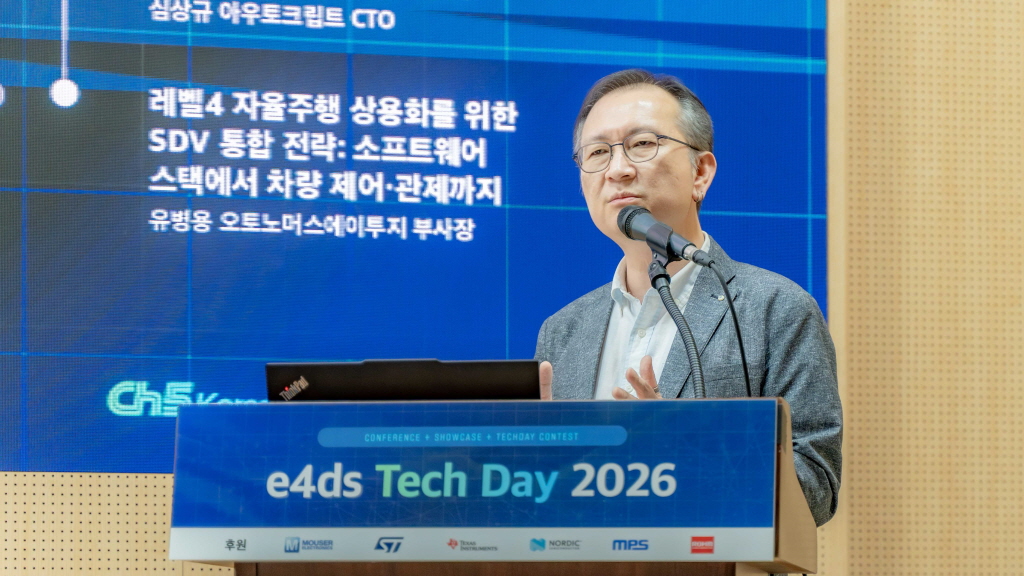
[e4ds Tech Day 2026 ⑨] Sim Sang-gyu, Autocrypt CTO: "In the Physical AI Era, Automotive Security Must Extend Beyond the Vehicle"
At e4ds Tech Day 2026, Sim Sang-gyu, CTO of Autocrypt, explained automotive cybersecurity strategies in the era of Physical AI and SDV (Software-Defined Vehicle). Automobiles are evolving as part of an ecosystem connected to AI, cloud, chargers, IoT, and robots, and he emphasized that the scope of security must expand beyond the vehicle interior to the entire connected environment. In particular, AI model tampering, adversarial attacks, OTA updates, and EV charger hacking were identified as major threats. He explained that response measures require zero trust, AI model integrity protection, intrusion detection, Security by Design and Default, and full lifecycle security management, and that proactive security system establishment beyond regulatory compliance is critical for securing future mobility competitiveness.
2026.10.12by 배종인 기자

Practical HIL Construction Strategy for Automotive and Off-Highway Controller Validation
As vehicle E/E architecture transitions to zonal structures and shifts to software-defined vehicles (SDV), the number of controllers (ECUs) requiring validation and software complexity are surging dramatically. Meanwhile, real vehicle testing cannot provide repeated verification under identical conditions and entails lead time and safety concerns. This white paper explains the principles of HIL (Hardware-in-the-Loop) validation and the structure of the NI platform composed of PXI, SLSC, and VeriStand, and through two actual implementation cases—Camera Record & Replay HIL for In-Cabin Monitoring Controller (ICMU) and Forklift Controller (VCU) HILS—describes how controller-level regression testing becomes possible. Additionally, it explicitly states application boundaries and limitations, such as lack of A2B support.
2026.10.12by 편집부