



Intel's influence is limited in hyperscale data centers, Xilinx FPGAs are superior
 Published2016.12.09 19:59
Expanding the market with FPGA products for hyperscale data centers
Is it because they are conscious of Intel, which has acquired Altera?
It seems like a natural progression for Xilinx to solidify its position as a market leader by releasing FPGA products that offer up to six times faster computing efficiency than competitors.
Xilinx announced a new technology last month that enables cloud service providers to rapidly develop and deploy acceleration platforms. The company emphasized that its reconfigurable acceleration stack, powered by FPGAs designed for cloud-scale applications, can achieve more than 40 times the computing efficiency of x86 server CPUs and provides up to 6 times the computing efficiency of other FPGA competitors.
The strategy is to expand the reach of the Xilinx FPGA market in the hyperscale data center market, which has emerged as a new keyword for data centers. The FPGA camp has long pointed out that today's CPUs cannot keep up with applications requiring complex computations, such as machine learning, data analysis, and video processing. This is because they are turning to accelerators for the overall throughput and efficiency of cloud data centers.
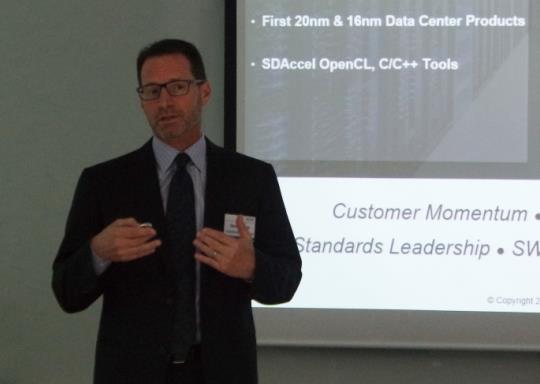
▲ Steve Glaser, Senior Vice President at Xilinx.
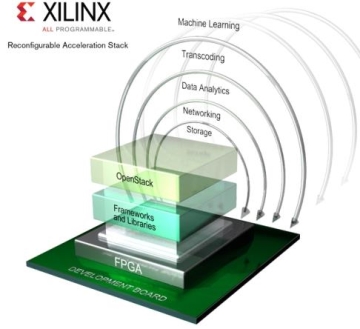
FPGAs have been recognized as programmable, optimizable hardware suitable for new applications or algorithms, and highly suitable for highly agile cloud computing environments. As proof of this, Xilinx’s reconfigurable acceleration stack includes compute libraries designed for cloud computing workloads, application libraries integrating major frameworks such as Caffe for machine learning, PCIe-based development boards and reference designs for high-density servers, and OpenStack support packages.
Major cloud service providers such as Microsoft and Baidu have already announced that they will adopt FPGA technology in hyperscale data centers, and Xilinx is showing signs of being one step ahead in the new data center market by successfully supplying FPGAs to Baidu and Amazon's hyperscale data centers.
Xilinx's emphasis on these achievements seems largely driven by its awareness of Intel's move to acquire Altera. Since acquiring Altera late last year, Intel has been strengthening its position in the data center market by recently introducing an MCM that integrates its own Xeon processors with Altera's FPGAs.
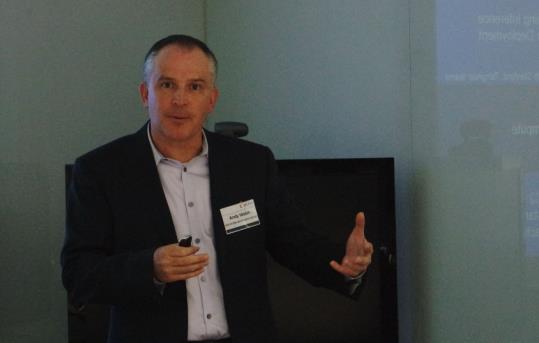
▲ Andy Walsh, Director at Xilinx
At the Intel Developer Forum held last August, Intel CEO Brian Krzanich emphasized that “Intel FPGAs and SoC FPGAs will continue to play an important role at Intel,” and expressed confidence that “through FPGA technology and Intel’s expanded processor family, Intel will be positioned to more effectively drive a virtuous cycle between the cloud and IoT.”
Steve Glaser, Senior Vice President of Corporate Strategy Marketing at Xilinx, and Andy Walsh, Director of Strategic Market Development and Cloud Computing, also visited Korea on the 7th and spent a significant amount of time comparing the performance of Intel's integrated MCM and their own FPGA during a discussion on Xilinx's strategy for data centers and future directions.
The following is a summary of some key questions raised after the meeting.
- How do Intel integrated MCMs and Xilinx FPGAs for hyperscale data centers differ?
When we compared them, Xilinx shared FPGAs outperformed Intel integrated MCMs in scalability and usability in terms of reconfigurable hardware multifunctionality and shared configuration. MCMs are limited in size, flexibility, and options due to power density. In addition, when looking at computer efficiency per watt, Xilinx shared FPGAs were 2 to 6 times more powerful than Altera's FPGAs.
Regarding the opinion that Xilinx would face difficulties competing with packages containing both Intel CPUs and FPGAs.
Ultimately, the topology the customer chooses is a matter of preference, and if the customer wants pooling, I believe there will be no obstacles to selecting the best Xilinx product.
Intel, which holds the upper hand in the data center market, likely has an advantage.
The customers we are referring to are hyperscale data center clients, namely companies such as Google, Facebook, Alibaba, Baidu, Amazon, and Microsoft. These companies possess a vast number of data centers and innovate their own technology, allowing them to select the best solutions they desire independently. Consequently, Intel, which holds a dominant position in the general data center market, will likely have limited influence.
Xilinx announced on this day that it is continuing robust growth across its business. Xilinx, which has recently been expanding its investment by increasing R&D spending to 9%, stated that it is seizing opportunities for market expansion in various markets. Vice President Steve Glazer said, “Because Xilinx’s product portfolio approaches diverse markets through various cycles, we are not in a position where we have to wait for profitability (by focusing on only one market),” adding, “Xilinx has grown for five consecutive quarters and expects a 6% growth rate this year.” "He said, 'We are in a favorable position, especially in rapidly growing markets such as cloud computing.'"
Xilinx added that, in addition to this, it has a robust InVision system established for automobiles, machine learning, drones, and robots, and is investing heavily in software development. Xilinx's direction could be gleaned from the words of Vice President Steve, who stated, "Our goal is to enable professional software users to use FPGAs five times more than they do now."
Comments
Related news
The Effect of Intel's Acquisition of Altera? FPGAs Play a Crucial Role Between Cloud and IoT
Intel held the inaugural Intel SoC FPGA (Field Programmable Gate Array) Developer Forum at the same venue during the 2016 Intel Developer Forum (IDF) event. The event focused on the newly established Intel Programmable Solutions Group created through the Altera acquisition and the SoC FPGA technology the group is developing. Intel CEO Brian Krzanich addressed various questions that many people have been curious about following the Altera acquisition through his keynote speech at the event, including: "What does the Altera acquisition mean for SoC FPGA users?" "What direction will Intel now move toward?" and most importantly, "What role will FPGA and SoC FPGA play for Intel going forward?"
2016.08.19by 신윤오 기자
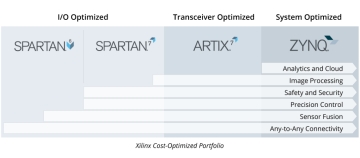
Xilinx Expands Portfolio for Embedded Vision and IIoT
Xilinx announced the expansion of its cost-optimized silicon portfolio for a wide range of applications including embedded vision and Industrial Internet of Things (IIoT). Today, embedded vision and IIoT applications can collect data from various sensors and obtain actionable insights through comprehensive analysis. Designers can leverage Xilinx® FPGAs and SoCs from the portfolio in whole or in part of their systems, such as expanding the capabilities of multi-sensor cameras on factory floors or developing smart drones equipped with innovative guidance systems based on sensor fusion.
2016.09.29by 김수지 기자
Xilinx Launches Reconfigurable Acceleration Stack Providing Fast Computing Efficiency
Xilinx announced new technology that enables the world's largest cloud service providers to rapidly develop and deploy accelerated platforms. The Xilinx® Reconfigurable Acceleration Stack, powered by FPGAs designed for cloud-scale applications, includes libraries, framework integration, developer boards, and OpenStack support.
2016.11.15by 홍보라 기자

Intel Unveils Next-Generation 'Core Ultra Series 3' and vPro Platform for Enterprise PCs
Intel has officially unveiled the "Intel Core Ultra Series 3" for next-generation enterprise PCs and the latest vPro platform, addressing a wide range of demands from enterprise notebooks to high-performance workstations.
2026.03.26by 배종인 기자

ROHM Launches ESD Protection Diode Compatible with High-Speed Interfaces of 10Gbps or Higher
Semiconductor specialist ROHM has developed the 'RESDxVx series' of ESD (electrostatic discharge) protection diodes capable of responding to next-generation high-speed data communication environments exceeding 10Gbps, simultaneously enhancing both signal quality maintenance required in high-speed interfaces and IC protection performance.
2026.03.26by 배종인 기자











