



[CES 2017 Wrap-up] Home Appliances and Cars Are Now a Single AI Device
 Published2017.01.09 16:50
Robots and refrigerators equipped with voice recognition capabilities are entering everyday life
If last year's CES (the world's largest consumer electronics show) clearly demonstrated the IT integration of automobiles, this year's exhibition was a time when the evolution of artificial intelligence (AI) applied to these appliances and automobiles stood out by far.
While previous home appliances and smartphones merely exchanged information and controlled operations, AI-powered home appliances are interconnected, autonomously learning customers' usage patterns and surrounding environments to provide optimized solutions. Furthermore, this exhibition highlighted collaboration between IT firms and automotive companies for the commercialization of autonomous vehicles more than ever before.
We looked into how artificial intelligence will change the concepts of home appliances and automobiles, and transform daily life, through the major companies participating in CES.
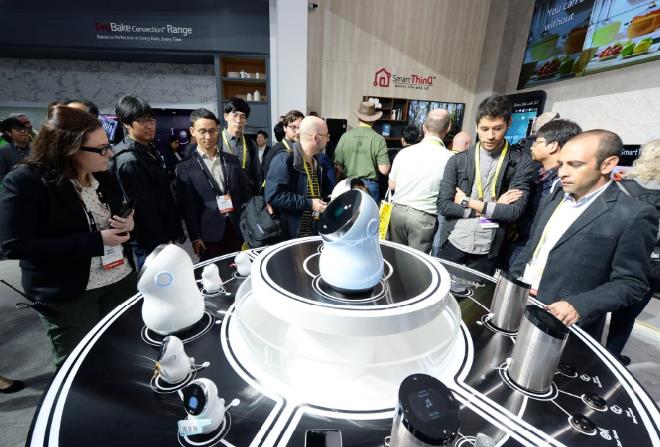
Visitors are looking around the home hub robot displayed at the LG Electronics booth at the CES 2017 exhibition.
LG Electronics made a surprise announcement at CES 2017 that it would enter the robot business in earnest by unveiling a new line of robot products.
The newly unveiled home hub robot acts as a household butler by controlling home appliances such as TVs, refrigerators, and air conditioners, as well as lighting and security systems, via Wi-Fi. Equipped with Amazon's voice recognition AI service 'Alexa,' it immediately activates the air conditioner simply by the user saying, "Turn on the air conditioner." When a user asks for a specific recipe, it displays the corresponding image on the screen and explains the process step-by-step verbally; it also serves as an excellent entertainer for children by telling bedtime stories or singing lullabies. The Hub Robot can be connected to Mini Robots located throughout the house. The Mini Robots are also equipped with Amazon's Alexa.
Instruct the LG home hub robot equipped with Amazon Alexa, “Turn on the air conditioner.”
LG Electronics' 'Airport Guide Robot' can answer customer questions in four languages, including Korean, English, Chinese, and Japanese. The 'Airport Cleaning Robot' is equipped with multiple motors, brushes, and a large-capacity dustbin to clean thoroughly regardless of the floor material, such as tile or carpet. The 'Lawn Mower Robot' moves its blades in a fast and efficient pattern to mow the lawn precisely and safely without damaging the garden.
Along with this, LG Electronics unveiled deep learning-based home appliances that learn customers' lifestyle patterns and surrounding environments to operate autonomously. This is a strategy to prepare for the future centered on AI-based home IoT and robots. LG Electronics is accelerating the IoT of home appliances by supporting Wi-Fi in all appliances released this year. Furthermore, the company plans to launch smart appliances equipped with its proprietary deep learning technology, 'DeepThinQ,' in earnest starting this year.
At 'CES 2017', Samsung Electronics presented a blueprint for IoT in daily life through enhanced connectivity of home appliances. The focus was placed on connecting products and services by integrating cloud-based technologies such as artificial intelligence and voice recognition.
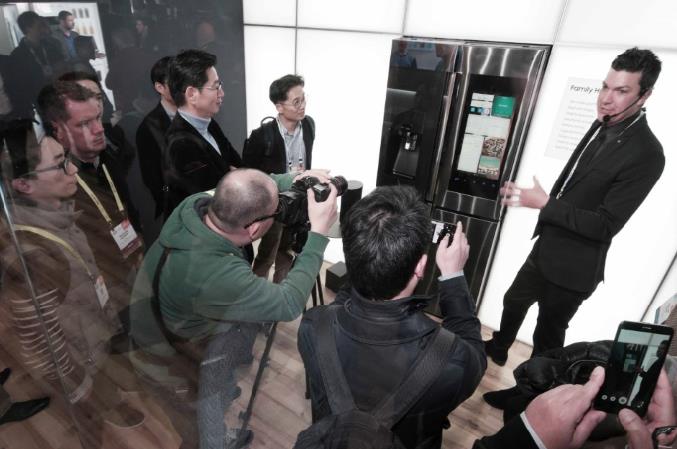
The Family Hub 2.0 refrigerator is being introduced at the Samsung Electronics booth at the CES 2017 exhibition.
A representative product is the 'Family Hub 2.0' refrigerator, which features enhanced voice recognition capabilities. Samsung's 'Family Hub' is a product that fully integrates IoT technology into kitchen appliances. It not only strengthens existing 'Food Management,' 'Family Communication,' and 'Entertainment' functions but also significantly improves user convenience through voice recognition, individual account settings for each family member, and an improved user interface.
'Family Hub 2.0' features enhanced voice recognition capabilities compared to the previous model. In a kitchen environment where hands are often occupied by cooking or washing dishes, 'Family Hub 2.0' clearly recognizes the user's voice to support features such as reading recipes according to the cooking sequence, online shopping using voice as if having a conversation, voice commands for key functions like music playback, and voice responses for daily life information like the latest news or weather, allowing users to execute commands using only their voice without needing to touch the screen.
Samsung IoT refrigerators have enhanced AI voice recognition capabilities.
The voice recognition feature, introduced by Samsung Electronics as an industry first in refrigerators, incorporates cloud-based IoT technology to process information based on data accumulated through user voice recognition and provide the most suitable services to the user. The 'FlexWash' and 'FlexDry' washing machines are also equipped with 'Smart Home' features featuring enhanced IoT connectivity, allowing users to control the entire washing process, including starting, stopping, and monitoring, via smartphone. Samsung Electronics announced that it has established the $150 million 'Samsung Next Fund' to discover and nurture promising startups worldwide in technology fields such as IoT, virtual reality, and artificial intelligence.
Intel announced that, together with BMW and Mobileye, about 40 autonomous vehicles would appear on actual roads by the second half of 2017. The companies revealed this during a podium discussion held at a joint press conference at CES.
Through partnerships, Intel provides innovative high-performance computing elements from vehicles to data centers. The newly launched 'Intel GO™' solution for autonomous driving includes world-class processor and FPGA technology. In data centers, Intel GO provides artificial intelligence capabilities based on powerful machine learning and deep learning simulation infrastructure required by the autonomous driving industry.
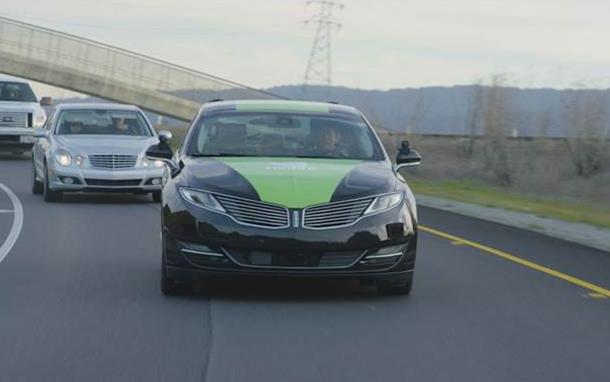
NVIDIA demonstrated the operation of BB8 equipped with DRIVE PX 2, an artificial intelligence (AI) autonomous driving computer.
NVIDIA, a prominent player in the field of AI computing, introduced Co-Pilot, an AI-based system that helps cars understand the driver and simultaneously comprehend their surroundings.
This technology, capable of understanding user commands through natural language-recognizing AI, enables the vehicle to identify the driver via facial recognition AI and supports settings tailored to the driver's preferences. As a result, the need for car keys is expected to disappear in the future. Furthermore, through AI that detects the driver's gaze, the vehicle can determine what the driver is currently focusing on, and it is even possible to play a song if the driver speaks the title they wish to play by recognizing their lip movements.
NVIDIA Announces AI-Based Copilot for Vehicle Context Perception
The AI-based Co-pilot is integrated not only with sensors inside the vehicle but also with external sensors to provide advance warnings of situations such as bicycles suddenly appearing or pedestrians jumping into the road during turns. In addition, it supports autonomous driving and, based on various sensors, HD maps, and diverse experiences accumulated through data sharing, it can acquire more information than even a skilled driver. During the exhibition, the company also conducted autonomous test drives of its self-driving car, BB8. BB8, equipped with NVIDIA’s AI autonomous driving computer DRIVE PX 2, demonstrated that it could naturally and accurately understand the driver’s words and intentions and drive itself.
Huawei attracted attention at CES 2017 by introducing an AI-enabled 'intelligent phone'.
Smartphones equipped with AI capabilities anticipate human needs through new features that replicate the way we think and feel. Intelligent phones require enhanced computing vision to observe and understand the surroundings, microphones capable of hearing and distinguishing different sounds, and power and battery life capable of processing large amounts of information. To develop such intelligent phones, Huawei is accelerating the development of sensor technology, machine learning, data management, and chipsets.
Intelligent phone equipped with enhanced computing vision capabilities to see and understand the surroundings.
Smart glasses that use artificial intelligence technology to recognize and identify real-world objects
Richard Yu, CEO of Huawei, stated, “Currently, users are connected to the digital world through smartphones, but in the future, intelligent phones will become an indispensable part of our daily lives, and the day will come when we can simultaneously connect and interact with the real and digital worlds through artificial intelligence capabilities.”
He also announced the US launch of the Huawei Mate 9, which was released last November. The Mate 9 Pro and Porsche Design Mate 9 will be Huawei's first Google Daydream-ready smartphones. The Mate 9 is equipped with the Amazon Alexa application, which enables voice conversation.
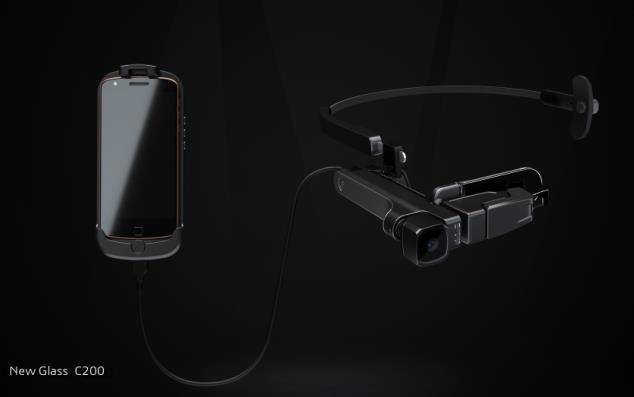
▲ 'Lenovo New Glass', smart glasses equipped with artificial intelligence (AI) technology
Lenovo unveiled the 'Lenovo New Glass C200,' a smart glass equipped with augmented reality (AR) and artificial intelligence (AI) technologies, at 'CES 2017.'
The Lenovo New Glass C200 is a single-lens smart glasses system that uses artificial intelligence technology to recognize and identify real-world objects. Targeting the enterprise market, this product collects information within its field of view and provides step-by-step guidance and instructions for tasks. In addition to identifying problematic equipment, it enables rapid access to information and allows for easy collaboration with colleagues in remote locations.
Microsoft Uses AI Bots to Enhance Driver Safety and Focus
At this exhibition, NXP Semiconductors demonstrated secure autonomous driving technology with automotive partners including Microsoft. NXP showcased technology that improves road driving safety and traffic flow using secure vehicle-to-vehicle (V2V) and vehicle-to-infrastructure (V2I) communication, while Microsoft introduced a scenario in the future where AI bots could be used to enhance driver safety and focus while integrating schedule and personal settings into the driving process. In addition, a solution was showcased that analyzes road traffic conditions or pedestrian density in real time using the Azure cloud, based on sensor data from V2X, radar, cameras, and LiDAR.
Comments
Related news
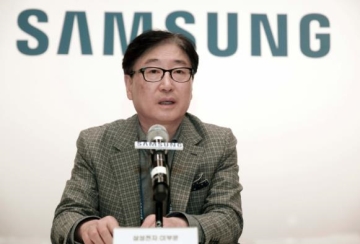
Samsung Electronics CEO Yoon Boo-keun, Leading Future Appliance and Home Changes Through Enhanced IoT Connectivity
"Now we will implement the infinite possibilities that IoT connectivity brings into consumers' daily lives and lead the transformation of future appliances and future homes." Samsung Electronics President and CEO Yoon Boo-keun held a press conference in Las Vegas, USA on the 4th (local time) ahead of the CES 2017 opening. At this event, CEO Yoon stated, "Last year, Samsung Electronics boldly reorganized its business structure centered on the market and consumers to create a revenue structure focused on premium products and made active investments in promising technologies and companies to strengthen core competencies," adding, "We will maintain industry leadership by building a structure that enables sustained growth regardless of any changes."
2017.01.05by 김수지 기자
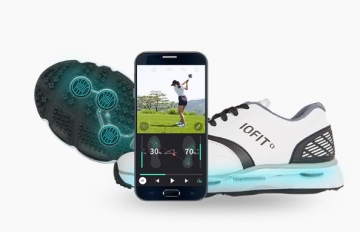
Globally Competitive Korean Startups Recognized at CES
The Ministry of Science, ICT and Future Planning (Minister Choi Yang-hee) announced that four domestic startups—Kremotech, Mango Slab Co., Ltd., Soltied Venture Co., Ltd., and Neofect—received 'Innovation Awards' at CES 2017. CES, which marks its 50th anniversary this year, will host approximately 3,800 companies from over 150 countries with thousands of products on display. Among these, a total of 446 products across 28 categories will receive 'Innovation Awards.' Additionally, 35 products have been selected for the 'Best of Innovations' award, which is presented only to the highest-scoring product in each category.
2017.01.05by 홍보라 기자
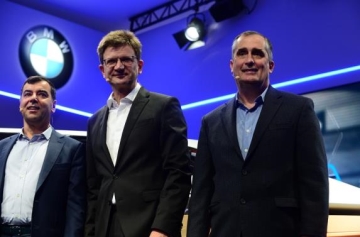
Intel to Test Approximately 40 Autonomous Vehicles on Real Roads in Second Half of This Year
Intel, BMW, and Mobileye announced that approximately 40 autonomous vehicles will appear on actual roads by the second half of 2017, thereby revealing the achievements the three companies have accomplished toward fully autonomous driving. During a panel discussion held at a joint press conference at CES, the three companies explained in detail the cutting-edge technologies from Intel and Mobileye incorporated in the BMW 7 Series through a global pilot period starting in the United States and Europe.
2017.01.06by 김수지 기자
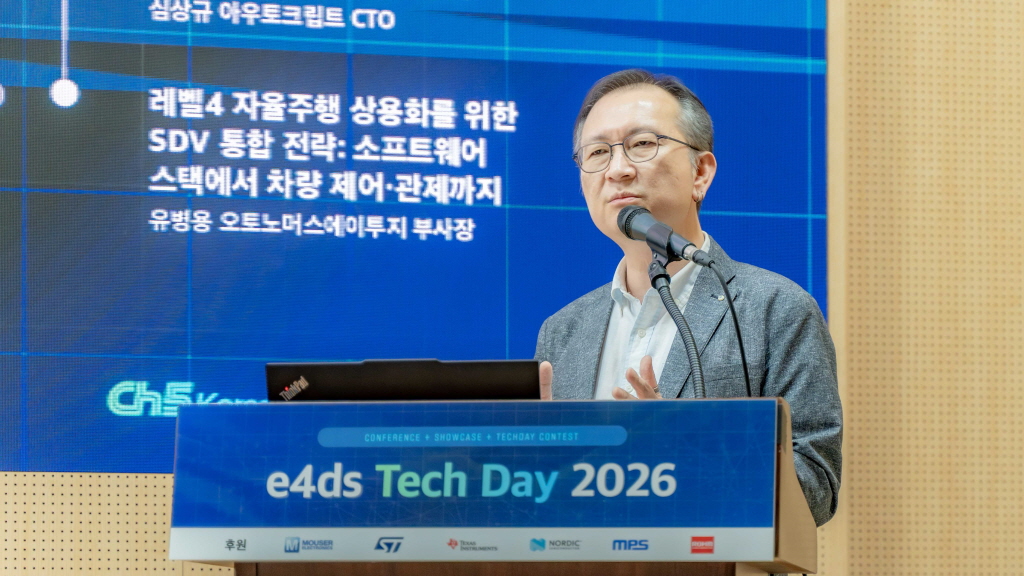
[e4ds Tech Day 2026 ⑨] Sim Sang-gyu, Autocrypt CTO: "In the Physical AI Era, Automotive Security Must Extend Beyond the Vehicle"
At e4ds Tech Day 2026, Sim Sang-gyu, CTO of Autocrypt, explained automotive cybersecurity strategies in the era of Physical AI and SDV (Software-Defined Vehicle). Automobiles are evolving as part of an ecosystem connected to AI, cloud, chargers, IoT, and robots, and he emphasized that the scope of security must expand beyond the vehicle interior to the entire connected environment. In particular, AI model tampering, adversarial attacks, OTA updates, and EV charger hacking were identified as major threats. He explained that response measures require zero trust, AI model integrity protection, intrusion detection, Security by Design and Default, and full lifecycle security management, and that proactive security system establishment beyond regulatory compliance is critical for securing future mobility competitiveness.
2026.10.12by 배종인 기자

Practical HIL Construction Strategy for Automotive and Off-Highway Controller Validation
As vehicle E/E architecture transitions to zonal structures and shifts to software-defined vehicles (SDV), the number of controllers (ECUs) requiring validation and software complexity are surging dramatically. Meanwhile, real vehicle testing cannot provide repeated verification under identical conditions and entails lead time and safety concerns. This white paper explains the principles of HIL (Hardware-in-the-Loop) validation and the structure of the NI platform composed of PXI, SLSC, and VeriStand, and through two actual implementation cases—Camera Record & Replay HIL for In-Cabin Monitoring Controller (ICMU) and Forklift Controller (VCU) HILS—describes how controller-level regression testing becomes possible. Additionally, it explicitly states application boundaries and limitations, such as lack of A2B support.
2026.10.12by 편집부











