


How to Reduce the Size of Electric Aircraft Power Systems
 Published2020.06.19 17:00
Need for compact, high-efficiency DC-DC converter solutions
High-voltage bus converters and low-voltage DC-DC converters must be adopted.
Major countries around the world are focusing on growing the markets for pure electric vehicles (EVs) and hybrid electric vehicles (HEVs) to reduce carbon dioxide emissions. Similar trends are occurring in the aviation industry.
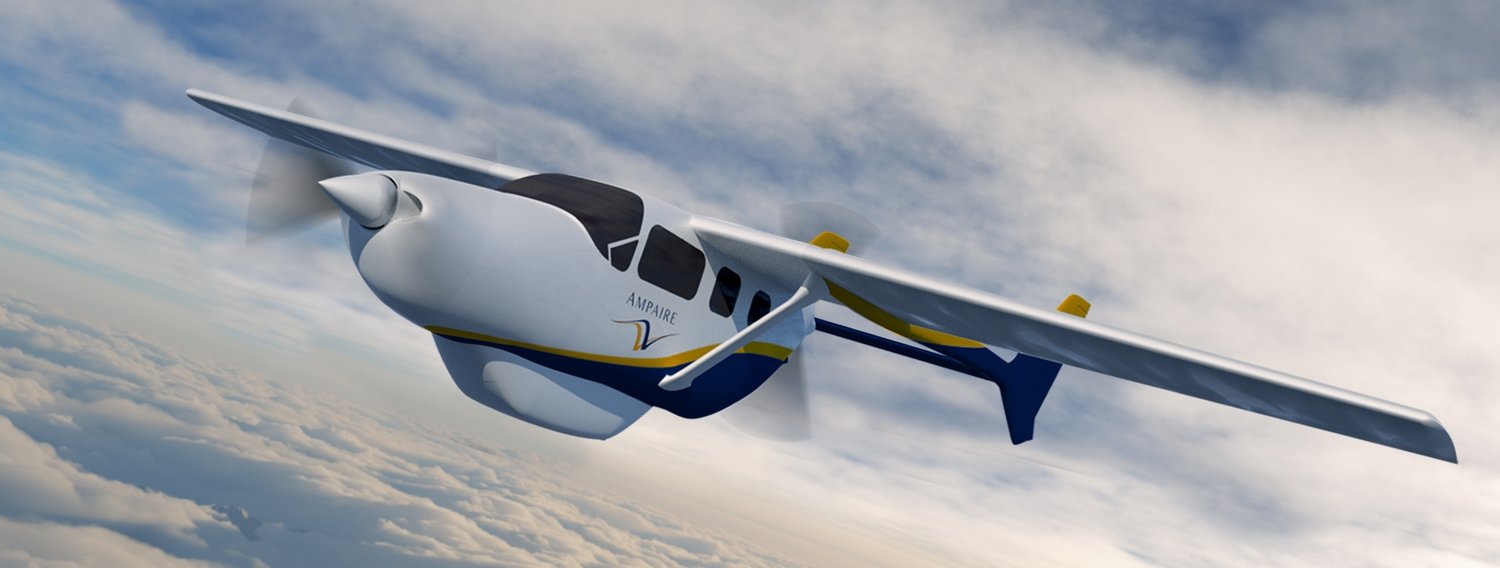
Ampere, headquartered in California, is currently developing an all-electric aircraft. Ampere's ultimate goal is to develop an electric aircraft that, compared to conventional combustion engine-powered aircraft, produces no tailpipe carbon emissions, uses 90% less fuel during takeoff and landing, has 50% less maintenance costs, and produces 66% less noise.
Ampere predicts that if electric aircraft become commercially available, the cost of operating aviation infrastructure will drop, leading to a tenfold increase in the number of airports in the US alone, from 500 to 5,000. This increase in airports will provide residents in remote areas with access to aviation infrastructure. Regional airlines will also have the opportunity to operate more aircraft and offer a wider range of services with the same operating capital.
Ampere, which is in the process of manufacturing an electric aircraft prototype, has already developed a dual power source architecture that allows for redundancy. Currently, we are developing technologies to share power and propulsion loads between fuel and electric power sources based on payload, cruise speed, and flight path.
Ampere has applied an inline parallel hybrid architecture to the Cessna 337 Skymaster. The aircraft features a standard combustion engine-driven propeller at the rear and an electric propeller at the front. During flight, the two propulsion systems can dynamically share power to optimize speed, power, fuel consumption, or noise.
The power supply system for the Cessna 337 Skymaster, which Ampere is modifying, consists of a high-voltage battery pack power supply ranging from 500 to 738 V. Typical flight control and monitoring systems operate on a 28 V supply.
Therefore, Ampere needed a compact, high-efficiency, and thermally-stable DC-DC converter solution that operates from a wide input voltage range and regulates the output to 28 V. Not only that, the high voltage battery required insulation and a maximum power output of 500W.
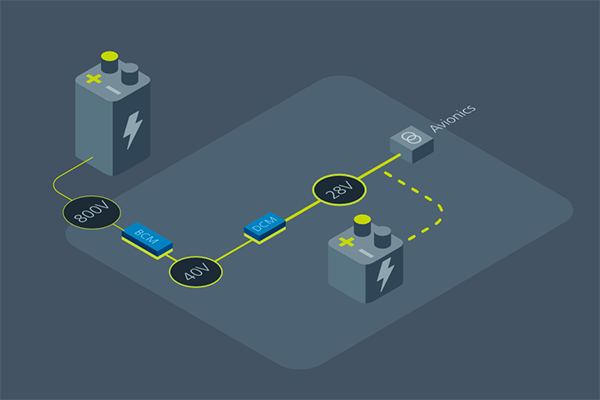
The Vicor engineering team approached the Ampere design team, who did not want to design and use a circuit board for the power converter, with a two-stage power conversion and regulation solution to optimize efficiency and power density and simplify thermal management.
The Ampere design team was able to isolate and down-convert the high-voltage battery with Vicor's 'High Voltage BCM Bus Converter', and then regulate the bus converter's output to 28V with Vicor's 'Low Voltage DCM DC-DC Converter'.
The prototype aircraft will be tested by Hawaii-based Mokulele Airlines, flying nine to 19 passengers on a 90-mile flight from Honolulu to Kahului.

Comments
Related news
Drone stations to charge drone batteries to be built nationwide
Dedicated drone battery charging stations are expected to be established nationwide, and drones will be able to travel anywhere with free battery charging just like electric vehicles. LG Uplus, Japan's KDDI, and Taiwan's CIRC have signed an MOU to expand their smart drone business. Through this collaboration, the three companies will expand their smart drone platform.
2020.04.12by 이수민 기자
Infineon Launches 650V MOSFETs Ideal for E-Mobility
Infineon launches the CoolMOS CFD7A series for the e-mobility market. Manufactured to exceed AEC-Q101 standards, the CoolMOS CFD7A series is a high-performance silicon-based product that can be used in PFC and DC/DC stages of onboard charging systems and HV/LV DC/DC converters optimized for electric vehicle applications.
2020.05.14by 이수민 기자
ROHM to Supply SiC Components for Vitesco's Electric Vehicle Battery Inverters
Vitesco Technologies, a subsidiary of the Continental Group, has selected Rohm as its preferred supplier of SiC power components. The company has also established a power product development partnership for electric vehicles. SiC power components enable more efficient utilization of electric energy from EV batteries compared to conventional components. Anticipating a significant increase in demand for SiC solutions, Vitesco plans to begin production of inverters equipped with SiC power components by 2025.
2020.06.05by 이수민 기자

[e4ds Tech Day 2026 ⑨] Sim Sang-gyu, Autocrypt CTO: "In the Physical AI Era, Automotive Security Must Extend Beyond the Vehicle"
At e4ds Tech Day 2026, Sim Sang-gyu, CTO of Autocrypt, explained automotive cybersecurity strategies in the era of Physical AI and SDV (Software-Defined Vehicle). Automobiles are evolving as part of an ecosystem connected to AI, cloud, chargers, IoT, and robots, and he emphasized that the scope of security must expand beyond the vehicle interior to the entire connected environment. In particular, AI model tampering, adversarial attacks, OTA updates, and EV charger hacking were identified as major threats. He explained that response measures require zero trust, AI model integrity protection, intrusion detection, Security by Design and Default, and full lifecycle security management, and that proactive security system establishment beyond regulatory compliance is critical for securing future mobility competitiveness.
2026.10.12by 배종인 기자

Practical HIL Construction Strategy for Automotive and Off-Highway Controller Validation
As vehicle E/E architecture transitions to zonal structures and shifts to software-defined vehicles (SDV), the number of controllers (ECUs) requiring validation and software complexity are surging dramatically. Meanwhile, real vehicle testing cannot provide repeated verification under identical conditions and entails lead time and safety concerns. This white paper explains the principles of HIL (Hardware-in-the-Loop) validation and the structure of the NI platform composed of PXI, SLSC, and VeriStand, and through two actual implementation cases—Camera Record & Replay HIL for In-Cabin Monitoring Controller (ICMU) and Forklift Controller (VCU) HILS—describes how controller-level regression testing becomes possible. Additionally, it explicitly states application boundaries and limitations, such as lack of A2B support.
2026.10.12by 편집부











